







 Publish to Newswire
 Add an Event
From the Open-Publishing Calendar
From the Open-Publishing Newswire
Indybay Feature
IMC-Palestine: Destruction in Balata
An update from the IDF raids of Balata refugee camp.
Fri, 8 Mar 2002
Rapprochement Centre
Witness to destruction
By: Adam Shapiro
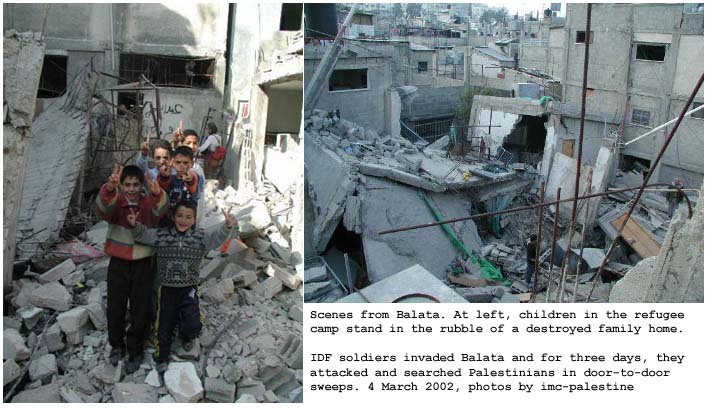
The first thing you notice at the entrance to the Balata Refugee Camp is the overturned, burned out car stuck in a huge man-made crater in the ground. But this was the battleground of the previous three days, as the Israeli Army sacked the camp and destroyed homes, cars, property, and lives with wanton abandon and without much purpose. Other than to attack and terrorize a people who have nothing in this world and who have already been made homeless - and who have remained refugees for over 50 years.
Inside the camp, this alleged "hotbed of terrorism," the group of us eight internationals were met and greeted by the residents with inquisitive looks, "salaam aleikum" shouted from time to time, and lots of little kids running up to us to see who were these strangers. All tried to make us feel welcome and when they learned that we were there in solidarity with the people of the camp and wanted to take pictures to show the world, we were pulled in many different directions at once to witness what the Israelis had done.
What they had done was obvious, and it was all over the camp. Immediately noticeable, at eye level, was the black spray paint on the walls - arrows, numbers, Hebrew writing and stars of David, markings the soldiers made to allow themselves to navigate through the crowded camp. Permanent markings of the three days of hell the camp endured. We later found these markings inside people's homes as well, painted on the walls.
Thirty homes were destroyed in the camp, but hundreds more effectively ruined and damaged. The camp is densely populated and some alleyways between the buildings are barely wide enough for me - an average sized male - to pass through. Other structures are just built wall-to-wall. When the Israeli army took down a building - allegedly looking for weapons or rockets (no evidence of any found) - it meant that the neighbors' buildings also were damaged. The first place I visited was a destroyed home. Next door, the building was still standing, but upon walking in, I discovered that the neighbor had lost his wall. The home was also damaged by the demolition and the home utterly unusable. If each house demolished results in the two or three neighboring buildings also being damaged beyond use, then the result is between 90 and 120 structures affected. Each structure contains at least two (and usually more) apartments, housing
anywhere from 10 to 40 people. Therefore, at minimum, 900 people were left homeless by the home demolitions in the camp - this is the calculus of Israel's war on the Palestinian people.
Walking through the streets of the camp, destruction was all around us. Peering down alleyways, we inevitably spotted the chunks of stone, the twisted metal and the broken piece of furniture that indicated a home was demolished. Cars had been set ablaze and riddled with bullet-holes - the carcasses lay in the streets as added testimony to the siege. Every house we visited had a story to tell. Some were simply shot up, others had tear gas thrown inside, while others were invaded and occupied by the soldiers.
We visited one home that had been occupied during the entire siege by Israeli soldiers. Upon entering the house, the soldiers offered to allow the family to leave, but promised them they would never come back to the house. The family stayed - three children (aged 4 to 9), two young women (one pregnant) and an elderly woman. The man of the house - PLC member and leading figure in the camp, Hussam Khader - was not home for fear of his life. The soldiers forced the family into one room - approximately 8x10 feet - and made them stay there the entire three days. For the first twenty-four hours, not a single person was allowed to leave the room at all - not for the bathroom, not for food, not for water. The soldiers ransacked the entire place - taking money and computer disks, breaking furniture and emptying drawers, ripping apart passports and overturning children's beds. We knocked at the door of the home when we arrived. As we entered the sitting room, we heard child whimper - little Ahmed (four years old) was afraid we were the Israelis coming back to the house. He is traumatized by the experience and needs to be near his mom and aunt constantly. But he is tough, and before long he was playing with my camera. He told me to follow him upstairs and there he showed me how the soldiers had ransacked his room. He was amazed by the sight and asked me why the soldiers did this to him. The last home we visited in the camp was located on the main street, near the cemetery. A ground floor apartment was located adjacent to a store. The main gate of the store was blown apart and the glass from the window lay in the street. The back wall of the small store was torn down and you could see directly into the apartment behind - but there was not much to see. Walking into the house we were unable to step on the floor directly - it was covered with clothing, broken dishes, broken furniture, etc. The electricity was cut, so we had to poke around in the diminishing light until a portable fixture was brought in. The lit room revealed the full destruction - even the washing machine was not safe from the brutality of the soldiers. A fully veiled young woman (only her eyes showed) boldly came up to me and asked if I spoke English. I replied that I did and that she could speak to me in either English or Arabic. She explained that she was the oldest of four children in the house - 14-years old - and that her father was dead. She led me over to where the kitchen had been and searched in the broken glass for something. Finally, she pulled up a picture frame with a photo of her father in it and explained to me that Israeli spies had killed him in 1994. In a flash she was back in the pile on the ground looking for another photo - that of her grandfather, also dead. Now holding both pictures, this young Muslim woman, proud to know English and proud of her family, calmly explained what had happened when the soldiers came - how they had to flee and spend the night outside the camp in the nearby fields. For more than fifty years they had been refugees, and now Israel wanted to attack them again. But, she told me, struggling with her emotions and her sense of dignity, "they must know we are strong children and we won't leave this land, my grandfather's land. We will return to the land which they occupied in 1948."
These refugees, like those in the other camps, have lost everything and live with virtually nothing. Now, day after day, the Israeli army is going after them in a pogrom deliberately designed to provoke and to strike terror in the hearts of an entire people. Like little Ahmed Khader, the world must ask, why are the Israelis doing this?
Rapprochement Centre
Witness to destruction
By: Adam Shapiro
The first thing you notice at the entrance to the Balata Refugee Camp is the overturned, burned out car stuck in a huge man-made crater in the ground. But this was the battleground of the previous three days, as the Israeli Army sacked the camp and destroyed homes, cars, property, and lives with wanton abandon and without much purpose. Other than to attack and terrorize a people who have nothing in this world and who have already been made homeless - and who have remained refugees for over 50 years.
Inside the camp, this alleged "hotbed of terrorism," the group of us eight internationals were met and greeted by the residents with inquisitive looks, "salaam aleikum" shouted from time to time, and lots of little kids running up to us to see who were these strangers. All tried to make us feel welcome and when they learned that we were there in solidarity with the people of the camp and wanted to take pictures to show the world, we were pulled in many different directions at once to witness what the Israelis had done.
What they had done was obvious, and it was all over the camp. Immediately noticeable, at eye level, was the black spray paint on the walls - arrows, numbers, Hebrew writing and stars of David, markings the soldiers made to allow themselves to navigate through the crowded camp. Permanent markings of the three days of hell the camp endured. We later found these markings inside people's homes as well, painted on the walls.
Thirty homes were destroyed in the camp, but hundreds more effectively ruined and damaged. The camp is densely populated and some alleyways between the buildings are barely wide enough for me - an average sized male - to pass through. Other structures are just built wall-to-wall. When the Israeli army took down a building - allegedly looking for weapons or rockets (no evidence of any found) - it meant that the neighbors' buildings also were damaged. The first place I visited was a destroyed home. Next door, the building was still standing, but upon walking in, I discovered that the neighbor had lost his wall. The home was also damaged by the demolition and the home utterly unusable. If each house demolished results in the two or three neighboring buildings also being damaged beyond use, then the result is between 90 and 120 structures affected. Each structure contains at least two (and usually more) apartments, housing
anywhere from 10 to 40 people. Therefore, at minimum, 900 people were left homeless by the home demolitions in the camp - this is the calculus of Israel's war on the Palestinian people.
Walking through the streets of the camp, destruction was all around us. Peering down alleyways, we inevitably spotted the chunks of stone, the twisted metal and the broken piece of furniture that indicated a home was demolished. Cars had been set ablaze and riddled with bullet-holes - the carcasses lay in the streets as added testimony to the siege. Every house we visited had a story to tell. Some were simply shot up, others had tear gas thrown inside, while others were invaded and occupied by the soldiers.
We visited one home that had been occupied during the entire siege by Israeli soldiers. Upon entering the house, the soldiers offered to allow the family to leave, but promised them they would never come back to the house. The family stayed - three children (aged 4 to 9), two young women (one pregnant) and an elderly woman. The man of the house - PLC member and leading figure in the camp, Hussam Khader - was not home for fear of his life. The soldiers forced the family into one room - approximately 8x10 feet - and made them stay there the entire three days. For the first twenty-four hours, not a single person was allowed to leave the room at all - not for the bathroom, not for food, not for water. The soldiers ransacked the entire place - taking money and computer disks, breaking furniture and emptying drawers, ripping apart passports and overturning children's beds. We knocked at the door of the home when we arrived. As we entered the sitting room, we heard child whimper - little Ahmed (four years old) was afraid we were the Israelis coming back to the house. He is traumatized by the experience and needs to be near his mom and aunt constantly. But he is tough, and before long he was playing with my camera. He told me to follow him upstairs and there he showed me how the soldiers had ransacked his room. He was amazed by the sight and asked me why the soldiers did this to him. The last home we visited in the camp was located on the main street, near the cemetery. A ground floor apartment was located adjacent to a store. The main gate of the store was blown apart and the glass from the window lay in the street. The back wall of the small store was torn down and you could see directly into the apartment behind - but there was not much to see. Walking into the house we were unable to step on the floor directly - it was covered with clothing, broken dishes, broken furniture, etc. The electricity was cut, so we had to poke around in the diminishing light until a portable fixture was brought in. The lit room revealed the full destruction - even the washing machine was not safe from the brutality of the soldiers. A fully veiled young woman (only her eyes showed) boldly came up to me and asked if I spoke English. I replied that I did and that she could speak to me in either English or Arabic. She explained that she was the oldest of four children in the house - 14-years old - and that her father was dead. She led me over to where the kitchen had been and searched in the broken glass for something. Finally, she pulled up a picture frame with a photo of her father in it and explained to me that Israeli spies had killed him in 1994. In a flash she was back in the pile on the ground looking for another photo - that of her grandfather, also dead. Now holding both pictures, this young Muslim woman, proud to know English and proud of her family, calmly explained what had happened when the soldiers came - how they had to flee and spend the night outside the camp in the nearby fields. For more than fifty years they had been refugees, and now Israel wanted to attack them again. But, she told me, struggling with her emotions and her sense of dignity, "they must know we are strong children and we won't leave this land, my grandfather's land. We will return to the land which they occupied in 1948."
These refugees, like those in the other camps, have lost everything and live with virtually nothing. Now, day after day, the Israeli army is going after them in a pogrom deliberately designed to provoke and to strike terror in the hearts of an entire people. Like little Ahmed Khader, the world must ask, why are the Israelis doing this?
We are 100% volunteer and depend on your participation to sustain our efforts!
Donate

$110.00 donated
in the past month
Get Involved
If you'd like to help with maintaining or developing the website, contact us.
Publish
Publish your stories and upcoming events on Indybay.
Topics
More
Search Indybay's Archives
Advanced Search
►
▼
IMC Network
BTW, how many times have you had dinner in a cafe in Jerusalem, or rode the Egged buses in Jerusalem, or strolled upon the boardwalk in Netanya?
Thought so.
Very true. The strange thing about it is if the Palestinians would just coordinate their efforts to demonstrate one week of Ghandi-esque massive nonviolent resistance, the entire world would come to their aid immediately. As it sits now, they play into the hands of Arab outsiders and extremists who, time and time again, manipulate the Palestinian people for their own gain.Not to mention the ultra-hawks in the Jabotinsky wing of Israeli politics.
Can you explain why this hasnt happened before when the intifada had massive non-violent demonstrations? Oh thats right, blah is the person who talks without really knowing anything about the situation. I said come back when you have a clue.
Your name tells me where your head is at, so there's really no point in debating. I should tell you, however, that as someone who has spent a good portion of his life studying the intricacies of international political economy and game theory, I do know quite a bit about the Zionist movement, the Palestinian Solidarity movement, and the conflict in general.
As for nonviolent resistance, my ideas are not so far-fetched, as many in the palestinian leadership are starting to question the efficacy of suicide bombings in particular and armed resistance in general.
See the following pro-palestinian publications for more background:
http://www.commondreams.org/headlines01/0924-01.htm
http://www.ccmep.org/hotnews/why012902.html
http://www.cfr.org/public/pubs/Siegman_Bombing_Article.html
http://www.santacruzsentinel.com/archive/2002/March/05/local/stories/07local.htm
BTW, don't you fucking dare tell me to go away. To do so is fascism, pure and simple.
I am not naive. If all you read was mainstream headlines I can understand why a person would think that the PA was a "terrorist organization" like they are making out to be more and more now. I know that it is possible that specific people in the PA may be secretly using the resources for thier own means. This is acutally nothing new. But the PA is not DIRECTLY sponsoring these bombers. It is not decided in a governing manner. But Israeli civilian-killing is. The PA was set up by Israel, lets not forget that. Which is much of the reason it is so unrepresentative and, along with my point above, unable to act more effectively.
I made the reference to Israel's arms specifically because of the arms shipment you mentioned. That event was widley pulicized and condemned. But do the constant shipments of arms to Israel ever recive the same attention? Why is is okay for Israel to have arms but not the PA? why is there an underlying logic in this "being resaonable" that says Israel has more of a right than Palestinains to defend themselves?
I condemn the killing of civilians, no matter who they are. But one has to realize the major difference in intentions and support for the killing of civilians on each side. Clearly, one has to really wonder what drives a person to kill themselves! Some say that they are wackos but this is "othering" and demonizing. The much more unsettling but real truth is that these are common people driven to extremes by the reality of the occupation, such as the recent woman who was an ambulance driver. An ambulance driver woman!
If the situation were reversed and Palestinains had Israelis confined in occupied territories with a massive military ruling thier daily life, and Sharon or whoever was under house arrest, I would expect Israelis to be driven to the same exterme. However that is not the situation. Palestinians civilians are not killed because of Israelis . Israelis are ordered to do so by the military. I'm sorry but the PA is not ordering the slaughter of Israelis.
As for supporting violence, I am against instutionalized violence, such as the Israeli military. As I've said before, what an indivdual person choses to do is a whole other category. Instiutions should be smart enough to support a department of peace, such as my congresswoman Barbara Lee, along with others, is currently calling for in our government.
Actually most pro-palestine activists, and others fighting for human rights in the Middle East I know have a lot of ciriticism of Mid-East leaders.
I hate it when palestinians are racistly put in such stereotypes as "playing into the hands of Arab outsiders and extremists." There are many types of Palestianians just as there are of Israelis. I would not make Israelis into animals and say that they are playing into the hands of Sharon.
I think a very important point for people who want to be "reasonable" and objective is that people who support the Israeli occupation are those who already have ties with Israel. Why is this? Why is it that those who call for the end of the occupation are diverse and filled with all kinds of commonly oppressed people and ethnic groups and those who support it are very ethnocentric. While you see vast numbers of Jews who are calling for an end to the occupation, there just not the pro-occupation Arab camp. Think about that.
I find it sad that those who support Israel as a people (which I do) feel they have to defend Israel as a government and military. I am American and love the American people, but I know its my duty to protest our govements policies such as our current growing war. If you are proud of those Israelis and other pro-palestinain jews around the world who protest the occupation, then please join them. If you hope that someday the Palestineans will be able to express their opinion openly, help end the occupation - which no one "being reasonable" could see as a place where a representative govenment can take fruit.
You got this backwards. Most intifada fighters actively refrain from attacking civilians. Most Israeli soldiers serve IDF proudly. A very, very small portion of Israeli citizens actively oppose the occupation. Even less question the legitimacy of the Israeli state. This is not tribalism. This is the truth, and it is symptomatic of a classist, racist situation where one group of people live in luxury while the other group lives in refugee camps. Almost 0.001% of Americans, who are also complicit without losing any of their loved ones like the Israeli's do, give a shit about it at all.
The "tribalism" line is a distortion, and it is exactly the lie used by the US Government and Israeli government. This isnt a tribe war, it is apartheid.
Check out what is on electronicintifada right now:
"The situation [on the ground in the Middle East] remains a very complicated situation..."
- Ari Fleischer, White House Minister of Propaganda
"You said 'this is very complex' ... one of the things I've learned in years of getting batted around in politics is that when someone tells you, 'this is very complex,' you got to dig behind that."
- Barbara Boxer, speaking to Jeffrey Skilling, former CEO of Enron, during the Enron hearings
And in the fifth paragraph i meant to say "Palestinians civilains are not killed because of Israelis individually becoming overwhellmed at the horor around them."
hercules medusa sheild trogan horse sin bad-discoveries discoverd by a population under the influence of the military sid bad discoverieds that specilize in shifting tides of war
and the key to winning war with jews