Publish to Newswire
 Add an Event
Feature Archives
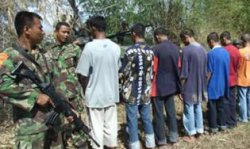
The quake and the massive flooding brought by the tsunami hit Aceh harder than any other place on Earth. Deaths number in the tens of thousands, with perhaps 40,000 in the coastal town of Meulabolah and 30,000 in the capital, Banda Aceh. A unilateral cease-fire declared by GAM has not been respected by the government, which continued raids in the last devastated highlands. Meanwhile visiting U.S. Secretary of State Colin Powell announced that the U.S. will be supplying new helicopters to the TNI, which has a record of turning such “non-lethal aid” to deadly and even genocidal use. Military authorities continue to have emergency powers in Aceh and are restricting outside aid groups. On January 6, Australian reporters who observed Indonesian troops beating Acehnese civilians were told "Your duties here are to observe the disaster, not the conflict between TNI and GAM" and ordered to leave.
Reports: Democracy Now: Activists Blast Indonesian Military for Holding Up Critical Aid | Acehnese Refugees Speak Out | Aceh: A Victim of Tsunami & Occupation || Indonesian army steps up war in Aceh | The Aftermath in Aceh
Aceh background: Wikipedia | Human Rights Watch | Indonesia Alert! | East Timor Action Network/US

Great power rivalries erupt over disputed election in Ukraine | Ukrainians show it's not what you do....
11/24/2004 A government committed troops to a war in Iraq under false pretenses. The party in power used its strength to pressure the media to toe the line. Many opposed to the war rallied behind an opposition candidate. Polls showed the opposition candidate ahead and on election day the exit polls confirmed the expected results. But, when the results came in, they didn't match the polls. Allegations were made of irregularities since the party in power was the very party that confirmed the election results and ran the election.
The November elections in the Ukraine and the US bore many similarities, but unlike the US, in Ukraine the opposition didnt take the results lying down. Thousands are now in the streets. There are calls for a general strike and many talk of civil war. Journalists in Ukraine have refused to present election programmes and walked out in disgust at "blatant" attempts to censor their coverage.
The first round of voting in the 2004 presidential election was held on October 31. Since no candidate held a 50 percent majority, another vote was held on November 21 to choose between Prime Minister Viktor Yanukovych and former prime minister Viktor Yushchenko. Yanukovych was considered to be more pro-Russian, while Yushchenko was seen as a reformer interested in bringing Ukraine closer to the European Union and the US. In the November 21 runoff, Ukraine's electoral commission declared Prime Minister Viktor Yanukovych the winner with 49.42 percent of the votes compared to Yushchenko's 46.69 percent.
From Wikipedia: The election was held in a highly-charged atmosphere, with allegations of media bias, intimidation and even an alleged poisoning of Yushchenko (that resulted in him becoming severely disfigured). Many commentators saw the elections as being influenced by outside powers, notably the United States, the European Union and Russia, with the U.S. and EU backing Yushchenko (sending former Secretary of State Henry Kissinger, former National Security Advisor Zbigniew Brzezinski and Senator John McCain to visit with Yushchenko), and Russian president Vladimir Putin publicly backing Yanukovych. In the media the two candidates are contrasted, with Yushchenko representing both the pro-Western Kiev residents as well as the rural Ukrainians, whereas Yanukovych represents the Eastern, pro-Russian industrial laborers.
Strangely, while the US backed Yushchenko against Yanukovych, it was Yanukovych's Party (under current President Leonid Kuchma) that committed troops to Iraq while Yushchenko has vowed to withdraw all US troops from Iraq if elected.
US rejects Ukraine poll result | Democracy Now | United States of Hypocrisy points finger at Vote Fraud in Ukraine | UK Guardian Ukraine Coverage | Havel backs opposition leader's stance
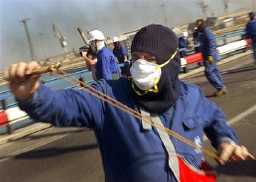

A Very Brief History of Palestine | |
2008 |
December 27th:
Israeli air strikes target police stations in Gaza killing over 200 people and injuring hundreds more. Air strikes continued on December 28th, with the death toll reaching close to 300 by mid-day.
|
2007 |
June 15th: Hamas militants seize the Palestinian presidential compound in Gaza City and took full control of the Gaza Strip. The Occupied Territories have now been effectively split into two separate entities with Hamas in charge of Gaza and Fatah controlling the West Bank.
|
2006 |
December 18th
After a month of fighting a cease fire is agreed between Hamas and Fatah, but gun battles continue in one of the worst days of fratricidal violence in the Gaza Strip. Walid Awad, a spokesman for President Mahmoud Abbas' Fatah party, said Fatah and Hamas had agreed to withdraw all armed men from the streets of Gaza and the West Bank. They also agreed to release all the people they had kidnapped from each other. Under the deal, negotiations for a national unity coalition would resume and all demonstrations have been prohibited for the foreseeable future. more
|
2005 |
August: Israel enagages in a "unlateral pullout" from Gaza (which mainly meant evacuating settlers)
|
2004 |
November 10th: Arafat dies after being in a coma and on life-support equipment for the several days.
|
2000 | September 28: Second Intifada Begins. Palestinians riot after Ariel Sharon visits the site of the Al-Aqsa mosque and proclaims the area eternal Israeli territory. The violence escalates rapidly and continues today... |
1993 | September 13: Oslo Accords. The PLO and Israel agree to mutual recognition. The PLO renounces terrorism, yet the number of new settlements increases and Palestinian groups do not remove their charter goals of destroying Israel. |
1987 | The First Intifada. An explosion of popular resistance to the Israeli occupation called the Intifada begins in the Gaza Strip and the West Bank. The PLO signals that it would accept a two state solution in 1988. |
1982 | June 6: Israel invades Lebanon to fight the PLO. A multinational force lands in Beirut on August 20, 1982 to oversee the PLO withdrawal from Lebanon. After a demoralizing occupation, Israel slowly withdraws. |
1979 | March 26: Egypt and Israel sign peace treaty. Israel withdraws to the pre-1967 border with Egypt. |
1973 | October 6: Yom Kippur War. In a surprise attack, Egypt retakes the Suez canal. Syria reconquers the Golan Heights. Israel succeeds in pushing back the Syrians. |
1967 | June 5: The Six-Day War. Israel attacks the Egyptians (reconquering the Sinai Peninsula and Gaza), Jordan (conquering the West Bank and Jerusalem), and Syria (conquering the Golan heights). |
1964 | May: Palestine Liberation Organization (PLO) founded, headquartered in Beirut, Lebanon and Damascus, Syria. |
1956 | October 29: Suez War. Israel invades the Sinai peninsula and occupies it for several months. Israel withdraws after a UN peace keeping force is placed in Sinai. |
1949 | April 3: Armistice between Israel and Arab states. The war has created over 780,000 Palestinian refugees. Israel has gained about 50% more territory. |
1948 | May 15: 1948 Arab-Israeli War. Declaration of Israel as the Jewish State. British leave Palestine. Egypt, Syria, Iraq, Lebanon, Jordan, Saudi Arabia declare war on Israel. |
1936 | Arab Revolt. Over 5,000 Arabs are killed, mostly by the British, and several hundred Jews are killed by Arabs |
1917 | October 2: Promising a homeland for the Jews in Palestine, the British issue the Balfour Declaration. |
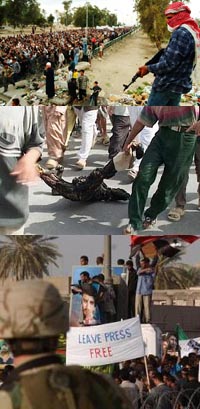
On Wednesday March 31st, four American contractors in Iraq were burned alive and had their bodies dragged through the streets of Fallujah before being hung from a bridge as a large crowd consisting largely of young children chanted that Fallujah would be America's graveyard. "The Group of Sheikh Ahmad Yassin" claimed responsibility for the attack, "saying it was retribution for the controversial Israeli assassination last month of the spiritual leader of Hamas".
Although some corporate media sources are trying to pretend that the situation in Fallujah is unique, anti-American sentiments are growing in all parts of Iraq. In the North, Kurds have been calling for their own state and many are not happy with the idea of a future where they have less autonomy than they did before the US invasion. In addition, Turkey is pressuring the US to attack remnants of the PKK who have setup camps in Northern Iraq and have widespread support among the Iraqi Kurds. In the South, there is growing anger among the Shi'as against the US due to high unemployment rates and dislike for the US imposed constitution. In central Iraq, many Sunnis are worried that they will be marginalized under any future government.
Iraqis News Updates: Electronic Iraq | Lunaville News | Iraq Today | MEMRI | Iraq Daily | AlterNet | US Crusade
Iraqi Blogs: Salam Pax | Baghdad Burning | Raed | A Family In Baghdad | Back To Iraq | Wildfire
Reports From Bay Area Journalists and Activists Who Have Visited Iraq: 1 | 2
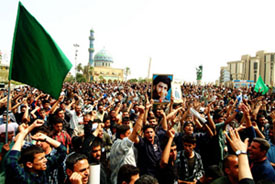
Photos & Reports from Andrew Stern/Naomi Klein: 1 | 2
David Martinez Back In Iraq - Dispatch 1 and 2
Democracy Now Reports: 1 | 2 | KCSB Interview with James Longley
Report from Dahr Jamail
On Sunday March 28th, US troops shut down the Southern Baghdad offices of the newspaper al-Hawza. The closure resulted from a direct order of CPA head Paul Bremer. Al-Hawza was owned by popular Shi'ite cleric Muqtada Al-Sadr. Iraqi anger at the US attack on Al-Sadr was immediate, and protests continued all week with crowds Friday April 2nd estimated at 20,000. On Saturday, massive crowds of Al-Sadr's supporters again marched through the streets of Bagdad and were met by US tanks which ran over and killed at least two protesters.
On Sunday April 4th, Shia protesters marched on a coalition base near Najaf. Spanish-led troops and Iraqi police fired on the protesters and clashed with armed members of Sadr's Mehdi Army militia leaving at least 25 people dead and more than 100 wounded. Later in the day in the Sadr City section of Baghdad, an ambush on US troops by Al-Sadr's supporters resulted in 7 American troops dead . By days end, there had been riots and bloodshed in cities all over southern Iraq including Amara, Basra, and Nassiriya.
On Monday April 5th, the US threatened to arrest Al-Sadr who had taken over Kufa with his supporters. The US threat to arrest the son of one of Iraq's most prominent Shi'ite clerics, was met by outrage from people across Iraq and protests spread. Even the Grand Ayatollah Sistani, who was believed to not be on speaking terms with Al-Sadr, issued a statement condemning the US attacks on the Shi'ite community.
In the US, Democrats and Republicans responded to the Iraqi uprising by calling for more troops and a delayed "handover" of power to the governing council, stating that a US pullout could spark a civil war. But there were few signs of splits among Iraqis as even many police and Sunni fundamentalists joined the Shia uprising in a show of unity. Only the US backed governing council refused to denounce the deaths of dozens of Iraqi civilians at US hands.

On Tuesday April 6th, Iraqis attacked a US Marine position near the governor's palace in Ramadi killing a dozen US troops. In Diwaniya Spanish soldiers were forced out of town as Iraqis loyal to al-Sadr seized buildings. In Nasiriya, Italian and Bulgarian soldiers fought for much of the day and Polish soldiers hid in their base south of Baghdad as angry Iraqis surrounded them. In Basra, Al-Sadr's militia occupied the governor's office and briefly drove British forces away. Al-Sadr himself moved to the holy city of Najaf and now controls much of the city.
Over one hundred Iraqis were killed and hundreds more wounded just in the fighting Monday and Tuesday alone. Saturday April 10 at Noon -- Emergency Protest - U.S. Out Of Iraq!
On Wednesday April 7th, the US closed off Fallujah in attempt to round up those responsible for the killing and mutilation of 4 US contractors on March 30th. By weeks end, hundreds of Iraqi civilians were dead, with new battles breaking out every day in cities across the country.
Shi'ite and Sunni militias appear to be joining forces.
On Friday April 9th, 200,000 Iraqis, many of them Shias, gathered near Baghdad's largest Sunni mosque to oppose the US occupation; "For the first time Iraqis have both Shia and Sunni speeches at the same mosque." Millions of pilgrims are expected to gather in the city of Karbala this weekend to mark the Shi'ite holy day of al-Arbaeen. As battles continue to rage across Southern and Central Iraq, a strike has been called for Saturday, Sunday and Monday.
 63
63