







 Publish to Newswire
 Add an Event
Feature Archives
Wed Dec 14 2005
One Thousand Days Of War
One thousand days ago today, the U.S. invasion of Iraq officially began. Reports show the death toll continues to mount to staggering numbers as support for the occupation drops. (Democracy Now Report)
A study released last year on the number of deaths in Iraq put the toll at more than 100,000. (This American Life: What's In a Number?) 82% of Iraqis are "strongly opposed" to presence of coalition troops and 67 per cent Iraqis feel less secure because of occupation and there is perhaps as much as a 40 per cent unemployment rate in the country (The war in numbers).
Indybay's Iraq Page
A study released last year on the number of deaths in Iraq put the toll at more than 100,000. (This American Life: What's In a Number?) 82% of Iraqis are "strongly opposed" to presence of coalition troops and 67 per cent Iraqis feel less secure because of occupation and there is perhaps as much as a 40 per cent unemployment rate in the country (The war in numbers).
Indybay's Iraq Page

Thu Nov 17 2005
Evidence Of Torture In Iraqi Jails
On November 13th repeated enquiries by parents of a missing teenager resulted in US forces raiding a building in Baghdad that turned out top be a secret jail run by Iraqi security forces.
Witnesses said many of the 169 men and youths found inside were emaciated and looked like "Holocaust survivors". Some had suffered beatings so severe that their skin had peeled off, "because of the appalling overcrowding, some of the most badly treated were squashed on to floors and their skins got stuck to the floor." Three men had been kept locked in a cupboard where they could not move while the rest were packed, blindfolded, into three rooms nine feet long and 11 feet wide. Instruments of torture and beating were found hidden in a false ceiling.
Hussein Kamal, the deputy interior minister, told journalists after visiting the scene: “I’ve never seen such a situation like this during the last two years in Baghdad. This is the worst. I saw signs of physical abuse by brutal beating, one or two detainees were paralysed and some had their skin peeled off various parts of their bodies.”
Leading Sunni politicians are demanding an international inquiry. They claim such abuse was regularly carried out by paramilitaries connected to the government and accuse US forces of giving it "the green light". " "According to our knowledge, regrettably, all the detainees were Sunnis," Mohsen Abdul-Hamid, head of the Iraqi Islamic Party, told the Associated Press news agency. "In order to search for a terrorist, they used to detain hundreds of innocent people and torture them brutally." "We insist on having an international investigation," Islamic Party spokesman Alaa Makki told AFP. "There have been similar cases in the past and investigations into them led to nothing," said another party spokesman, Ayad Samarrai. The UN's top human rights official has also called for an international probe into the conditions for detainees in Iraq.
Torture centre discovered in Baghdad | State denial adds insult to torture victims’ injuries | Baghdad Burning: House of Horrors... | Juan Cole: The Skin is Peeling off the New Iraq | Juan Cole: Iraqi Prisoner Abuse | Stirring memories of a bygone era
The use of torture in Iraq has not been limited to Iraqi militia members. A former U.S. Army interrogator recently described to Democracy Now his use of harsh interrogation techniques on prisoners including dogs, sleep deprivation, prolonged isolation and dietary manipulation. The US Army is also investigating whether U.S. soldiers put Iraqis in a lion cage to scare them into giving information and a senior United Nations official has accused US-led coalition troops of depriving Iraqi civilians of food and water in breach of humanitarian law. While Bush recently claimed that "We don’t torture", Cheney hs been trying to pressure senators into exempting the CIA from a proposed amendment that would ban “cruel, inhuman, and degrading treatment” of prisoners in US custody. Proof that US soliders have engaged in torture was made clear in 2004 when photos were leaked of abuses at the Abu Ghraib prison.
Cheney's Torture Policy | Can The CIA Legally Kill a Prisoner?
Past Coverage Of Torture In Iraq: US Charged With War Crimes | Pictures Emerge Of US And UK Torture Of Prisoners
Leading Sunni politicians are demanding an international inquiry. They claim such abuse was regularly carried out by paramilitaries connected to the government and accuse US forces of giving it "the green light". " "According to our knowledge, regrettably, all the detainees were Sunnis," Mohsen Abdul-Hamid, head of the Iraqi Islamic Party, told the Associated Press news agency. "In order to search for a terrorist, they used to detain hundreds of innocent people and torture them brutally." "We insist on having an international investigation," Islamic Party spokesman Alaa Makki told AFP. "There have been similar cases in the past and investigations into them led to nothing," said another party spokesman, Ayad Samarrai. The UN's top human rights official has also called for an international probe into the conditions for detainees in Iraq.
Torture centre discovered in Baghdad | State denial adds insult to torture victims’ injuries | Baghdad Burning: House of Horrors... | Juan Cole: The Skin is Peeling off the New Iraq | Juan Cole: Iraqi Prisoner Abuse | Stirring memories of a bygone era
The use of torture in Iraq has not been limited to Iraqi militia members. A former U.S. Army interrogator recently described to Democracy Now his use of harsh interrogation techniques on prisoners including dogs, sleep deprivation, prolonged isolation and dietary manipulation. The US Army is also investigating whether U.S. soldiers put Iraqis in a lion cage to scare them into giving information and a senior United Nations official has accused US-led coalition troops of depriving Iraqi civilians of food and water in breach of humanitarian law. While Bush recently claimed that "We don’t torture", Cheney hs been trying to pressure senators into exempting the CIA from a proposed amendment that would ban “cruel, inhuman, and degrading treatment” of prisoners in US custody. Proof that US soliders have engaged in torture was made clear in 2004 when photos were leaked of abuses at the Abu Ghraib prison.
Cheney's Torture Policy | Can The CIA Legally Kill a Prisoner?
Past Coverage Of Torture In Iraq: US Charged With War Crimes | Pictures Emerge Of US And UK Torture Of Prisoners
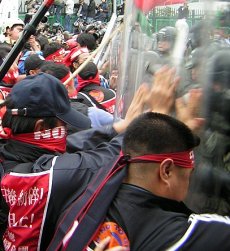
The World Trade Organization wrapped up its six-day ministerial meeting on Sunday December 18th with a partial trade agreement.
The 149 member nations have until April 30 to agree to the framework for the completion of the Doha round by the end of 2006. In other words, they must carry out in just four months what they have failed to do in the four years since the round began. Throughout the six days of negotiations the main sticking point was agriculture and the commitment by the European Union to end export subsidies.
Democracy Now Report | Deciphering the Language of Globalization | WTO Reaches Compromise Trade Accord | WTO talks keep trade round on life support
On Saturday the 17th, police arrested 900 protesters during widespread protests on the streets of Hong Kong led by farmers, peasants and union members. At the end of the confrontation, around 1000-1500 other activists, from Korean groups and Via Campesina, as well as individuals from Hong Kong, other parts of Asia the US, and Europe were involved in an all night standoff with police who had surrounded them. They sang, danced, and chanted, while police fired more tear gas and threatened them with rubber bullets.
Bay Area organizers Puck Lo and Handle have been posting regular dispatches from Hong Kong:
Dispatch 9: Lapsing Into CrimethInc Jargon on the Day After the Big One
Dispatch 8: EMERGENCY: Arrests Have Begun at the WTO Protests in Hong Kong
Dispatch 7: WTO MC6, Hong Kong, Day 4: “We’re Hungry. We’re Angry.”
Dispatch 6: Humility, Strategy, and Boldness: Emo Reflections on the Third Day of the WTO Protests in Hong Kong
Dispatch 5 part 2: Farmers Procession Sways Hearts and Minds at WTO Protests in Hong Kong
Dispatch 5 part 1: Low Wage Workers and Migrants Lead Opposition to GATS and Imperialism
Dispatch 4: WTO MC6, Day 2: Face-Off at the Barricades, Stand-Off at the Summit
Dispatch 3: WTO 6, Day 1: Just The Beginning
Dispatch 2: Raids Target Migrant Workers as WTO Summit Nears
Dispatch 1: As The Tide Rushes In: Four Days Before the WTO in Hong Kong
Photos: - First Day: 1 |
2 |
3 |
4 |
5 |
6
|
Second Day:
1 |
2 |
3
|
Third Day:
1 |
2 |
3 |
4 |
5 |
6 |
Fourth Day:
1 |
2 |
3 |
4 |
5
|
Fifth Day:
1 |
2 |
3
1 |
2 |
3 |
4 |
5 |
6
|
Second Day:
1 |
2 |
3
|
Third Day:
1 |
2 |
3 |
4 |
5 |
6 |
Fourth Day:
1 |
2 |
3 |
4 |
5
|
Fifth Day:
1 |
2 |
3
Asian Americans in Hong Kong
Democracy Now Report | Deciphering the Language of Globalization | WTO Reaches Compromise Trade Accord | WTO talks keep trade round on life support
On Saturday the 17th, police arrested 900 protesters during widespread protests on the streets of Hong Kong led by farmers, peasants and union members. At the end of the confrontation, around 1000-1500 other activists, from Korean groups and Via Campesina, as well as individuals from Hong Kong, other parts of Asia the US, and Europe were involved in an all night standoff with police who had surrounded them. They sang, danced, and chanted, while police fired more tear gas and threatened them with rubber bullets.
Bay Area organizers Puck Lo and Handle have been posting regular dispatches from Hong Kong:
Dispatch 9: Lapsing Into CrimethInc Jargon on the Day After the Big One
Dispatch 8: EMERGENCY: Arrests Have Begun at the WTO Protests in Hong Kong
Dispatch 7: WTO MC6, Hong Kong, Day 4: “We’re Hungry. We’re Angry.”
Dispatch 6: Humility, Strategy, and Boldness: Emo Reflections on the Third Day of the WTO Protests in Hong Kong
Dispatch 5 part 2: Farmers Procession Sways Hearts and Minds at WTO Protests in Hong Kong
Dispatch 5 part 1: Low Wage Workers and Migrants Lead Opposition to GATS and Imperialism
Dispatch 4: WTO MC6, Day 2: Face-Off at the Barricades, Stand-Off at the Summit
Dispatch 3: WTO 6, Day 1: Just The Beginning
Dispatch 2: Raids Target Migrant Workers as WTO Summit Nears
Dispatch 1: As The Tide Rushes In: Four Days Before the WTO in Hong Kong
Photos: - First Day:
1 |
2 |
3 |
4 |
5 |
6
|
Second Day:
1 |
2 |
3
|
Third Day:
1 |
2 |
3 |
4 |
5 |
6 |
Fourth Day:
1 |
2 |
3 |
4 |
5
|
Fifth Day:
1 |
2 |
3
Asian Americans in Hong Kong

11/9/2005:
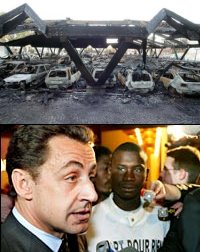
A state of emergency was announced November 8, along with the call-up of police reservists, authorizing local governments to impose curfews and permits police to conduct raids and searches without warrants. The emergency decree, made possible by a 1955 law, will be in effect for 12 days, but the National Assembly can pass a law extending it, “if necessary.” Under the decree, local officials have the power to place people under house arrest and demand that weapons be handed over. Public spaces can be closed down. The law gives the government the power to restrict freedom of the press and freedom of assembly and to shut down theaters. The mass general strike of 1968 did not precipitate such a state of emergency. The 1955 law is most associated, and certainly in the minds of the older generation of North African descent, with the violence and torture perpetrated by the French state on the Algerian population and Algerian immigrants in France in the 1950s and 1960s.
WSWS: Oppose the state of emergency in France
|
Sarkozy threatens mass deportations
|
Militants attack mosque in bid to reignite French riots
|
France: racism, poverty lead to violence
|
Paris march planned amid unrest
|
Boris Kagarlitsky on the unrest in France
11/8/2005: Jose Bove has urged the French parliament to debate the root causes of crisis, describing the unrest as "a revolution by desperate youths who have lost all hopes." Muslim thinker Tareq Ramadan blamed the entire political class in France for the riots, saying the political class has been "blind" to what has been happening in the suburbs, with their unemployed youth of Arab and African origin and bleak high-rises. Bove has also asked Interior Minister Nicolas Sarkozy to apologize for his anti-immigrant remarks. The interior minister has been under fire for his "zero-tolerance" policy, which caused violence in the areas. The French Communist Party, the Greens and the Socialist Party have joined forces, demanding the sacking of Sarkozy over his handling of the crisis. He has been accused of stoking passions by calling troublemakers "racaille" or rabble, and saying that crime-ridden areas need to be "cleaned with a power-hose."
Read More | Q&A - Riots in France: Causes and Consequences | French Unrest Sends Shockwaves Across Europe | Do not Put Islamic Spin on French Riots | The Rebellion Spreads to Belgium | France is clinging to an ideal that's been pickled into dogma | Juan Cole: The Problem with Frenchness
11/7/2005: Urban unrest escalated around France this weekend as youths continued rioting throughout the country for an eleventh straight night. On Sunday, rioters opened fire on police in a working-class suburb of Paris, wounding ten officers. On Saturday night, rioting spread from the Paris suburbs into the more well-off districts. Also on Saturday, the rioting reached inside the French capital for the first time, with youths setting fire to more than 30 cars in central Paris.
Read More | LCR refuses to take a stand on police repression | The Explosion in the Suburbs | Rebellion in Real Time | 10 Officers Shot as Riots Worsen in French Cities | French violence hits fresh peak | French government and opposition back intensified repression
On Thursday, October 27th, 2005, a group of 10 highschool kids were playing soccer in the Paris suburb of Clichy-sous-Bois. when police arrived to do ID checks, the kids ran away and hid, because some of them had no ID. Three of the children hid in an electrical transformer building of EDF and were electrocuted. Two of them, Ziad Benn (17) and Banou Traoré (15), died; the third, Metin (21), was severely injured.
On the morning of Saturday October 29th, 1000 joined in a march organised by religious associations and mosques in Clichy-sous-Bois. Representatives of the Muslim community appealed for calm and marchers wore T-shirts saying mort pour rien ("dead for nothing"). The mayor of Clichy, Claude Dilain, called for an enquiry into the deaths of the two boys. All eyes were on Interior Minister Nicolas Sarkozy. The response? As people were gathering in the mosques for the Night of Destiny, the most sacred night in the month of Ramadan, a night people usually spent at the mosque, the empty streets of the Cité du Chêne Pointu filled with about 400 CRS militant riot police and gendarmes, blocking off the neighborhood. Yet very few people allowed themselves to be provoked into breaking the sanctity of this night, despite racist insults from the police. On Sunday, however, provocation turned into outrage as the women's prayer room at de Bousquets mosque was teargassed by police. As people stumbled out gasping for air, the policemen called the women "whores", "bitches" and other insults.
Ever since that night, Clichy-sous-Bois has been burning, with the insurrection spreading on Monday to Seine-Saint-Denis and on Tuesday night (November 1st) to nine other Parisian suburbs. A week after the death of the two boys, the uprising is spreading throughout France -- to Dijon, Bouches-du-Rhone and Rouen.
Read More | Reports from Paris IMC (fr): one | two | three | four | Eyewitness account in English: UK IMC | kersplebedeb
Deep roots of Paris riots | Massive Riots All Over France | Eyewitness to Paris riots charges police with deliberate provocation | Widening anti-police riots provoke government crisis | Wikipeda: 2005 Paris suburb riots
11/8/2005: Jose Bove has urged the French parliament to debate the root causes of crisis, describing the unrest as "a revolution by desperate youths who have lost all hopes." Muslim thinker Tareq Ramadan blamed the entire political class in France for the riots, saying the political class has been "blind" to what has been happening in the suburbs, with their unemployed youth of Arab and African origin and bleak high-rises. Bove has also asked Interior Minister Nicolas Sarkozy to apologize for his anti-immigrant remarks. The interior minister has been under fire for his "zero-tolerance" policy, which caused violence in the areas. The French Communist Party, the Greens and the Socialist Party have joined forces, demanding the sacking of Sarkozy over his handling of the crisis. He has been accused of stoking passions by calling troublemakers "racaille" or rabble, and saying that crime-ridden areas need to be "cleaned with a power-hose."
Read More | Q&A - Riots in France: Causes and Consequences | French Unrest Sends Shockwaves Across Europe | Do not Put Islamic Spin on French Riots | The Rebellion Spreads to Belgium | France is clinging to an ideal that's been pickled into dogma | Juan Cole: The Problem with Frenchness
11/7/2005: Urban unrest escalated around France this weekend as youths continued rioting throughout the country for an eleventh straight night. On Sunday, rioters opened fire on police in a working-class suburb of Paris, wounding ten officers. On Saturday night, rioting spread from the Paris suburbs into the more well-off districts. Also on Saturday, the rioting reached inside the French capital for the first time, with youths setting fire to more than 30 cars in central Paris.
Read More | LCR refuses to take a stand on police repression | The Explosion in the Suburbs | Rebellion in Real Time | 10 Officers Shot as Riots Worsen in French Cities | French violence hits fresh peak | French government and opposition back intensified repression
On Thursday, October 27th, 2005, a group of 10 highschool kids were playing soccer in the Paris suburb of Clichy-sous-Bois. when police arrived to do ID checks, the kids ran away and hid, because some of them had no ID. Three of the children hid in an electrical transformer building of EDF and were electrocuted. Two of them, Ziad Benn (17) and Banou Traoré (15), died; the third, Metin (21), was severely injured.
On the morning of Saturday October 29th, 1000 joined in a march organised by religious associations and mosques in Clichy-sous-Bois. Representatives of the Muslim community appealed for calm and marchers wore T-shirts saying mort pour rien ("dead for nothing"). The mayor of Clichy, Claude Dilain, called for an enquiry into the deaths of the two boys. All eyes were on Interior Minister Nicolas Sarkozy. The response? As people were gathering in the mosques for the Night of Destiny, the most sacred night in the month of Ramadan, a night people usually spent at the mosque, the empty streets of the Cité du Chêne Pointu filled with about 400 CRS militant riot police and gendarmes, blocking off the neighborhood. Yet very few people allowed themselves to be provoked into breaking the sanctity of this night, despite racist insults from the police. On Sunday, however, provocation turned into outrage as the women's prayer room at de Bousquets mosque was teargassed by police. As people stumbled out gasping for air, the policemen called the women "whores", "bitches" and other insults.
Ever since that night, Clichy-sous-Bois has been burning, with the insurrection spreading on Monday to Seine-Saint-Denis and on Tuesday night (November 1st) to nine other Parisian suburbs. A week after the death of the two boys, the uprising is spreading throughout France -- to Dijon, Bouches-du-Rhone and Rouen.
Read More | Reports from Paris IMC (fr): one | two | three | four | Eyewitness account in English: UK IMC | kersplebedeb
Deep roots of Paris riots | Massive Riots All Over France | Eyewitness to Paris riots charges police with deliberate provocation | Widening anti-police riots provoke government crisis | Wikipeda: 2005 Paris suburb riots
Thu Jul 7 2005
4 Bombs Rock London: Scores Dead, Hundreds Hurt
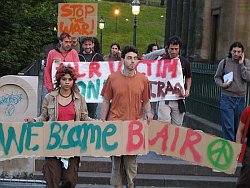
1:50pm PST: Casualty figures in the coordinated attacks have risen to 37 dead and over 700 wounded with many of those in critical condition. British authorities are said to be in search of perpetrators. It is still unknown if suicide bombers or placed-explosives are to blame. Conspiracy theories have begun to fly around the internet as to who is responsible, possible motives, and who might stand to gain or lose politically from the attacks.
8:35am PST: In London this morning, three subway bombs and one in a double-decker bus have killed scores of people. At the moment, reports are in that at least 21 have died in one subway attack, 5 in another, and 7 in the third, while it is unknown the number killed in totally destroyed double-decker bus. London's transport system has been shut down. A group calling itself "Secret Organization Group of al Qaida of Jihad Organization in Europe" has claimed responsibility. Tony Blair has said he is returning to London from Gleneagles.
8:35am PST: In London this morning, three subway bombs and one in a double-decker bus have killed scores of people. At the moment, reports are in that at least 21 have died in one subway attack, 5 in another, and 7 in the third, while it is unknown the number killed in totally destroyed double-decker bus. London's transport system has been shut down. A group calling itself "Secret Organization Group of al Qaida of Jihad Organization in Europe" has claimed responsibility. Tony Blair has said he is returning to London from Gleneagles.
In the Bay Area, D.C., and nationwide transportation officials are on heightened alert. US officials have raised terror alert system to "Code Orange" for domestic mass transit.
Inititial Photo and Video links | Edinburgh Vigil Photos | Terror, Politics, and War | UK Indymedia | Commentary from Indybay Reporter | Timeline of Events

Sun Jun 19 2005
Resistance and Refusal in Osaka
Japan, 6/16/2005: There is a quiet park, or kouen, on the way to the Osaka ports, still in the city but not near any subway exits, far from the crowds of the Tsuruhashi mall to its east; two blocks away the highway churns past at a dizzying speed. The park’s name according to the city is Tsumori, but for the workers and unemployed who have dug themselves into its contours, it is known as Nishi-Nari.
What exists at Nishi-Nari Park is a quasi-autonomy: a refusal of capitalist housing. These aging workers, many at the lowest end of Japanese society, choose instead of monthly rent payments, a policed neighborhood, or even a "worker’s hotel" (which charge the equivalent of 20 dollars a night), to live collectively, without a landlord, in a permanent tent village. Residents are now engaged in a sustained campaign to defend the occupied park against a city-imposed "assistance menu," which in the past has taken shape as an aggressive city intervention and eviction campaign, as recently experienced by the residents of Osaka Castle Park.
Residents have requested solidarity actions, such as contacting the Osaka Prefecture office in San Francisco (tel 415-288-3920, fax 415-288-3924). The city of Osaka has reportedly refused to even look at a statement of demands presented by residents of the park. Full story | Indymedia Japan
What exists at Nishi-Nari Park is a quasi-autonomy: a refusal of capitalist housing. These aging workers, many at the lowest end of Japanese society, choose instead of monthly rent payments, a policed neighborhood, or even a "worker’s hotel" (which charge the equivalent of 20 dollars a night), to live collectively, without a landlord, in a permanent tent village. Residents are now engaged in a sustained campaign to defend the occupied park against a city-imposed "assistance menu," which in the past has taken shape as an aggressive city intervention and eviction campaign, as recently experienced by the residents of Osaka Castle Park.
Residents have requested solidarity actions, such as contacting the Osaka Prefecture office in San Francisco (tel 415-288-3920, fax 415-288-3924). The city of Osaka has reportedly refused to even look at a statement of demands presented by residents of the park. Full story | Indymedia Japan

Sat Feb 5 2005
Nepalese King Sacks And Arrests Government, Cuts Phone Service And Rounds Up Human Rights Activists
2/17/2005:
The authorities in Nepal have cut off all telephone lines again on a day of planned pro-democracy protests.
The human rights situation in Nepal, where soldiers are battling Maoist guerrillas in a nine-year conflict, had worsened after the king assumed absolute power and suspended civil liberties, Amnesty International officials said after a tour of the country.
Amnesty International | AI requests urgent audience with King | Nepal's media 'suffocated'
2/16/2005: Nepali police arrested two senior politicians on Wednesday, two days ahead of planned protests by their party against King Gyanendra's assumption of complete power in the Himalayan kingdom this month. Policemen arrested Arjun Narsingh K.C., a senior leader of the centrist Nepali Congress party that has planned peaceful protests on Friday to force the king to restore democracy.
2/13/2005: Nepal's Maoist rebels called a national strike and began an indefinite "blockade" of the capital, Kathmandu, at the weekend - a move that could raise prices and worsen the state of emergency imposed by the king. The rebels launched the action to mark 10 years since the start of their "people's war" to topple Nepal's monarchy, a campaign that has claimed nearly 11,000 lives in the Himalayan nation.
2/5/2005: A student demonstration at Prithvi Narayan Campus in Pokhara was fired on by a military helicopter gunship leaving several protestors badly injured if not dead; all FM radio broadcasts outside of Kathmandu are blocked and those broadcasting in Kathmandu play only entertainment-oriented programmes; the BBC FM station recently established in Kathmandu is forbidden from broadcasting the news in Nepali; news stands outside of the Valley have been closed; and a 72-hour blockade on long-distance public bus travel in and out of Kathmandu is in place.Read More On Indymedia.org
Nepal’s Maoists have warned the king to reverse power grab or face a blockade.
On February 1st 2005, King Gyanendra of Nepal sacked the government, suspended democracy for three years and declared a state of emergency. Prime Minister Sher Bahadur Deuba and other leading members of the Congress party have been placed under house arrest and most of the the rank and file members of the Congress party have been put in jail. Human rights activists said a number of prominent campaigners had been taken in for questioning by the security services. "Nepalis have had their most basic rights taken away. With his newly restored medieval powers, Gyanendra has 'suspended' not only the right to free speech, but freedom of thought. He has subjected the press to strict censorship. The papers carried fawning accounts yesterday of the king's announcement that he was taking power. The king 'suspended' the right to assemble peacefully, and the right to privacy." Phone, television and internet services have been suspended and most Nepalese outside of Nepal are unable to communicate with their relatives.
King Gyanendra came to power in June 2001 when Crown Prince Dipendra went on a shooting-spree assassinating 11 members of the royal family including King Birendra and Queen Aishwarya before shooting himself. Gayendra was already unpopular and his unexpected rise to power gave support to the Maoist insurgency (in 1996, the Communist Party of Nepal had launched a "people's war" aimed at overthrowing the existing monarchic state and establishing a Maoist state). In 2002, Gyanendra removed Sher Bahadur Deuba from his role as Prime Minister for the first time. Public street protests ensued, and Gyanendra reinstated Deuba in 2004, charging him with instituting elections by March of 2005 and establishing peace talks with Maoist rebels. With this new state of emergency, the Maoists are finding themselves allied with the government they once fought against the increasingly tyrannical monarch.
Statement By Communist Party of Nepal | Wikipedia | Reports From The People's War in Nepal | Nepal's media subjected to total censorship | Too scared to protest in Nepal | King Gyanendra: The absolute monarch
Amnesty International | AI requests urgent audience with King | Nepal's media 'suffocated'
2/16/2005: Nepali police arrested two senior politicians on Wednesday, two days ahead of planned protests by their party against King Gyanendra's assumption of complete power in the Himalayan kingdom this month. Policemen arrested Arjun Narsingh K.C., a senior leader of the centrist Nepali Congress party that has planned peaceful protests on Friday to force the king to restore democracy.
2/13/2005: Nepal's Maoist rebels called a national strike and began an indefinite "blockade" of the capital, Kathmandu, at the weekend - a move that could raise prices and worsen the state of emergency imposed by the king. The rebels launched the action to mark 10 years since the start of their "people's war" to topple Nepal's monarchy, a campaign that has claimed nearly 11,000 lives in the Himalayan nation.
2/5/2005: A student demonstration at Prithvi Narayan Campus in Pokhara was fired on by a military helicopter gunship leaving several protestors badly injured if not dead; all FM radio broadcasts outside of Kathmandu are blocked and those broadcasting in Kathmandu play only entertainment-oriented programmes; the BBC FM station recently established in Kathmandu is forbidden from broadcasting the news in Nepali; news stands outside of the Valley have been closed; and a 72-hour blockade on long-distance public bus travel in and out of Kathmandu is in place.Read More On Indymedia.org
Nepal’s Maoists have warned the king to reverse power grab or face a blockade.
On February 1st 2005, King Gyanendra of Nepal sacked the government, suspended democracy for three years and declared a state of emergency. Prime Minister Sher Bahadur Deuba and other leading members of the Congress party have been placed under house arrest and most of the the rank and file members of the Congress party have been put in jail. Human rights activists said a number of prominent campaigners had been taken in for questioning by the security services. "Nepalis have had their most basic rights taken away. With his newly restored medieval powers, Gyanendra has 'suspended' not only the right to free speech, but freedom of thought. He has subjected the press to strict censorship. The papers carried fawning accounts yesterday of the king's announcement that he was taking power. The king 'suspended' the right to assemble peacefully, and the right to privacy." Phone, television and internet services have been suspended and most Nepalese outside of Nepal are unable to communicate with their relatives.
King Gyanendra came to power in June 2001 when Crown Prince Dipendra went on a shooting-spree assassinating 11 members of the royal family including King Birendra and Queen Aishwarya before shooting himself. Gayendra was already unpopular and his unexpected rise to power gave support to the Maoist insurgency (in 1996, the Communist Party of Nepal had launched a "people's war" aimed at overthrowing the existing monarchic state and establishing a Maoist state). In 2002, Gyanendra removed Sher Bahadur Deuba from his role as Prime Minister for the first time. Public street protests ensued, and Gyanendra reinstated Deuba in 2004, charging him with instituting elections by March of 2005 and establishing peace talks with Maoist rebels. With this new state of emergency, the Maoists are finding themselves allied with the government they once fought against the increasingly tyrannical monarch.
Statement By Communist Party of Nepal | Wikipedia | Reports From The People's War in Nepal | Nepal's media subjected to total censorship | Too scared to protest in Nepal | King Gyanendra: The absolute monarch
International:
 62
62

62