







 Publish to Newswire
 Add an Event
Feature Archives
Thu Jan 26 2006
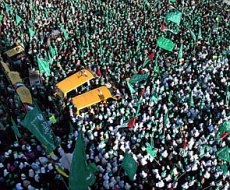
Hamas Wins Palestinian Parliamentary Elections
In the Occupied Territories, unofficial results indicate Hamas has won a sweeping victory in the first Palestinian parliamentary elections in a decade. Israel and the United States have said they would not deal with a Palestinian Authority that includes Hamas.
According to Ali Abunimah, from writing on Electronic Intifada:
The election result is not entirely surprising, however, and has been foreshadowed by recent events. Take for example the city of Qalqilya in the north of the West Bank. Hemmed in by Israeli settlements and now completely surrounded by a concrete wall, the city's fifty thousand residents are prisoners in a Israeli-controlled giant ghetto. For years Qalqilya's city council was controlled by Fatah but after the completion of the wall, voters in last years' municipal elections awarded every single city council seat to Hamas. The Qalqilya effect has now spread across the occcupied territories, with Hamas reportedly winning virtually all of the seats elected on a geographic basis. Thus Hamas' success is as much an expression of the determination of Palestinians to resist Israel's efforts to force their surrender as it is a rejection of Fatah. It reduces the conflict to its most fundamental elements: there is occupation, and there is resistance.
For Palestinians under occupation, it is not yet clear what Hamas' win will mean. It is now common to speak of a Palestinian "government" being formed out of the election results, as though Palestine were already a sovereign and independent state. But if the first duty of a government is to protect its people's lives, liberty and property, then the Palestinian Authority has never deserved to be called a government. Since its inception, it has not been able to protect Palestinians from lethal daily attacks by the Israeli army in the heart of their towns and refugee camps, or to prevent a single dunum of land being seized for settlements, nor to save a single sapling of the more than one million trees uprooted by Israel in the past ten years. Rather, in Israel's conception the Palestinian Authority was supposed to crush Palestinian resistance to make the occupied territories safe for continued Israeli colonization.
Democracy Now Coverage | Hamas to Form Cabinet, Loser Fatah Not Joining | Hamas victory redraws political map of Middle East | Who's who in Hamas | Hamas claims victory | How Israel and the United States Helped to Bolster Hamas | Abbas Urges Respect of Result, West Alarmed | Palestinian PM and cabinet resign | Israeli Arab MKs: Hamas win will help peace process | Palestinian Elections: Forcing the West to awake to the voices of the people | Hamas Election Victory: A Vote for Clarity | Listening to the Voices of Palestine | Bush Calls Hamas Kettle Black
According to Ali Abunimah, from writing on Electronic Intifada:
The election result is not entirely surprising, however, and has been foreshadowed by recent events. Take for example the city of Qalqilya in the north of the West Bank. Hemmed in by Israeli settlements and now completely surrounded by a concrete wall, the city's fifty thousand residents are prisoners in a Israeli-controlled giant ghetto. For years Qalqilya's city council was controlled by Fatah but after the completion of the wall, voters in last years' municipal elections awarded every single city council seat to Hamas. The Qalqilya effect has now spread across the occcupied territories, with Hamas reportedly winning virtually all of the seats elected on a geographic basis. Thus Hamas' success is as much an expression of the determination of Palestinians to resist Israel's efforts to force their surrender as it is a rejection of Fatah. It reduces the conflict to its most fundamental elements: there is occupation, and there is resistance.
For Palestinians under occupation, it is not yet clear what Hamas' win will mean. It is now common to speak of a Palestinian "government" being formed out of the election results, as though Palestine were already a sovereign and independent state. But if the first duty of a government is to protect its people's lives, liberty and property, then the Palestinian Authority has never deserved to be called a government. Since its inception, it has not been able to protect Palestinians from lethal daily attacks by the Israeli army in the heart of their towns and refugee camps, or to prevent a single dunum of land being seized for settlements, nor to save a single sapling of the more than one million trees uprooted by Israel in the past ten years. Rather, in Israel's conception the Palestinian Authority was supposed to crush Palestinian resistance to make the occupied territories safe for continued Israeli colonization.
Democracy Now Coverage | Hamas to Form Cabinet, Loser Fatah Not Joining | Hamas victory redraws political map of Middle East | Who's who in Hamas | Hamas claims victory | How Israel and the United States Helped to Bolster Hamas | Abbas Urges Respect of Result, West Alarmed | Palestinian PM and cabinet resign | Israeli Arab MKs: Hamas win will help peace process | Palestinian Elections: Forcing the West to awake to the voices of the people | Hamas Election Victory: A Vote for Clarity | Listening to the Voices of Palestine | Bush Calls Hamas Kettle Black
Thu Jan 26 2006
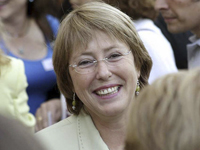
Michelle Bachelet, Socialist, Is Elected President of Chile
January 15 marked the election of Chile’s first woman President, 54 year-old Michelle Bachelet, on the ticket of a Christian Democrat-Left coalition, the Concertación. Bachelet is a socialist and a former Minister of Health and Minister of Defense in the center-left Lagos administration. During the regime of dictator Augusto Pinochet, Bachelet was imprisoned, tortured, and exiled. She is a pediatrician and a single mother of three. "I have not had an easy life," she told a cheering crowd after her victory. Bachelet is known as a supporter of the Free Trade Area of the Americas. Indymedia Santiago Chile voiced this critique of the election: "During the recent electoral struggle for control of the state, the Concertación, along with the right, only seemed to show their teeth, while the press, orchestrating the show, spoke of 'polarization' of the elections—what a fallacy! Everything could be found perfectly situated within the boundaries of the political marketplace."
Santiago Indymedia Article (In Spanish) | Election Day Coverage | Democracy Now on Election | World Socialist Website Report
Santiago Indymedia Article (In Spanish) | Election Day Coverage | Democracy Now on Election | World Socialist Website Report
Thu Jan 26 2006
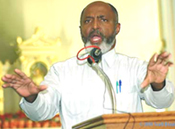
Political Prisoner Jean-Juste Release From Haitian Prison
1/29/2006:
Haitian political prisoner Gerard-Jean-Juste has been released from prison. He arrived in Miami on Sunday after Haiti's government granted him a temporary release from jail to be treated for leukemia and pneumonia. He is undergoing tests and treatment at Miami's Jackson Memorial Hospital. Reverend Jesse Jackson warned Gerard Latortue that he would be on the next plane to Haiti if the seriously ill Father Gerard Jean Juste was not released immediately for medical care.
Jean-Juste's
lawyers at the Bureau des Avocats Internationaux (BAI) have filed an appeal, asking for the charges to be dismissed. The appeals court can rule on the appeal without Fr. Gerry’s presence, so it is possible that the case will be dismissed without requiring him to return to court.
Read More | Corporate Coverage &Video From Miami
On January 25, Dr. Jennifer Furin of Harvard Medical School examined Amnesty International Prisoner of Conscience Fr. Jean-Juste. Dr Furin reports that the condition of the activist priest, jailed on trumped up charges since July 2005, is worsening. She writes, "Over the last four days [Fr. Jean-Juste] has had a fever and cough, and was diagnosed with pneumonia. His blood cell counts have dropped markedly due to the leukemia, and he appears extremely pale, fatigued, and with visible skin bruises due to his rapidly advancing disease." Father Jean-Juste requires immediate hospital-level care for this deteriorating condition. Further, given his precipitously low blood cell counts‹significantly worse than two weeks ago‹it is imperative that he also receives immediate treatment for his leukemia. Without this treatment he will die in prison.
Also on January 25, international human rights lawyer Brian Concannon called the State Department to demand Fr. Jean-Juste¹s release. Concannon reports he ³was told that they continue to believe that the Haitian justice system is following its normal course. They deny that Fr. Jean-Juste is a victim of persecution. They do not intend to do anything different than what they have been doing, which is to urge that the justice system process his case and give him medical treatment.
Half-Hour for Haiti: Enough is Enough, Release Fr. Gerry Now | Haiti's invisible "Big Boss" is keeping Father Jean-Juste in Prison | Letter from a Haitian Prison | Previous Coverage Of Jean-Juste
Read More | Corporate Coverage &Video From Miami
On January 25, Dr. Jennifer Furin of Harvard Medical School examined Amnesty International Prisoner of Conscience Fr. Jean-Juste. Dr Furin reports that the condition of the activist priest, jailed on trumped up charges since July 2005, is worsening. She writes, "Over the last four days [Fr. Jean-Juste] has had a fever and cough, and was diagnosed with pneumonia. His blood cell counts have dropped markedly due to the leukemia, and he appears extremely pale, fatigued, and with visible skin bruises due to his rapidly advancing disease." Father Jean-Juste requires immediate hospital-level care for this deteriorating condition. Further, given his precipitously low blood cell counts‹significantly worse than two weeks ago‹it is imperative that he also receives immediate treatment for his leukemia. Without this treatment he will die in prison.
Also on January 25, international human rights lawyer Brian Concannon called the State Department to demand Fr. Jean-Juste¹s release. Concannon reports he ³was told that they continue to believe that the Haitian justice system is following its normal course. They deny that Fr. Jean-Juste is a victim of persecution. They do not intend to do anything different than what they have been doing, which is to urge that the justice system process his case and give him medical treatment.
Half-Hour for Haiti: Enough is Enough, Release Fr. Gerry Now | Haiti's invisible "Big Boss" is keeping Father Jean-Juste in Prison | Letter from a Haitian Prison | Previous Coverage Of Jean-Juste
Tue Jan 3 2006
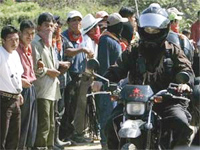
The Other Campaign Begins in Mexico
January 1st, 2006 was the first day of the "Other Campaign." The EZLN, or Zapatista Army for National Liberation, has begun its tour of Mexico. They began in colonial San
Cristóbal de las Casas, the city that was taken over on January 1,
1994 by some two thousand masked, armed, and defiant indigenous men
and women, who from the balcony of city hall sent their message of
war to the federal government. This began a 12-year political journey in Mexico. The first phase of the Other Campaign will conclude on June 25th, which is also the closing of official electoral campaigns for president, congress, the senate, and, in some states (including Chiapas), governors. Schedule
The Amado Avendaño Figueroa Brigade, which formed last month to provide an other kind of journalism to cover the Other Campaign, has filed its first report. Read Reports
Background from Concepción Villafuerte | Call to Create and Other Journalism | Indybay story about September meeting with civil society | Irlandesa's translations of past EZLN statements | Chiapas Indymedia | EZLN website
The Amado Avendaño Figueroa Brigade, which formed last month to provide an other kind of journalism to cover the Other Campaign, has filed its first report. Read Reports
Background from Concepción Villafuerte | Call to Create and Other Journalism | Indybay story about September meeting with civil society | Irlandesa's translations of past EZLN statements | Chiapas Indymedia | EZLN website
Mon Dec 26 2005
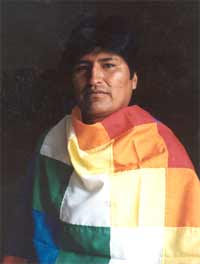
Evo Morales Elected President of Bolivia with 51% of Vote
Socialist Evo Morales, an Aymara Indian, was elected President of Bolivia December 16 with 51% of the vote. In his campaign, Morales, 46, was highly critical of neo-liberal policies and called for the legalization of coca growing. "The fight against drug trafficking has been a pretext for the U .S. government to install military bases," Morales said. He also calls for asserting Bolivian rights over natural gas resources. Morales, who has worked for the rights of coca growers for many years, is the first indigenous person to become President of Bolivia, and won the election with the greatest mandate of any candidate since elections were restored in Bolivia 23 years ago. The party he founded, the Movement Toward Socialism (MAS), has 78 congressmen, one short of a majority in both houses of the National Congress. Morales has forged positive relations with Fidel Castro and Venezuela’s Hugo Chavez. His election is part of a trend towards left-leaning democracies that is sweeping Latin America. U.S. officials were cautious in responding to the election of Morales—on CNN Condoleezza Rice only said the U.S. would watch and wait, and dodged a question about legalization of coca in Bolivia.
Morales’ Platform on Coca | Narco News on the Election 1 | 2
New American Media Report—Coca is the Tree of the Poor
Photos of election day in Cochabamba, Bolivia by Bolivia Indymedia
Bolivian Democracy and the US: A History Lesson
Morales’ Platform on Coca | Narco News on the Election 1 | 2
New American Media Report—Coca is the Tree of the Poor
Photos of election day in Cochabamba, Bolivia by Bolivia Indymedia
Bolivian Democracy and the US: A History Lesson
Tue Dec 20 2005
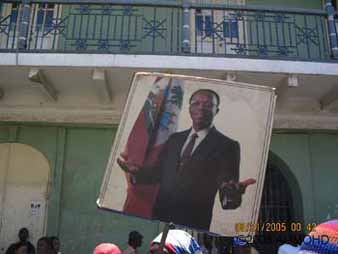
Haiti's election dates have now been reset again
Haiti's election dates have now been reset for the fourth time in the last five months. The Interim Government of Haiti (IGH) will now miss the February 7, 2005 deadline for transferring power that it had promised to meet for 21 months.
Voting registration stretched past the August deadline into October, because registration facilities were not installed in poor urban and rural areas. An international outcry pushed the CEP to expand the opportunities to register, and eventually about 3.5 million people reportedly registered, out of an estimated pool of 4.2 million eligible citizens. The latest schedule calls for a first round of Presidential and legislative elections on January 8, a runoff election on February 15, and local elections on March 5. Several remaining hurdles make reaching this goal unlikely, including distributing electoral cards, printing the ballots, recruiting and training electoral officials and establishing enough voting centers. The electoral cards pose a particular challenge.
The distribution of the electoral cards is complicated, involving alphabetical order and date of registration, and the urban and rural poor who had so much difficulty registering often lack access to radio, television or other means of hearing the announcements. The schedule leaves five weeks before the first round to distribute the cards (and hire and train officials and find facilities for voting centers, which the CEP announced it was starting to do on November 30), when registration alone took over five months. Those particular five weeks may be the hardest of the year to get things done. They include Christmas, Haiti's Independence Day on January 1 and the beginning of Carnaval season on January 8, and much of that is school vacation.
Read More | Taking us to democracy like cattle to the killing house | Haiti's Achievements Under Aristide Now Lost Since The U.S. Led Coup | Haiti sacks Supreme Court judges | Why would I trust this fake election? | Haiti poll postponed a third time | In support of Batay Ouvriye
Voting registration stretched past the August deadline into October, because registration facilities were not installed in poor urban and rural areas. An international outcry pushed the CEP to expand the opportunities to register, and eventually about 3.5 million people reportedly registered, out of an estimated pool of 4.2 million eligible citizens. The latest schedule calls for a first round of Presidential and legislative elections on January 8, a runoff election on February 15, and local elections on March 5. Several remaining hurdles make reaching this goal unlikely, including distributing electoral cards, printing the ballots, recruiting and training electoral officials and establishing enough voting centers. The electoral cards pose a particular challenge.
The distribution of the electoral cards is complicated, involving alphabetical order and date of registration, and the urban and rural poor who had so much difficulty registering often lack access to radio, television or other means of hearing the announcements. The schedule leaves five weeks before the first round to distribute the cards (and hire and train officials and find facilities for voting centers, which the CEP announced it was starting to do on November 30), when registration alone took over five months. Those particular five weeks may be the hardest of the year to get things done. They include Christmas, Haiti's Independence Day on January 1 and the beginning of Carnaval season on January 8, and much of that is school vacation.
Read More | Taking us to democracy like cattle to the killing house | Haiti's Achievements Under Aristide Now Lost Since The U.S. Led Coup | Haiti sacks Supreme Court judges | Why would I trust this fake election? | Haiti poll postponed a third time | In support of Batay Ouvriye
Sun Dec 18 2005
The Iraqi Elections
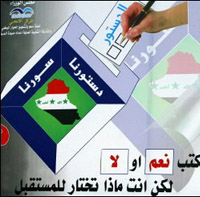
Parliamentary elections were held on December 15th in Iraq. Turnout was estimated at nearly 70%.
Unlike the previous elections this year, Sunni Arabs turned out in large numbers. Many Sunnis said they were fed up with the situation in Iraq and "were ready to take a stab at post-Baathist Iraqi politics".
Juan Cole reports that "It is not actually a positive sign for the Americans that Sunni Arabs came out to vote in order to get rid of them, to see if they couldn't get rid of the current pro-American government, to underline that the armed struggle will continue, and to prove that Sunni Arabs (20% of so of the population) are a majority of the country! The American faith that if people go to the polls it means they won't also be blowing things up is badly misplaced."
Shia fundamentalist parties are expected to have done well in the election, and some expect the results to be a victory for Iran.
Voting In Iraq: A Family in Baghdad | Iraq counts ballots after landmark vote | Snipers and sandbags - Iraq votes
Juan Cole reports that "It is not actually a positive sign for the Americans that Sunni Arabs came out to vote in order to get rid of them, to see if they couldn't get rid of the current pro-American government, to underline that the armed struggle will continue, and to prove that Sunni Arabs (20% of so of the population) are a majority of the country! The American faith that if people go to the polls it means they won't also be blowing things up is badly misplaced."
Shia fundamentalist parties are expected to have done well in the election, and some expect the results to be a victory for Iran.
Voting In Iraq: A Family in Baghdad | Iraq counts ballots after landmark vote | Snipers and sandbags - Iraq votes
International:
 61
61

61