







 Publish to Newswire
 Add an Event
From the Open-Publishing Calendar
From the Open-Publishing Newswire
Indybay Feature
NOBLE Presents Disturbing Report on BART Police Department, 10/1/09: audio and full report
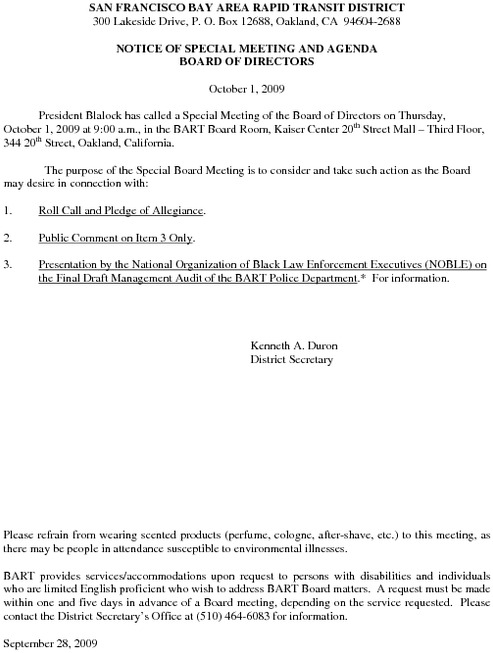
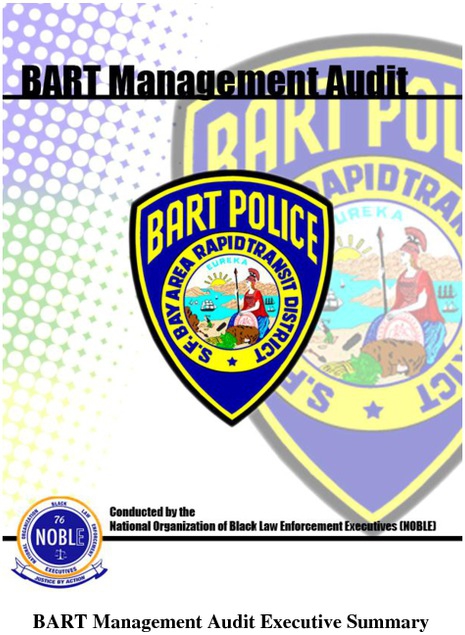
Exactly nine months to the day after the BART police murder of Oscar Grant III, the National Organization of Black Law Enforcement Executives (NOBLE) presented a draft version of its "top to bottom" review of the BART police department to the Board of Directors in a Special Meeting on October 1st. NOBLE was hired by BART in April to conduct the review at a cost of $128,000. The entire 303-page draft version of the "BART Police Department Management Audit" is attached below. The final version is expected in two to three weeks. Pictured here are the NOBLE representatives who presented the review to the BART Board of Directors: Patrick Oliver, former Chief of Police for four different departments in Ohio; Lou Dekmar, Chief of Police in LaGrange, Georgia; and Wanda Dunham, Chief of Police for the Metropolitan Atlanta Rapid Transit Authority (MARTA).
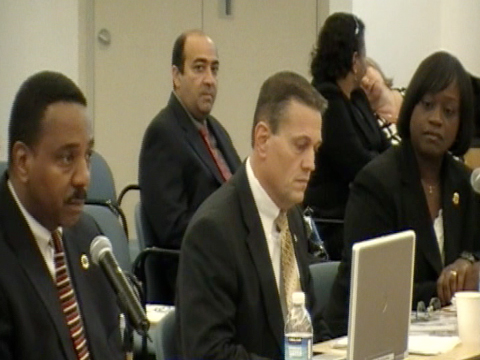
While the public version of the Meyers Nave report released in August largely focused on the many failures of January 1st -- when BART officers detained and abused several young men and Johannes Mehserle shot Oscar Grant in the back -- the NOBLE report thoroughly examines BART police as a whole from the perspective of modern standards of policing.
Not surprising to community activists who have long claimed that BART police are an unprofessional and out of control danger to communities of color, the NOBLE report depicts the BART Police Department as deficient in every way imaginable. From a lack of training to issues with recruiting and promotions, from internal affairs to community relations, from use of force to discipline of officers, from racial profiling to civilian oversight, from policy manuals to plans for catastrophic events, the report identifies problems everywhere. The report notes that BART police's headquarters at the Lake Merritt station is "embarrassing" and "disgusting", which aptly could be taken as a metaphor for the department itself.
In an attempt to compensate for its many failures, and pretend that it has done more than it has to rectify the situation over the last nine months, BART officials such as Director Carole Ward Allen and General Manager Dorothy Dugger trumpeted during the course of the Special Board Meeting that the agency has recently instituted eight updates to its police department manual, including changing their use of force polices so that all use of force incidents will soon be reported, not just "major" ones as in the past, and that they have increased police training hours and added topics such as diversity and racial profiling to the course work.
The elephant in the board room, of course, is that BART continues to refuse to hold even a single person accountable for the serious misconduct of their officers on New Year's Day or for the cover-up by supervisors afterwards. Johannes Mehserle was never interviewed by BART about the shooting and was allowed to resign of his own accord. On Chief Gary Gee's watch, BART police have murdered two unarmed African American men in the East Bay -- Bruce Edward Seward in 2001 and Oscar Grant in 2009. Yet as 2010 approaches he has taken no notable action to reign in his out of control police force. And still, the BART Board and Dorothy Dugger are allowing him to retire on his own timetable. Gee is not expected to be out before the end of the year, and since he stated that he is in opposition to the Meyers Nave report, there is now little reason to expect that before he leaves he will hold anyone accountable or take any serious steps toward implementing NOBLE recommendations. GM Dorothy Dugger has played apologist for Chief Gee and his rogue BART police department all along -- and despite that at least one Board member called for her to be fired as far back as February, she has yet to be held accountable for the many failures that have happened under her supervision. Dugger and Gee are the only ones at BART who can fire police, and the BART Board has failed to hold them accountable, so officers Tony Pirone and Marysol Domenici, who both abused Oscar Grant and his friends on the Fruitvale station platform, continue to enjoy paid leave while BART looks the other way. The other four officers on the platform with Mehserle, Pirone, and Domenici were reinstated in September and are now back on the force. And besides the general dereliction of duty mentioned in the public version of the Meyers Nave report, BART supervisors ranking in between the officers on the platform and Chief Gee, including those in Internal Affairs, have not been called out regarding failures or cover-up attempts related to the murder of Oscar Grant. At the Special Meeting, though, it was revealed that several BART police supervisors will also be retiring soon. (Were they named in the non-public version of the Meyers Nave report which apparently recommended the firing of Tony Pirone and Marysol Domenici?) In short, the BART Board has lacked the moral courage to hold a single person accountable no matter how obvious the evidence against them. It appears that some of the culprits are being allowed to slither away on their own.
Nevertheless, much can be gleaned from NOBLE's lengthy report, either directly or by reading between the lines, regarding reasons as to why BART police would feel free to act as badly as they were caught on camera behaving on January 1st. For instance, one BART officer is quoted as saying, "Discipline here is you either get fired or nothing gets done... it's worthless when trying to correct behavior." Discipline was "weak to poor" before Oscar Grant was shot, officers reported to NOBLE, and it has only "tightened-up some" since. (Thanks, Chief Gee.) One supervisor told NOBLE that it was common for officers, when assigned a task they don't want to do, to simply declare "I'm sick" and then depart work for the day. Another reported that the attitude most officers have toward discipline is: "Write me up... nothing will happen and it will be out of my file in nine months." As for reading between the lines, NOBLE's focus on racial profiling training and record-keeping, and likewise BART's Board members trumpeting that this most basic of instruction will now be a part of police training, indirectly are admissions that the racism that runs through the department needs to be addressed. Regarding the escalation of officer misconduct, NOBLE writes: "minor policy violations are frequently overlooked and 'don't get dealt with' and those violations develop into major performance and behavior issues." Combine that with the strong NOBLE emphasis on establishing a proper promotions policy for BART police, and it appears that some officers have been sent up the ranks despite known severe behavioral issues. With problem officers and supervisors running amok and covering for each other, it is little wonder when NOBLE points out that the 13 citizen complaints against BART police on file for 2008 seems unusually low compared with the agency's number of sworn officers and the number of BART patrons. With its lack of structure and predictability for officers, it is also little wonder that morale is not good amongst BART police. The problems go on and on, and on and on, for most of the 303 pages in the full report.
Oddly, knowing what they know now about BART's deeply inept, reckless, and corrupt police force, the NOBLE report attempts to justify the continued existence of the BART police department, albeit on flimsy grounds that ignore the fact that every supposed reason listed why BART needs its own force could easily be accomplished by other departments in the area BART serves.
After the NOBLE representatives walked BART directors through the "executive summary" of their report at the meeting, elaborating on the recommendations point by point, the few members of the community who were aware of the meeting and chose to attend were allowed to comment. All of the speakers expressed great skepticism that BART will implement a fraction of the recommendations. It was pointed out that the online survey NOBLE conducted which came up with some positive results for public opinion of BART was not a scientific survey so the data presented is relatively meaningless. As a sidenote, NOBLE appears to have ignored in its report the two public forums it held in June, purportedly to gather community feedback for the report.
Several BART Directors spoke of creating action plans and matrices to track progress made toward adoption or rejection of NOBLE's recommendations. The Board agreed that the new mission of their Police Department Review Committee will be to oversee implementation of the NOBLE recommendations that they choose to adopt. The BART Police Department Review Committee will meet next at 9am on Monday, October 5th, in the BART Board Room on the third floor at 344 20th St., Oakland. The meeting is semi-public ("semi" because it is open but they schedule it during business hours when most people work).
BART Police Oversight Plan Dead
http://www.indybay.org/newsitems/2009/09/20/18622616.php
BART Releases Public Report from Meyers Nave Investigation of New Year's Day Murder, 8/18/09
http://www.indybay.org/newsitems/2009/08/18/18616548.php
NOBLE requesting public take survey on performance of BART police
http://www.indybay.org/newsitems/2009/07/13/18607600.php
NOBLE Improves Their People Skills for 2nd Community Forum on BART Police, Oakland, 6/23/09: audio
http://www.indybay.org/newsitems/2009/06/25/18603935.php
Disappointing NOBLE Community Forum for BART Police Review, San Francisco, 6/22/09: audio
http://www.indybay.org/newsitems/2009/06/23/18603524.php
NOBLE Honors Rashidah Grinage and PUEBLO at Awards Dinner, Oakland, 4/24/09: audio
http://www.indybay.org/newsitems/2009/04/25/18591221.php
Not surprising to community activists who have long claimed that BART police are an unprofessional and out of control danger to communities of color, the NOBLE report depicts the BART Police Department as deficient in every way imaginable. From a lack of training to issues with recruiting and promotions, from internal affairs to community relations, from use of force to discipline of officers, from racial profiling to civilian oversight, from policy manuals to plans for catastrophic events, the report identifies problems everywhere. The report notes that BART police's headquarters at the Lake Merritt station is "embarrassing" and "disgusting", which aptly could be taken as a metaphor for the department itself.
In an attempt to compensate for its many failures, and pretend that it has done more than it has to rectify the situation over the last nine months, BART officials such as Director Carole Ward Allen and General Manager Dorothy Dugger trumpeted during the course of the Special Board Meeting that the agency has recently instituted eight updates to its police department manual, including changing their use of force polices so that all use of force incidents will soon be reported, not just "major" ones as in the past, and that they have increased police training hours and added topics such as diversity and racial profiling to the course work.
The elephant in the board room, of course, is that BART continues to refuse to hold even a single person accountable for the serious misconduct of their officers on New Year's Day or for the cover-up by supervisors afterwards. Johannes Mehserle was never interviewed by BART about the shooting and was allowed to resign of his own accord. On Chief Gary Gee's watch, BART police have murdered two unarmed African American men in the East Bay -- Bruce Edward Seward in 2001 and Oscar Grant in 2009. Yet as 2010 approaches he has taken no notable action to reign in his out of control police force. And still, the BART Board and Dorothy Dugger are allowing him to retire on his own timetable. Gee is not expected to be out before the end of the year, and since he stated that he is in opposition to the Meyers Nave report, there is now little reason to expect that before he leaves he will hold anyone accountable or take any serious steps toward implementing NOBLE recommendations. GM Dorothy Dugger has played apologist for Chief Gee and his rogue BART police department all along -- and despite that at least one Board member called for her to be fired as far back as February, she has yet to be held accountable for the many failures that have happened under her supervision. Dugger and Gee are the only ones at BART who can fire police, and the BART Board has failed to hold them accountable, so officers Tony Pirone and Marysol Domenici, who both abused Oscar Grant and his friends on the Fruitvale station platform, continue to enjoy paid leave while BART looks the other way. The other four officers on the platform with Mehserle, Pirone, and Domenici were reinstated in September and are now back on the force. And besides the general dereliction of duty mentioned in the public version of the Meyers Nave report, BART supervisors ranking in between the officers on the platform and Chief Gee, including those in Internal Affairs, have not been called out regarding failures or cover-up attempts related to the murder of Oscar Grant. At the Special Meeting, though, it was revealed that several BART police supervisors will also be retiring soon. (Were they named in the non-public version of the Meyers Nave report which apparently recommended the firing of Tony Pirone and Marysol Domenici?) In short, the BART Board has lacked the moral courage to hold a single person accountable no matter how obvious the evidence against them. It appears that some of the culprits are being allowed to slither away on their own.
Nevertheless, much can be gleaned from NOBLE's lengthy report, either directly or by reading between the lines, regarding reasons as to why BART police would feel free to act as badly as they were caught on camera behaving on January 1st. For instance, one BART officer is quoted as saying, "Discipline here is you either get fired or nothing gets done... it's worthless when trying to correct behavior." Discipline was "weak to poor" before Oscar Grant was shot, officers reported to NOBLE, and it has only "tightened-up some" since. (Thanks, Chief Gee.) One supervisor told NOBLE that it was common for officers, when assigned a task they don't want to do, to simply declare "I'm sick" and then depart work for the day. Another reported that the attitude most officers have toward discipline is: "Write me up... nothing will happen and it will be out of my file in nine months." As for reading between the lines, NOBLE's focus on racial profiling training and record-keeping, and likewise BART's Board members trumpeting that this most basic of instruction will now be a part of police training, indirectly are admissions that the racism that runs through the department needs to be addressed. Regarding the escalation of officer misconduct, NOBLE writes: "minor policy violations are frequently overlooked and 'don't get dealt with' and those violations develop into major performance and behavior issues." Combine that with the strong NOBLE emphasis on establishing a proper promotions policy for BART police, and it appears that some officers have been sent up the ranks despite known severe behavioral issues. With problem officers and supervisors running amok and covering for each other, it is little wonder when NOBLE points out that the 13 citizen complaints against BART police on file for 2008 seems unusually low compared with the agency's number of sworn officers and the number of BART patrons. With its lack of structure and predictability for officers, it is also little wonder that morale is not good amongst BART police. The problems go on and on, and on and on, for most of the 303 pages in the full report.
Oddly, knowing what they know now about BART's deeply inept, reckless, and corrupt police force, the NOBLE report attempts to justify the continued existence of the BART police department, albeit on flimsy grounds that ignore the fact that every supposed reason listed why BART needs its own force could easily be accomplished by other departments in the area BART serves.
After the NOBLE representatives walked BART directors through the "executive summary" of their report at the meeting, elaborating on the recommendations point by point, the few members of the community who were aware of the meeting and chose to attend were allowed to comment. All of the speakers expressed great skepticism that BART will implement a fraction of the recommendations. It was pointed out that the online survey NOBLE conducted which came up with some positive results for public opinion of BART was not a scientific survey so the data presented is relatively meaningless. As a sidenote, NOBLE appears to have ignored in its report the two public forums it held in June, purportedly to gather community feedback for the report.
Several BART Directors spoke of creating action plans and matrices to track progress made toward adoption or rejection of NOBLE's recommendations. The Board agreed that the new mission of their Police Department Review Committee will be to oversee implementation of the NOBLE recommendations that they choose to adopt. The BART Police Department Review Committee will meet next at 9am on Monday, October 5th, in the BART Board Room on the third floor at 344 20th St., Oakland. The meeting is semi-public ("semi" because it is open but they schedule it during business hours when most people work).
BART Police Oversight Plan Dead
http://www.indybay.org/newsitems/2009/09/20/18622616.php
BART Releases Public Report from Meyers Nave Investigation of New Year's Day Murder, 8/18/09
http://www.indybay.org/newsitems/2009/08/18/18616548.php
NOBLE requesting public take survey on performance of BART police
http://www.indybay.org/newsitems/2009/07/13/18607600.php
NOBLE Improves Their People Skills for 2nd Community Forum on BART Police, Oakland, 6/23/09: audio
http://www.indybay.org/newsitems/2009/06/25/18603935.php
Disappointing NOBLE Community Forum for BART Police Review, San Francisco, 6/22/09: audio
http://www.indybay.org/newsitems/2009/06/23/18603524.php
NOBLE Honors Rashidah Grinage and PUEBLO at Awards Dinner, Oakland, 4/24/09: audio
http://www.indybay.org/newsitems/2009/04/25/18591221.php
For more information:
http://indybay.org/oscargrant
Listen now:
Add Your Comments
We are 100% volunteer and depend on your participation to sustain our efforts!
Donate

$110.00 donated
in the past month
Get Involved
If you'd like to help with maintaining or developing the website, contact us.
Publish
Publish your stories and upcoming events on Indybay.
Topics
More
Search Indybay's Archives
Advanced Search
►
▼
IMC Network