







International News
Contribute by publishing to the newswire or calendar and selecting the topic "East Bay"
Indybay's International Pages: Afghanistan | Americas | Haiti | Iraq | Palestine Upcoming Events |
 Photo Gallery
Indybay's International Pages: Afghanistan | Americas | Haiti | Iraq | Palestine
Upcoming Events |
Photo Gallery
Sunday Apr 28
Tuesday Apr 30
[ × close ]
Tue Dec 12 2023 (Updated 12/20/23)
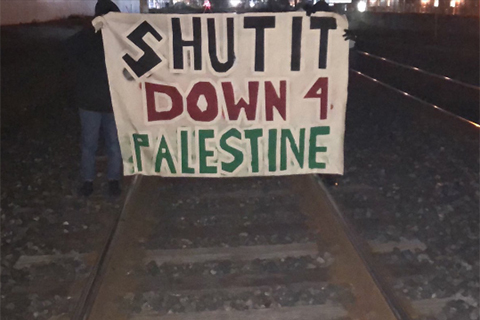
Taking Direct Action Against US Support for Israel's War on Gaza
Protesters in Northern California have engaged in direct actions aimed at disrupting business as usual and raising the profile of the call to free Palestine. Activists shut down the Bay Bridge. A US military vessel destined to deliver weaponry to Israel was blocked from leaving the Port of Oakland. A defense contractor's office was locked down. Communiqués posted on Indybay claim sabotage of train lines, as well as a water main at a pro-IDF fundraiser.

Fri Dec 8 2023 (Updated 12/13/23)
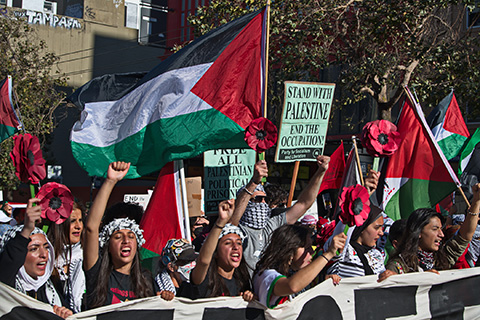
Millions Stand Up Worldwide in Solidarity with Palestine
Millions of people worldwide are standing in solidarity with Palestinians as Israel wages war on Gaza. Marches and rallies have demanded a ceasefire, the end of US military support for Israel, and that Palestine be freed once and for all. Every week there are more protests in cities large and small, including in many that have never seen a pro-Palestinian demonstration. In San Francisco, tens of thousands have marched against Israel's war on Gaza.
Tue Oct 31 2023 (Updated 12/12/23)
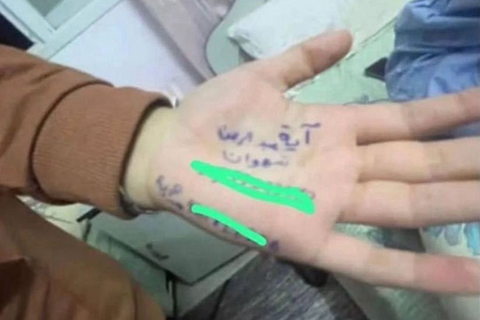
Israel Decimates Gaza, Nearly 2M Palestinians Displaced
Over 1.7 million Palestinians have been displaced and face serious malnutrition and dehydration. Nearly 15,000 have been killed, a third of whom are children. Around 50% of all residential housing in the strip has been destroyed. Israel has killed over 200 medical and aid workers, and 65 journalists. It has bombed and raided hospitals, schools, UN facilities, and more, allowing in barely enough supplies to keep the population from starving to death.

Thu Oct 12 2023
Institute for Study of Zionism to Hold Inaugural Conference
The newly-formed Institute for the Critical Study of Zionism (ICSZ) will hold its inaugural bicoastal conference, Battling the “IHRA Definition”: Theory & Activism, on October 13-14. Through the lens of research on structural racism, state violence, and social justice movements, the conference will analyze political campaigns that seek to codify the “IHRA definition” of antisemitism, and efforts to oppose IHRA policies.
Tue Aug 8 2023
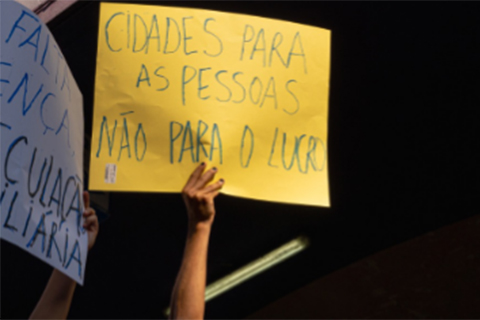
Cities for People, Not for Profit
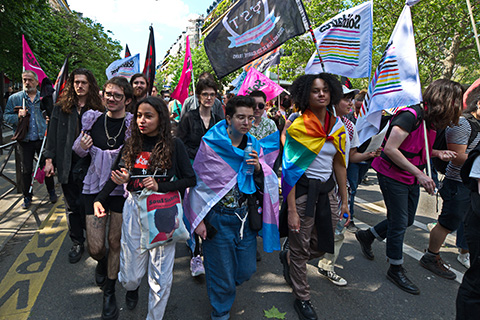
More than a decade ago, artists and musicians created a vibrant hub for the arts in an abandoned shopping mall in Porto, Portugal. City officials long sought to close the DIY space and finally moved on the Stop Shopping Center in late July. For over 10 days, more than 500 musicians were forcibly evicted from their workspace by police and city authorities, with over 100 rehearsal rooms and workplaces closed down. Thousands came out to protest the eviction.

Thu Jul 13 2023 (Updated 07/15/23)
French See Democracy Fading
In response to anti-government protests after police murdered a seventeen-year-old boy of Algerian descent, the French government has taken a number of repressive anti-democratic actions. Several hundred protesters were tried, convicted, and sentenced to lengthy prison terms within just forty-eight hours. One teenager with no prior record was sent to prison for a year and a month for allegedly throwing an empty soda can at a group of police.
Fri May 26 2023 (Updated 05/28/23)
Aussies Say No to Nuclear Sub Base at Port Kembla
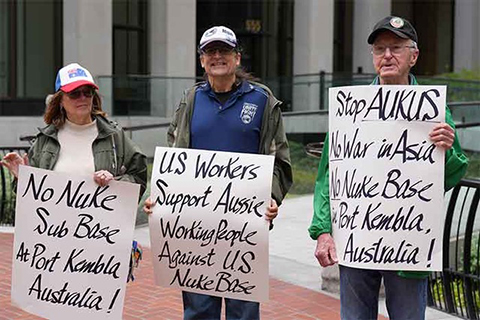
An international day of action was held on May 5 against a US nuclear submarine base in the Australian Port Kembla. Rallies took place at Port Kembla and in San Francisco against the base and the Australian, UK, and US military alliance (AUKUS). Several speakers representing Veterans for Peace, union activists, and others spoke of their opposition to the build-up of a war with China, along with using Australia as a pawn in that effort.
Thu May 25 2023 (Updated 05/28/23)
May Day 2023 Marches and Rallies Demand Dignity and Equality
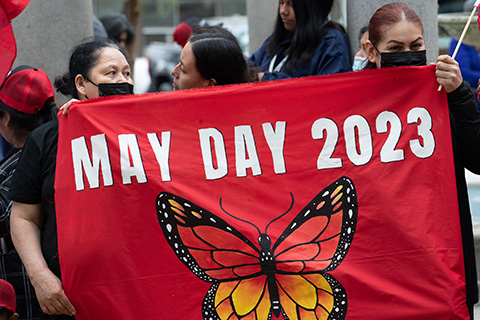
In San Francisco on May 1, IBU-ILWU ferry boat workers marched and rallied at Alcatraz Cruises at Pier 33 which is owned by the anti-union Hornblower company. In San José, union members and allies gathered from throughout the South Bay and beyond, then took to the streets. They chanted, "Up, up with liberation! Down, down with deportation!" In Fresno, around 200 people marched through downtown to advocate immigrants' rights.
Tue Apr 25 2023 (Updated 07/15/23)
French Working People Will Not Accept Retirement Age Increase
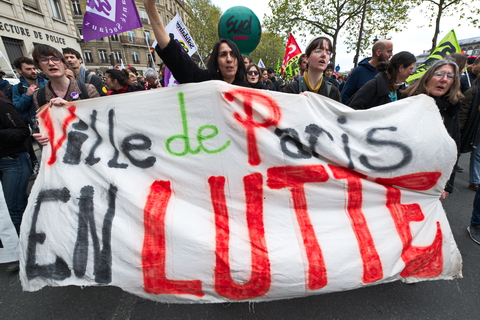
Though technically legal, over seventy percent of the French people feel that the way President Macron pushed through legislation raising the retirement age was a violation of their democratic rights. He relied on Article 49.3, which allows legislation to pass without voting. Even though the Constitutional Assembly claimed the increase was legitimate, working people continue to reject the "reform." Huge demonstrations have wracked the country.
Sat Apr 1 2023 (Updated 04/02/23)
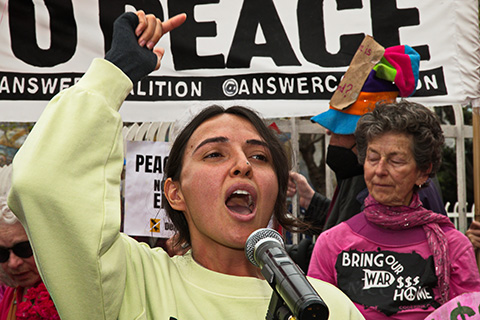
Anti-War Protest Marks 20th Anniversary of Iraq War
On March 18, Answer Coalition and numerous other anti-war organizations rallied and marched in San Francisco. Banners and signs demanded peace in Ukraine, abolishing NATO, the diversion of taxpayers' money to meet human needs, and the end of US aggression toward other nations. Counter demonstrators said Russians are committing genocide and Ukrainians need more weapons. March 19 was the twentieth anniversary the US invasion of Iraq.
Sat Mar 11 2023 (Updated 03/13/23)
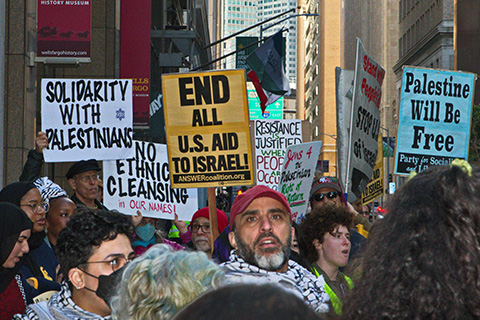
Palestinians Demand Freedom at Israeli Consulate in SF
In Israel, the reascension to power of former Prime Minister Benjamin Netanyahu to head an extreme Zionist government in Israel has provoked huge protests, even spreading to the Israeli military. Settler terrorism against Palestinians, while rampant before, has even more leeway under the new government. A series of protests against the occupation and moves to disempower Israeli courts have happened in San Francisco.

Sat Jan 14 2023 (Updated 01/16/23)
Time to Close Guantanamo Prison
CodePink hosted a demonstration and press conference at U.C. Berkeley Law School on January 11, the 21st anniversary of Guantanamo Prison. The demand was for the Biden administration to close Guantanamo, free the 20 men cleared for release yet still detained, and prosecute U.C. law professor John Yoo for complicity in torture. It was John Yoo who provided the legalistic rationale for torture at US prisons throughout the world.

Sat Dec 24 2022 (Updated 12/27/22)
Unholy Days and Nights in Bethlehem
On December 25, Bethlehem commemorates the birth of Jesus Christ. It is a holy time of year for residents and visitors. Many people picture a sleepy, picturesque town surrounded by hills, dotted with sheep, but the reality in the city of Bethlehem is much different. It is a historic and troubled town. Since the municipal Christmas tree was lit on December 3, Israeli forces and settlers have committed a number of human rights abuses in the area.
Sun Nov 6 2022 (Updated 11/09/22)
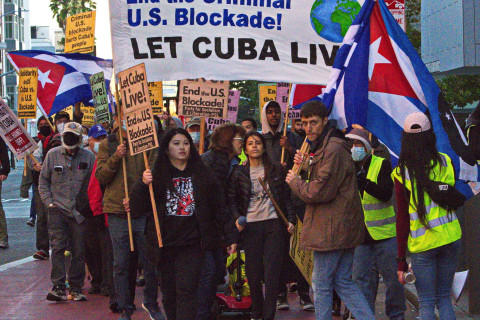
Demonstration Calls for Nancy Pelosi to Let Cuba Live
On November 3, close to a hundred demonstrators protested the US blockade of Cuba at San Francisco's Federal building. The action was timed to coordinate with the UN's 185 to 2 vote to condemn the US economic war against Cuba. After music and speeches, the demonstrators marched to, appropriately, United Nations Plaza and held another rally in front of the statue of Simon Bolivar, a hero of South America's liberation struggles.

 From the
Calendar
From the
Calendar
We are 100% volunteer and depend on your participation to sustain our efforts!
Donate

$230.00 donated
in the past month
Get Involved
If you'd like to help with maintaining or developing the website, contact us.
Publish
Publish your stories and upcoming events on Indybay.
Topics
More
Search Indybay's Archives
Advanced Search
►
▼
IMC Network
Webinar: Update from the West Bank: How the Occupation has Intensified Since October 7th
Event: Sun Apr 28th 10am
Webinar: Anatomy of a Genocide: A Conversation with Special Rapporteur Francesca Albanese
Event: Thu May 2nd 8:30am
Brasil_Abril de Luchas: MST moviliza a más de 30 mil familias sin tierra
Posted: Tue Apr 23rd 4:45am
A New Generation of Warriors at the U.N. Permanent Forum on Indigenous Issues
Posted: Mon Apr 22nd 9:08am
 On the occasion of the death of "the leading left communist in the United States"
(2 comments)
Posted: Tue Apr 16th 2:41pm
Indigenous Youths and Women Leading U.N. Permanent Forum on Indigenous Issues
Posted: Tue Apr 16th 1:06pm
Webinar: Discriminatory Policies on Social Media Platforms in Times of War
Event: Thu Apr 18th 10:30am
Webinar: A Tribute to Refaat Alareer: The Power of Telling the Story of Gaza
Event: Tue Apr 23rd 10am
Lola López Resina still imprisoned at 73 years old, the machine grinds on
Posted: Sat Apr 13th 12:21pm
Ecuador: CONAIE convoca a construir movimiento internacional contra el extractivismo
Posted: Sat Apr 13th 3:46am
On the occasion of the death of "the leading left communist in the United States"
(2 comments)
Posted: Tue Apr 16th 2:41pm
Indigenous Youths and Women Leading U.N. Permanent Forum on Indigenous Issues
Posted: Tue Apr 16th 1:06pm
Webinar: Discriminatory Policies on Social Media Platforms in Times of War
Event: Thu Apr 18th 10:30am
Webinar: A Tribute to Refaat Alareer: The Power of Telling the Story of Gaza
Event: Tue Apr 23rd 10am
Lola López Resina still imprisoned at 73 years old, the machine grinds on
Posted: Sat Apr 13th 12:21pm
Ecuador: CONAIE convoca a construir movimiento internacional contra el extractivismo
Posted: Sat Apr 13th 3:46am
 Disabled Communists and Anarchists: Disability Action Research Kollective
Posted: Fri Apr 12th 3:07pm
Australian Lithium Company and Navajo Enterprise Plan to Mine Hualapai Ceremonial Site
Posted: Fri Apr 12th 9:06am
Palestinian prisoner Walid Daqqah (وليد دقة) dies, the machine grinds on
(1 comment)
Posted: Sun Apr 7th 3:24pm
Disabled Communists and Anarchists: Disability Action Research Kollective
Posted: Fri Apr 12th 3:07pm
Australian Lithium Company and Navajo Enterprise Plan to Mine Hualapai Ceremonial Site
Posted: Fri Apr 12th 9:06am
Palestinian prisoner Walid Daqqah (وليد دقة) dies, the machine grinds on
(1 comment)
Posted: Sun Apr 7th 3:24pm