







 Publish to Newswire
Central Valley News - Sacramento, Fresno, & All of Central Valley
Contribute by publishing to the newswire or calendar and selecting the topic "Central Valley"
 Upcoming Events |
 Photo Gallery
Upcoming Events |
Photo Gallery
Tuesday Oct 27
[ × close ]

Sat Apr 18 2026 (Updated 04/19/26)
Chevron Outspends All Other Lobbyists in California
Big Oil pumped $34 million into influencing lawmakers in Sacramento in 2025, allowing fossil fuel corporations to stonewall and roll back health and climate policy. Chevron and the Western States Petroleum Association (WSPA) are not only the biggest spenders in the fossil fuel industry, but have been the top spenders on overall lobbying most years. Chevron was among those pushing back against bills like the Polluters Pay Climate Superfund Act.

Fri Apr 3 2026 (Updated 04/06/26)
No Kings, No ICE, No War
On March 28, in over 3,000 cities in the US and around the world, millions of people protested the erosion of democracy, anti-immigrant belligerence, and the war against Iran. It was the third "No Kings Day" protest, following the previous two in 2025. Demonstrators demanded "No Kings, No ICE, No War." The No Kings call to action declared that "power belongs to the people — not to wannabe kings or their billionaire cronies."


Thu Jan 22 2026 (Updated 02/09/26)
Students Across Nevada County Walkout to Resist Fascism
A revolutionary student writes, "On January 20th students across Nevada County walked out to protest the fascist federal government, and its supporters in the school board. Building on the walkouts from last year, students self organized walkouts from at least six schools in Nevada County, convening in downtown Grass Valley. Despite attempts by liberal elements to co-opt the movement, the students stood fast in their revolutionary intent."

Thu Jan 15 2026 (Updated 01/24/26)
No Fascism! No Ice! Nationwide Walkouts
On January 20, Women’s March coordinated a day of action which declared, "We will walk out of work, school, and commerce because a Free America begins the moment we stop cooperating with fascism. One year into Trump’s second regime, we face an escalating fascist threat: ICE raids on our communities, troops occupying our cities, families torn apart, attacks on our trans siblings, mass surveillance, and terror used to keep us silent."

Wed Dec 24 2025 (Updated 12/28/25)
Animal Rights Activist Jailed in Sonoma County for Rescuing Chickens
On December 17, activists with the animal rights network Direct Action Everywhere (DxE) rallied at Governor Gavin Newsom’s office, urging him to pardon jailed animal rescuer Zoe Rosenberg and ensure her immediate release. Ms. Rosenberg, a UC Berkeley student and animal cruelty investigator with DxE, was convicted of felony conspiracy and sentenced to 90 days in jail for rescuing four sick chickens from Perdue’s Petaluma Poultry slaughterhouse.

Fri Nov 7 2025 (Updated 11/11/25)
California Youth Demand: Make Polluters Pay
On October 24, youth from 50 middle schools, high schools, and colleges in California walked out of class in a coordinated statewide action demanding that oil and gas corporations be held financially accountable for the damage caused by their pollution. Students called on lawmakers to pass the Polluters Pay Climate Superfund Act, SB 684/AB 1243. While not passed this legislative session, students and climate advocates are working to pass it next year.

Big Oil won a major victory on September 13 when the California Legislature passed Governor Gavin Newsom’s bill, S.B. 237, as part of a controversial “climate” package that greenlights tens of thousands of new oil and gas drilling permits in Kern County over the next decade with no further environmental review. The bill passed as a last minute “gut and amend” measure at the end of the legislative session, truncating public participation.
Thu Sep 11 2025 (Updated 09/20/25)
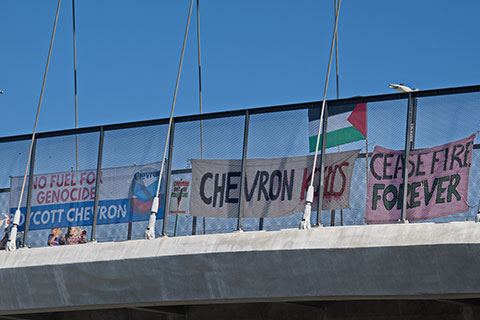
Banner Drops Support BDS Movement's Call for Chevron Boycott
Activists on the West Coast from Bellingham, WA to San Diego, CA organized highway banner drops on August 29 to amp up the Global Chevron Boycott, which has been initiated as a priority campaign by Palestine's Boycott Divestment and Sanctions (BDS) movement. Chevron operates and co-owns fossil gas fields off the coast of occupied Palestinian land that Israel has illegally claimed, and also manages a pipeline that runs from Israel to Egypt.
Sun Aug 31 2025 (Updated 09/08/25)
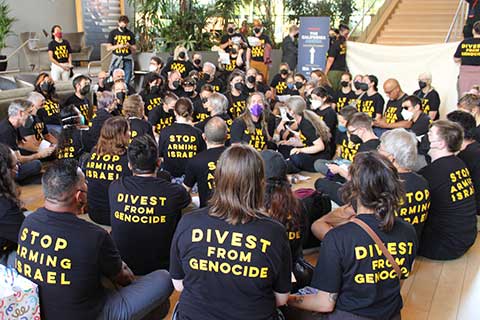
Jews and Allies Hold Sit-In at Padilla Appearance in Sacramento
Over 100 members of Jewish Voice for Peace Sacramento and their allies staged a sit-in in the lobby of Kimpton Sawyer Hotel in Sacramento on August 27 as U.S. Senator Alex Padilla participated as a featured guest in Politico’s corporate funded inaugural California policy summit. The protest was part of a Jewish-led day of action across the state calling on both U.S. Senators from California to stop voting to arm Israel.

Thu Aug 28 2025 (Updated 09/18/25)
Climate Action Demanded as CA Legislature Returns to Session
As the California Legislature returned to session after summer recess, climate activists organized multiple events at the state Capitol. On August 18, demonstrators unfurled large banners in the Capitol rotunda proclaiming “Newson Stand Up To Big Oil." On August 20, advocates representing a coalition of 140 organizations held a press conference on the Capitol lawn to call attention to oil industry-backed bills moving through the session this year.

 From the
Calendar
From the
Calendar
We are 100% volunteer and depend on your participation to sustain our efforts!
Donate

$110.00 donated
in the past month
Get Involved
If you'd like to help with maintaining or developing the website, contact us.
Publish
Publish your stories and upcoming events on Indybay.
Topics
More
Search Indybay's Archives
Advanced Search
►
▼
IMC Network
 audio
Judge Grants Diversion in Goat Rescue Case, Over Prosecution’s Objection
Posted: Thu Sep 24th 10:33am
California 176 - International Underground Railroad Network to Freedom Month
Posted: Tue Sep 1st 2:59pm
Juneteenth continues to grow in the City of Folsom, it's time for an official paid holiday
Posted: Sat Jun 27th 12:17pm
Preserving the Folsom Juneteenth History, Restoring the Legacy of Negro Bar Chinatown
Posted: Thu Jun 25th 11:08pm
2026 Folsom Juneteenth - Dia de Los Negroes toward an official paid City Holiday
Posted: Sun Jun 21st 11:09pm
Old Sacramento prepares for California 175 - State Capitol Juneteenth Dia de Los Negroes
Posted: Mon Jun 1st 6:12pm
1854 Historic Negro Bar, Sacramento County - Leidesdorff Plaza - Diamond Jubilee
Posted: Fri May 29th 2:04pm
Diamond Jubilee - Leidesdorff Plaza - Historic Folsom - Rancho Rio de Los Americanos
Posted: Sat Apr 18th 9:30am
160th Anniversary Year of the Buffalo Soldiers Preparing for Allensworth Rededication
Posted: Thu Oct 8th 7:02am
California Buffalo Soldiers Heritage Trail - Allensworth Historic State Park
Posted: Fri Sep 25th 10:30pm
Discover William Alexander Leidesdorff, Jr. & our 2026 Golden Harvest Birthday Fandango
Posted: Wed Sep 23rd 9:04am
What a "Temporary Removal" of Negro Bar, Sacramento County means to CA Gold Rush Heritage
Posted: Mon Sep 14th 9:50pm
160th Anniversary Year of the Buffalo Soldiers - California State Capitol - July 28, 2026
Posted: Sun Jul 26th 5:43am
Leidesdorff Plaza Diamond Jubilee Historic Preservation along the American River Parkway
Posted: Thu Jun 4th 4:46pm
audio
Judge Grants Diversion in Goat Rescue Case, Over Prosecution’s Objection
Posted: Thu Sep 24th 10:33am
California 176 - International Underground Railroad Network to Freedom Month
Posted: Tue Sep 1st 2:59pm
Juneteenth continues to grow in the City of Folsom, it's time for an official paid holiday
Posted: Sat Jun 27th 12:17pm
Preserving the Folsom Juneteenth History, Restoring the Legacy of Negro Bar Chinatown
Posted: Thu Jun 25th 11:08pm
2026 Folsom Juneteenth - Dia de Los Negroes toward an official paid City Holiday
Posted: Sun Jun 21st 11:09pm
Old Sacramento prepares for California 175 - State Capitol Juneteenth Dia de Los Negroes
Posted: Mon Jun 1st 6:12pm
1854 Historic Negro Bar, Sacramento County - Leidesdorff Plaza - Diamond Jubilee
Posted: Fri May 29th 2:04pm
Diamond Jubilee - Leidesdorff Plaza - Historic Folsom - Rancho Rio de Los Americanos
Posted: Sat Apr 18th 9:30am
160th Anniversary Year of the Buffalo Soldiers Preparing for Allensworth Rededication
Posted: Thu Oct 8th 7:02am
California Buffalo Soldiers Heritage Trail - Allensworth Historic State Park
Posted: Fri Sep 25th 10:30pm
Discover William Alexander Leidesdorff, Jr. & our 2026 Golden Harvest Birthday Fandango
Posted: Wed Sep 23rd 9:04am
What a "Temporary Removal" of Negro Bar, Sacramento County means to CA Gold Rush Heritage
Posted: Mon Sep 14th 9:50pm
160th Anniversary Year of the Buffalo Soldiers - California State Capitol - July 28, 2026
Posted: Sun Jul 26th 5:43am
Leidesdorff Plaza Diamond Jubilee Historic Preservation along the American River Parkway
Posted: Thu Jun 4th 4:46pm
[ × close ]