







 Publish to Newswire
 Add an Event
Feature Archives
Sun Apr 25 2004
Unrest In Iraq Spreads As Bloodbath Looms In Najaf and Fallujah
4/25/2004:
The US is threatening to move
into both Najaf and Fallujah as troops continue to surround both cities, engaging in
daily skirmishes with both Sunni and Shi'ite
resistance fighters.
Bombings across Iraq have resulted in many civilian deaths but it remains unclear who has
been carrying them out.
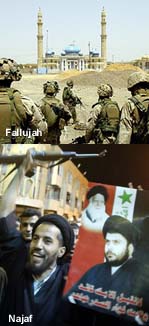
The US is threatening to move troops into the Shi'ite holy city of Najaf, claiming that Sadr's militia is stockpiling weapons and ammunition. Grand Ayatollah Sistani has declared a "red line" around the city forbidding the US from entering. Sadr has threatened suicide attacks against the US if attacked and Iran has also expressed its concern about the US entrance into a city considered holy to most Iranians. An emergency delegation of U.S. civilians (including two activists from Santa Cruz) has gone to Najaf to place themselves "nonviolently, symbolically and physically" between the U.S. armed forces and the civilian population. As the Najaf standoff continues, clashes are already taking place in Karbala, which is the second holiest city to Shi'ites after Najaf. Anger over US attacks on Sadr and an attack on free speech that makes even private displays of Sadr's picture illegal have lead to widespread Shi'ite unrest that now appears to include the "infiltration" of the US backed Iraqi army by resistance fighters.
Coverage of the Fallujah massacre in the Arab press has raised anti-American sentiments in Iraq (and the rest of the Arab world) to unprecedented levels, but the details of what has been happening in Fallujah are only starting to emerge in the mainstream Western press. As US soldiers brag of the number of Iraqis they have killed in Fallujah, estimates of the number of civilian dead grows. Schools no longer have pupils, homes are being demolished, and "the stench of dead bodies has become overpowering" due to the US targeting of ambulances and hospitals. Despite the large number of deaths in a city of only 300,000, resistance fighters in Fallujah remain resolute with anger over deaths of relatives and destruction of mosques only encouraging them to fight harder.
On April 21st, 68 Iraqis were killed and over 200 injured when bombs went off in downtown Basra. No group took responsibility for the attacks but protesters in Basra blamed British forces. On April 24th, over 40 died in a day of violence that included a rocket attack on a busy market in Sadr City that locals claim to have come from US helicopters. Also on the 24th, three boats exploded, as suicide boats attacked Iraq's main oil terminal. Instability and violence in Iraq have resulted in endless suffering for most Iraqis who can not "change the channel" as Brigadier General Mark Kimmitt asked people to do in response to questions about problems in the country.
The US is threatening to move troops into the Shi'ite holy city of Najaf, claiming that Sadr's militia is stockpiling weapons and ammunition. Grand Ayatollah Sistani has declared a "red line" around the city forbidding the US from entering. Sadr has threatened suicide attacks against the US if attacked and Iran has also expressed its concern about the US entrance into a city considered holy to most Iranians. An emergency delegation of U.S. civilians (including two activists from Santa Cruz) has gone to Najaf to place themselves "nonviolently, symbolically and physically" between the U.S. armed forces and the civilian population. As the Najaf standoff continues, clashes are already taking place in Karbala, which is the second holiest city to Shi'ites after Najaf. Anger over US attacks on Sadr and an attack on free speech that makes even private displays of Sadr's picture illegal have lead to widespread Shi'ite unrest that now appears to include the "infiltration" of the US backed Iraqi army by resistance fighters.
Coverage of the Fallujah massacre in the Arab press has raised anti-American sentiments in Iraq (and the rest of the Arab world) to unprecedented levels, but the details of what has been happening in Fallujah are only starting to emerge in the mainstream Western press. As US soldiers brag of the number of Iraqis they have killed in Fallujah, estimates of the number of civilian dead grows. Schools no longer have pupils, homes are being demolished, and "the stench of dead bodies has become overpowering" due to the US targeting of ambulances and hospitals. Despite the large number of deaths in a city of only 300,000, resistance fighters in Fallujah remain resolute with anger over deaths of relatives and destruction of mosques only encouraging them to fight harder.
On April 21st, 68 Iraqis were killed and over 200 injured when bombs went off in downtown Basra. No group took responsibility for the attacks but protesters in Basra blamed British forces. On April 24th, over 40 died in a day of violence that included a rocket attack on a busy market in Sadr City that locals claim to have come from US helicopters. Also on the 24th, three boats exploded, as suicide boats attacked Iraq's main oil terminal. Instability and violence in Iraq have resulted in endless suffering for most Iraqis who can not "change the channel" as Brigadier General Mark Kimmitt asked people to do in response to questions about problems in the country.
Mon Apr 19 2004
John Negroponte Put In Charge Of Iraq As Spanish, Dominican, and Honduran Troops Leave
4/19/2004:
Spain's new Prime Minister Zapatero has announced that all 1,400 Spanish troops will be withdrawn from Iraq within the next few weeks. Honduran President Maduro responded by announcing that Honduras will remove its 370 troops from Iraq "in the shortest time possible" and the Dominican Republic has also announced the immediate withdraw of its 300 troops.
Thailand has announced that if they are attacked, it will withdraw its 451 medical and engineering troops and
there are reports that Poland may pull out its 2,500 soldiers at the end of the year.
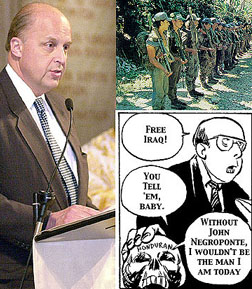
On June 30th, the US claims it will hand "limited sovereignty" to the Iraqis, but this will mean little to most Iraqis since it will be a change in name only. Neocons in the US appear to be trying "to turn an Iraq scandal over the oil-for-food program into a reason why the UN should stay out of Iraq." After June 30th, neither the international community or the new "Iraqi government" will have any say in the actions of the over 100,000 US troops in the country, the new "Iraqi government" will have no power to make or change laws and real power will be in the hands of the US ambassador. On April 19th, Bush announced that he will nominate John Negroponte for this role. Negroponte is currently ambassador to the UN and was the US ambassador to Honduras from 1981 through 1985. According to The New York Times, Negroponte was responsible for "carrying out the covert strategy of the Reagan administration to crush the Sandinistas government in Nicaragua." "Negroponte supervised the creation of the El Aguacate air base, where the US trained Nicaraguan Contras and which critics say was used as a secret detention and torture center during the 1980s. In August 2001, excavations at the base discovered 185 corpses, including two Americans, who are thought to have been killed and buried at the site. " John Negroponte "worked closely with General Alvarez, Chief of the Armed Forces in Honduras, to enable the training of Honduran soldiers in psychological warfare, sabotage, and many types of human rights violations, including torture and kidnapping." In 1994, the Honduran Rights Commission "specifically accused John Negroponte of a number of human rights violations."
DisInfopedia on John Negroponte | Global Research on John Negroponte
On June 30th, the US claims it will hand "limited sovereignty" to the Iraqis, but this will mean little to most Iraqis since it will be a change in name only. Neocons in the US appear to be trying "to turn an Iraq scandal over the oil-for-food program into a reason why the UN should stay out of Iraq." After June 30th, neither the international community or the new "Iraqi government" will have any say in the actions of the over 100,000 US troops in the country, the new "Iraqi government" will have no power to make or change laws and real power will be in the hands of the US ambassador. On April 19th, Bush announced that he will nominate John Negroponte for this role. Negroponte is currently ambassador to the UN and was the US ambassador to Honduras from 1981 through 1985. According to The New York Times, Negroponte was responsible for "carrying out the covert strategy of the Reagan administration to crush the Sandinistas government in Nicaragua." "Negroponte supervised the creation of the El Aguacate air base, where the US trained Nicaraguan Contras and which critics say was used as a secret detention and torture center during the 1980s. In August 2001, excavations at the base discovered 185 corpses, including two Americans, who are thought to have been killed and buried at the site. " John Negroponte "worked closely with General Alvarez, Chief of the Armed Forces in Honduras, to enable the training of Honduran soldiers in psychological warfare, sabotage, and many types of human rights violations, including torture and kidnapping." In 1994, the Honduran Rights Commission "specifically accused John Negroponte of a number of human rights violations."
DisInfopedia on John Negroponte | Global Research on John Negroponte
4/14/2004: Bay Area-based independent journalist and filmmaker, David Martinez was taken prisoner by the resistance fighters in Fallujah over the weekend, and then was released unharmed. Martinez returned to Falluja to help evacuate civilians and wounded people in the "kill zone". Martinez, along with several other internationals, was held in a resistance safe house while being questioned. He reports being treated respectfully. Once the resistence fighters were convinced the internationals were in Fallujah doing humanitarian work, they were released unharmed. Martinez reports that the fighters in Fallujah were mostly young men, all natives of Fallujah that have lost friends and relatives in the occupation. He characterizes the Fallujah resistance a "grassroots response to the invasion of their town." Martinez estimates the death toll at being close to 1200 in Fallujah so far. Listen to the Flashpoints Audio Interview
This group of internationals has been attempting to use their international status to get the wounded to hospitals in the few ambulances that still exist. While trying to pick up the wounded and dead, the ambulances often get shot up by U.S. snipers, preventing the medical team from doing their work. During the cease-fire, civilians have attempted to evacuate Fallujah, but often the young men get held back. It is feared that once a considerable amount of people are evacuated, the U.S. will level the town.
David Martinez's Reports: April 4 | April 7 | April 15
Photos & Reports from Andrew Stern/Naomi Klein: March 19 | April 6 | April 9
This group of internationals has been attempting to use their international status to get the wounded to hospitals in the few ambulances that still exist. While trying to pick up the wounded and dead, the ambulances often get shot up by U.S. snipers, preventing the medical team from doing their work. During the cease-fire, civilians have attempted to evacuate Fallujah, but often the young men get held back. It is feared that once a considerable amount of people are evacuated, the U.S. will level the town.
David Martinez's Reports: April 4 | April 7 | April 15
Photos & Reports from Andrew Stern/Naomi Klein: March 19 | April 6 | April 9
A Family In Baghdad | Juan Cole | Baghdad Burning
Older Independent Reports From Iraq: 1 2 3
Sun Apr 11 2004
Over 700 Dead as US Takes Revenge On Fallujah
4/11/2004:
On Monday April 5th, the US closed off Fallujah in attempt to round up those responsible for the killing and mutilation of 4 US contractors on March 30th.
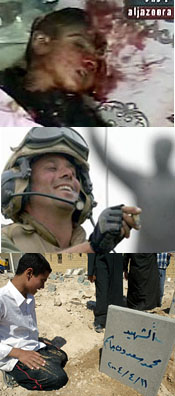
By Wednesday, there were reports of many civilian deaths, with 40 dead in a US bombing of a mosque. While the US maintained those being killed were all combatants, the Al Jazeera crew in Fallujah broadcast out images of young children killed in the US offensive.
As estimates of the numbers of Iraqis killed grew to over 700 (including 160 women, 141 children and many elderly), even coalition partners of the US were horrified. A Senior British officer was reported as stating that the US troops "don't see the Iraqi people the way we see them. They view them as untermenschen. They are not concerned about the Iraqi loss of life..." A batallion of the US backed Iraqi army refused to deploy to Fallujah with members quoted as saying they "did not sign up to fight Iraqis." One of the most famous guerrilla leaders against Saddam Hussein, Abdel-Karim Mahoud al-Mohammedawi, said he was suspending his membership in the Council until "the bleeding stops in Iraq". Even Adnan Pachachi, who Bush showed off in his January 2004 State of the Union address as a future leader of Iraq,
stated of the seige: "These operations were a mass punishment...It is not right to punish all the people of Fallujah, and we consider these operations by the Americans unacceptable and illegal."
On Friday April 9th, Paul Bremer announcement that his forces were suspending military operations in Fallujah, but there were fresh reports of US offensive operations despite the claimed ceasefire.
Saturday April 10th: Negotiations between the US, members of the Governing Council and rebels in Fallujah seems to have resulted in a lull in fighting. Women and children fled the city as the US Marines ordered "Iraqi men of 'military age' to stay behind, sometimes turning back entire families if they refused to be separated." A soccer stadium has been turned into a mass grave.
The Falluja Massacre will surely be remembered by many in the Middle East in the same way as Jenin, Deir Yassin, Sabra and Chatila, and Saddam Hussein's massacre of thousands of Shiite's in South Iraq in 1991. As with most massacres, in the future there will be outrage, but as the killing occurs the world is again silent.
Read More About The Massacre in Fallujah On UK Indymedia
On Friday April 9th, Paul Bremer announcement that his forces were suspending military operations in Fallujah, but there were fresh reports of US offensive operations despite the claimed ceasefire.
Saturday April 10th: Negotiations between the US, members of the Governing Council and rebels in Fallujah seems to have resulted in a lull in fighting. Women and children fled the city as the US Marines ordered "Iraqi men of 'military age' to stay behind, sometimes turning back entire families if they refused to be separated." A soccer stadium has been turned into a mass grave.
The Falluja Massacre will surely be remembered by many in the Middle East in the same way as Jenin, Deir Yassin, Sabra and Chatila, and Saddam Hussein's massacre of thousands of Shiite's in South Iraq in 1991. As with most massacres, in the future there will be outrage, but as the killing occurs the world is again silent.
Read More About The Massacre in Fallujah On UK Indymedia
Fri Mar 7 2003
As War on the World Looms, Worldwide Resistance Surges
3/7/2003: Dictator Saddam Hussein's defector son-in-laws told the United Nations that Iraq "had destroyed its entire stockpile of chemical and biological weapons and banned missiles." The US government's campaign of dirty tricks was exposed in the European press, but ignored by the US corporate media. The FBI's own tell of a possible increase in terror attacks in the US after a war in Iraq starts. Despite these well-known facts, the US government and corporate media have already started the war on Iraq. In Turkey the military has overruled parliament and US troops are now massing on the Iraqi border. On the Kuwait-Iraq Border, fences have been cut and UN "peace keepers" have reported that US Marines are violating the demilitarized zone. US Military officials openly admit that "U.S. special operations forces are inside several areas of Iraq" as US and British bombings of Iraq escalate
The US government needs this war. A message must be sent to its obstructionist allies that obedience to the US policies and politics is the only option. But the people of the world must realize that standing with the government of the US is not the same as standing with the people of the US.
The US government needs this war. A message must be sent to its obstructionist allies that obedience to the US policies and politics is the only option. But the people of the world must realize that standing with the government of the US is not the same as standing with the people of the US.
Deaths in Iraq Since March 2003
(Last Updated 1/24/2010)
| Sources: iCasualties.org, Antiwar.com, Centcom, Iraqi Body Count, Medact |
Iraq:
 13
13

13