







 Publish to Newswire
 Add an Event
Feature Archives
On Monday June 28th the US officially transferred power in Iraq from the CPA to the Interim Iraqi Government.
"Technically the handover of power ends the 14-month occupation of Iraq, but many questions remain as to how much power the US has actually handed over. The U.S. will keep 130,000 troops on the ground. US Ambassador John Negroponte will head up the largest embassy in the world. The new government will be barred from amending the interim constitution that was drawn up by the US and the US-appointed Iraqi Governing Council. The US has put in place numerous laws to protect US forces and contractors." (listen to interviews and analysis on Democracy Now).
The Interim Iraqi Government is headed by Prime Minister Iyad Allawi, a man with past ties to both the CIA and MI6. Allawi was also responsible for the 45-minute WMD claim used to trick the public into supporting a US invasion.
The Interim Iraqi Government is headed by Prime Minister Iyad Allawi, a man with past ties to both the CIA and MI6. Allawi was also responsible for the 45-minute WMD claim used to trick the public into supporting a US invasion.
Fri Jun 4 2004
Continued Violence As Interim Governing Council Is Dissolved
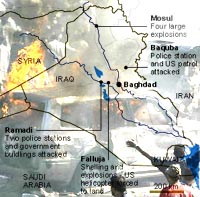
On June 24th, 2004 over ninety people were killed and over 280 wounded in a series of bombings that hit Mosul, Ba'qubah, Ramadi, Baghdad and Fallujah. Christian Parenti Reported From Baquba on Thursday's events (Audio).
On June 1, the Iraq Interim Governing Council dissolved after choosing Ghazi Mashal Ajil al-Yawer as the new Iraqi President. According to most US press sources Grand Ayatollah Ali Sistani endorsed the new Interim government, but his actual statement was qualified. Many Iraqis question what power the Interim government will really have after the June 30th "handover".
The Iraqi Interim Governing Council was established by the US on July 13, 2003. The Governing Council was given limited power and was subject to the authority of the Coalition Provisional Authority administrator Paul Bremer. Among the few decisions made by the Governing Council during its short life were the replacement of Iraq's former secular family law with Shari'a family law and the establishment of a new Iraqi flag. Most Iraqis saw the governing council as US puppets and two members were assassinated. On Sept 20th 2003, Aqila al-Hashimi was wounded in an attack and died 5 days later. On May 17th 2004, the President of the Governing Council Ezzedine Salim was killed in a car bomb in Baghdad. Since the presidency of the Governing Council was rotating, many Iraqis were surprised to learn who their President was when they heard of his death.
On June 1, the Iraq Interim Governing Council dissolved after choosing Ghazi Mashal Ajil al-Yawer as the new Iraqi President. According to most US press sources Grand Ayatollah Ali Sistani endorsed the new Interim government, but his actual statement was qualified. Many Iraqis question what power the Interim government will really have after the June 30th "handover".
The Iraqi Interim Governing Council was established by the US on July 13, 2003. The Governing Council was given limited power and was subject to the authority of the Coalition Provisional Authority administrator Paul Bremer. Among the few decisions made by the Governing Council during its short life were the replacement of Iraq's former secular family law with Shari'a family law and the establishment of a new Iraqi flag. Most Iraqis saw the governing council as US puppets and two members were assassinated. On Sept 20th 2003, Aqila al-Hashimi was wounded in an attack and died 5 days later. On May 17th 2004, the President of the Governing Council Ezzedine Salim was killed in a car bomb in Baghdad. Since the presidency of the Governing Council was rotating, many Iraqis were surprised to learn who their President was when they heard of his death.
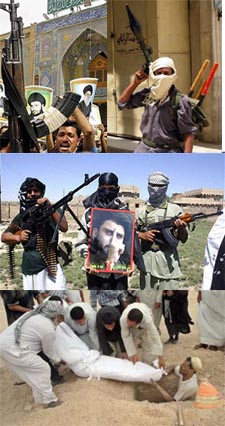
On May 22nd Sadr's militia agreed to leave Karbala and on May 27th there were signs
that Sadr's troops may be pulled from Najaf if the US were to agree to also withdraw its troops from the city.
Weeks of fighting have resulted in dozens of Iraqi casualties and the destruction of many historical buildings in both Najaf and Karbala. The Shrine of Ali in Najaf was damaged twice resulting in outrage by Shiites worldwide. In Iran, the British embassy was attacked several times with fire bombs and the government warned the US about the dangers of its actions. In Bahrain, demonstrators clashed with police and the police overreaction forced the resignation of the interior minister. In Lebanon, over 200,000 marched in Beirut demanding an end to US attacks on the Shiite holy cities.
While fighting may soon end in the holy cities, US attacks on Sadr's militias in other cities are likely to continue. On May 23rd the US went on the offensive in Kufa (Sadr's main stronghold) killing dozens in heavy fighting that resulted in damage to the Selah mosque. There has also been fighting between Sadr's militia and coalition forces across much of Southern Iraq. British forces have been ambushed every day around the town of Majar al-Kabir and at nearby Amarah.
A poll conducted by the Iraq Center for Research and Strategic Studies shows that Moqtada al-Sadr is "Iraq's second most influential figure after Grand Ayatollah Ali al-Sistani, the country's most senior Shia cleric. Some 32 per cent of respondents said they strongly supported Mr Sadr and another 36 per cent somewhat supported him". "For many of his followers, radical Iraqi Shiite cleric Moqtada Sadr has taken on the persona of a Robin Hood or a David fighting Goliath as he defiantly stands up to the US-led coalition. " Despite being a Shiite cleric, Sadr has considerable support among Sunnis too. Fallujan Sunni clerics have met with Sadr to talk of unifying the struggle for national liberation. A commander of two brigades of the Mehdi Army in Sadr City recently confirmed to Dahr Jamail that many Sunnis have joined the Shi’ite-led resistance force. "We have 700 Sunnis fighting with us here, because we are fighting so that our holy places aren’t destroyed like they are in Najaf, Kut and Kerbala...The Americans invaded us, and now they have made this a holy war."
Weeks of fighting have resulted in dozens of Iraqi casualties and the destruction of many historical buildings in both Najaf and Karbala. The Shrine of Ali in Najaf was damaged twice resulting in outrage by Shiites worldwide. In Iran, the British embassy was attacked several times with fire bombs and the government warned the US about the dangers of its actions. In Bahrain, demonstrators clashed with police and the police overreaction forced the resignation of the interior minister. In Lebanon, over 200,000 marched in Beirut demanding an end to US attacks on the Shiite holy cities.
While fighting may soon end in the holy cities, US attacks on Sadr's militias in other cities are likely to continue. On May 23rd the US went on the offensive in Kufa (Sadr's main stronghold) killing dozens in heavy fighting that resulted in damage to the Selah mosque. There has also been fighting between Sadr's militia and coalition forces across much of Southern Iraq. British forces have been ambushed every day around the town of Majar al-Kabir and at nearby Amarah.
A poll conducted by the Iraq Center for Research and Strategic Studies shows that Moqtada al-Sadr is "Iraq's second most influential figure after Grand Ayatollah Ali al-Sistani, the country's most senior Shia cleric. Some 32 per cent of respondents said they strongly supported Mr Sadr and another 36 per cent somewhat supported him". "For many of his followers, radical Iraqi Shiite cleric Moqtada Sadr has taken on the persona of a Robin Hood or a David fighting Goliath as he defiantly stands up to the US-led coalition. " Despite being a Shiite cleric, Sadr has considerable support among Sunnis too. Fallujan Sunni clerics have met with Sadr to talk of unifying the struggle for national liberation. A commander of two brigades of the Mehdi Army in Sadr City recently confirmed to Dahr Jamail that many Sunnis have joined the Shi’ite-led resistance force. "We have 700 Sunnis fighting with us here, because we are fighting so that our holy places aren’t destroyed like they are in Najaf, Kut and Kerbala...The Americans invaded us, and now they have made this a holy war."
Wed May 19 2004
US Kills Over 40 Attending Wedding In Western Iraq
On Wednesday May 19, 2004 a US helicopter opened fire on a wedding party in Western Iraq killing
over 40 people (Photos). As Iraqis
buried their dead, the US insisted the wedding was
a legitimate target. The Red Cross scolded the
Americans that
"Even if (you came under) fire, there are rules of proportion in retaliation and the
absolute need to prevent civilian casualties".
On May 23rd, the AP released a video (Photos | Video) showing scenes of a wedding with several people also seen in later footage of the US carnage. Unwilling to admit that its earlier reports that there was no evidence of a wedding were lies, the US military released a statement that "Bad people have parties too".
This latest US atrocity fall on the heals of many other American actions that have angered the Iraqi people including the prison torture scandal, allegations of US troops stealing from houses during raids, and thousands of deaths in the last few months resulting from US raids and detentions.
This latest US atrocity fall on the heals of many other American actions that have angered the Iraqi people including the prison torture scandal, allegations of US troops stealing from houses during raids, and thousands of deaths in the last few months resulting from US raids and detentions.
Fri May 14 2004
Battles in Najaf and Karbala Could Spark A Shi'ite Civil War
5/14/2004:
On May 6th, the US began its first major assault on Shi'ite insurgents. Troops entered Diwaniya and Karbala and attacking strongholds of Sadr's Mehdi militia. Also on the 6th, the US appointed Adnan al-Dhurfi as the governor for the city
of Najaf, moving tanks into the city to "secure" the
governor's offices. Sadr's initial response was in Basra where hundreds of militia men took over portions of the city, but within a day the
British claimed to have quelled the revolt.
On Friday May 7th, Sadr's Shi'ite supporters were invited to pray at Sunni mosques in
Baghdad in a show of unity against the US occupation. Sadr himself spoke at a mosque in Kufa
demanding that Bush face trial for the abuse of
Iraqi prisoners at Abu Ghraib.
The US assault on Karbala continued into the
weekend.
On Saturday May 8th, the US attacked the Sadr City
neighborhood in Baghdad and destroyed offices
belonging to Sadr's supporters. While dozens were
killed in the US raid, Iraqis stood strong in the face of the US assault, as Baghdad residents quickly gathered to help rebuild the buildings destroyed by the US.
Unrest continued throughout the week in Najaf and Karbala. Insurgents also blasted an oil pipeline, slashing Iraq's daily oil exports by about 25 per cent.
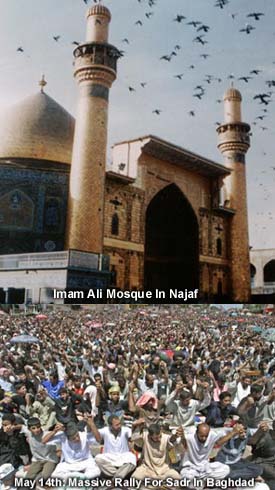
On Thursday May 13th, fighting in Karbala intensified with battles taking place near the Imam Abbas and Imam Hussein shrines. On Friday May14th, US tanks attacked Sadr militia members in the cemetary in Najaf. As US tanks moved in, fire from the tanks damaged the dome of the Shrine of Ali, the most sacred Shi'ite holy site.
"Sadr and SCIRI are the two main Shia parties controlling the southern region of Iraq now, but the party and militias of Sadr are much more popular" On May 7th, "the SCIRI spokesman indirectly announced the beginning of the new Shia-Shia conflict. From the SCIRI position, I think they find themselves committed to criticizing any anti-occupation movement, because they are the main player in the GC[Governing Council]". The most popular religious leader in Iraq, Sistani has been quiet during the latest fighting and hasn't even made a statement about the pictures of torture and humiliation in US prison camps. The latest fighting in Najaf and the damage done to Shi'ite holy sites will guarantee some sort of response. If Sistani sides with the US he could lose much of his support and spark a civil war and if he sides with Sadr he will lose much of his power over US backed Shi'ites in the governing Council. He will almost certainly try to ride the fence, but his unwillingness to take tough stands on issues that are impacting the Shi'ite holy cities is already starting to chip away at his popularity.
"Sadr and SCIRI are the two main Shia parties controlling the southern region of Iraq now, but the party and militias of Sadr are much more popular" On May 7th, "the SCIRI spokesman indirectly announced the beginning of the new Shia-Shia conflict. From the SCIRI position, I think they find themselves committed to criticizing any anti-occupation movement, because they are the main player in the GC[Governing Council]". The most popular religious leader in Iraq, Sistani has been quiet during the latest fighting and hasn't even made a statement about the pictures of torture and humiliation in US prison camps. The latest fighting in Najaf and the damage done to Shi'ite holy sites will guarantee some sort of response. If Sistani sides with the US he could lose much of his support and spark a civil war and if he sides with Sadr he will lose much of his power over US backed Shi'ites in the governing Council. He will almost certainly try to ride the fence, but his unwillingness to take tough stands on issues that are impacting the Shi'ite holy cities is already starting to chip away at his popularity.
Wed May 5 2004
The US Siege of Fallujah Is Over... For Now
5/5/2004:
On April 29th, it was announced that a new Iraqi force run by former Republican Guard Major General Mohammed Saleh was replacing US forces around Fallujah.
Fallujah had been cut off from vital necessities for days. With the exit of
US forces, food and supplies were finally able to enter the city. Refugees from Fallujah also started to return as Iraqis rallied in the streets celebrating what many saw as a victory over US forces.
On May 1st, General Saleh questioning US orders to crack down on the city saying he did not see the presence of the "foreign fighters" the US had supposedly been attacking. Claiming that pressure by Shi'ites over Saleh's Republican Guard background was causing problems, Saleh was replaced within days by Muhammad Latif, a former intelligence officer who was an opponent of Saddam Hussein. Latif has now visited Falluja and says he too sees no notable presence of "foreign fighters", but it appears the US will let him remain in charge.
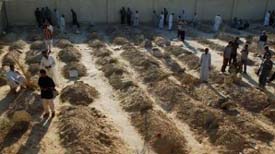
The US attack on Fallujah is over for now. A UN human rights investigator is calling for an independent probe into crimes committed by the US during the month long siege of the city. Western journalists are now able to visit the city and report on the devastation caused by US bombs, tanks and snipers. Fallujans are now able to dig out their dead from collapsed buildings and bury them in a mass grave set up in what had been a soccer stadium. During the month of April an estimated 1,361 Iraqis were killed; many of the deaths occurred during the US raid on Fallujah.
Cornel West On Fallujah | Interview With Refugees | Past Fallujah Coverage: 4/25 4/15 4/11
On May 1st, General Saleh questioning US orders to crack down on the city saying he did not see the presence of the "foreign fighters" the US had supposedly been attacking. Claiming that pressure by Shi'ites over Saleh's Republican Guard background was causing problems, Saleh was replaced within days by Muhammad Latif, a former intelligence officer who was an opponent of Saddam Hussein. Latif has now visited Falluja and says he too sees no notable presence of "foreign fighters", but it appears the US will let him remain in charge.
The US attack on Fallujah is over for now. A UN human rights investigator is calling for an independent probe into crimes committed by the US during the month long siege of the city. Western journalists are now able to visit the city and report on the devastation caused by US bombs, tanks and snipers. Fallujans are now able to dig out their dead from collapsed buildings and bury them in a mass grave set up in what had been a soccer stadium. During the month of April an estimated 1,361 Iraqis were killed; many of the deaths occurred during the US raid on Fallujah.
Cornel West On Fallujah | Interview With Refugees | Past Fallujah Coverage: 4/25 4/15 4/11
Fri May 7 2004
Pictures Emerge Of US And UK Torture Of Iraqi Prisoners
5/7/2004:
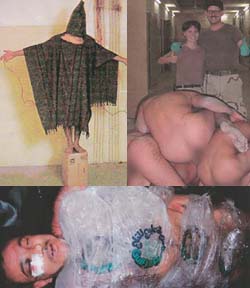
On Wednesday April 28th, CBS aired footage showing US abuse of Iraqi prisoners at the Abu Ghraib prison. The pictures showed Iraqis with
electrical wires strapped to their genitals, prisoners forced to simulate or engage in sex
acts, and at least one person who appeared to have been tortured to death. As Bush and Blair
denounced the incidents but claimed they were isolated, more examples of torture have come to
light. On April 30th, Seymour Hersh detailed many additional abuses in an article in the New Yorker. Hersh based his article off of a report by General Antonio M. Taguba completed in late
February but classified such that it was never seen by the US Congress until it appeared
online. On May 6, the Washington Post published
additional pictures and on May 7th an ICRC report on US torture of prisoners in Iraq was leaked to the Wall Street Journal and during hearings in Washington, Secretary of Defense
Rumsfeld admitted many more cases of torture had taken place and many more pictures and video could appear
soon.
The torture of prisoners at Abu Ghraib has resulted in the passing of blame between soldiers, officers, contractors and intelligence agencies. The most visible people taking the blame are the soldiers shown in pictures: Staff Sgt. Ivan "Chip" Frederick, Sgt. Javal Davis, Spec. Charles A. Graner Jr., Spec. Sabrina Harman, Spec. Jeremy Sivits, and Spec. Lynndie England. All six of these soliders are from the Army Reserve's 372nd Military Police Company based in Cumberland, Md. The 372nd Company was commanded by Captain Donald Reese and is part of the 800th Military Police Brigade. Another person taking a lot of the blame is Brig. Gen. Janis Karpinski who was in charge of several jails and commander of the 800th Brigade, but she claims that "military intelligence officials who were not under her command had condoned the abuse." The Taguba Report also singles out for blame Colonel Thomas Pappas and Lt. Col. Steven L. Jordan of the 205th Military Intelligence Brigade and private defence contractor/interrogators Steven Stephanowicz, Adel Nakhla, Torin Nelson and John Israel. The private contractors are believed to be from CACI International, Inc. based in Arlington, Virginia, and Titan which is based in San Diego, California. Lt. Col. Jerry L. Phillabaum and Maj. David W. DiNenna Sr. of the 320th Military Police Battalion and First Lt. Lewis C. Raeder, a platoon leader in the 372nd have also been mentioned as possibly being responsible for abuse at the prison.
For the past year, many Iraqis and independent reporters have been documenting abuses by "coalition" forces, but the mainstream US media has been largely unwilling to talk to ordinary Iraqis and has instead chosen to rely on embedded reporters and interviews with US military experts. Media in the Middle East has done a better job at talking to Iraqis and revealing the real costs of war, but that could change as the US government is putting pressure on governments in the region to restrict coverage of news that might hurt US interests.
Taguba Report (text and pdf) | Red Cross (ICRC) Report (pdf) | Amnesty International | The New Yorker: Torture At Abu Ghraib | Reportback From Iraq: Analysis of Prison Abuses | PHOTOS | AUDIO from Enemy Combatant Radio
The torture of prisoners at Abu Ghraib has resulted in the passing of blame between soldiers, officers, contractors and intelligence agencies. The most visible people taking the blame are the soldiers shown in pictures: Staff Sgt. Ivan "Chip" Frederick, Sgt. Javal Davis, Spec. Charles A. Graner Jr., Spec. Sabrina Harman, Spec. Jeremy Sivits, and Spec. Lynndie England. All six of these soliders are from the Army Reserve's 372nd Military Police Company based in Cumberland, Md. The 372nd Company was commanded by Captain Donald Reese and is part of the 800th Military Police Brigade. Another person taking a lot of the blame is Brig. Gen. Janis Karpinski who was in charge of several jails and commander of the 800th Brigade, but she claims that "military intelligence officials who were not under her command had condoned the abuse." The Taguba Report also singles out for blame Colonel Thomas Pappas and Lt. Col. Steven L. Jordan of the 205th Military Intelligence Brigade and private defence contractor/interrogators Steven Stephanowicz, Adel Nakhla, Torin Nelson and John Israel. The private contractors are believed to be from CACI International, Inc. based in Arlington, Virginia, and Titan which is based in San Diego, California. Lt. Col. Jerry L. Phillabaum and Maj. David W. DiNenna Sr. of the 320th Military Police Battalion and First Lt. Lewis C. Raeder, a platoon leader in the 372nd have also been mentioned as possibly being responsible for abuse at the prison.
For the past year, many Iraqis and independent reporters have been documenting abuses by "coalition" forces, but the mainstream US media has been largely unwilling to talk to ordinary Iraqis and has instead chosen to rely on embedded reporters and interviews with US military experts. Media in the Middle East has done a better job at talking to Iraqis and revealing the real costs of war, but that could change as the US government is putting pressure on governments in the region to restrict coverage of news that might hurt US interests.
Taguba Report (text and pdf) | Red Cross (ICRC) Report (pdf) | Amnesty International | The New Yorker: Torture At Abu Ghraib | Reportback From Iraq: Analysis of Prison Abuses | PHOTOS | AUDIO from Enemy Combatant Radio
Iraq:
 12
12

12