







 Publish to Newswire
 Add an Event
Feature Archives
Fri Oct 1 2004
A Month Of Violence And Hardship
It is time now that the world would say to America 'that's enough, stop what you're doing to Iraq and its people...Saddam was a tyrant, but we didn't see in his era this killing and destruction
- Mohamed Al Imam, a cloths shop owner
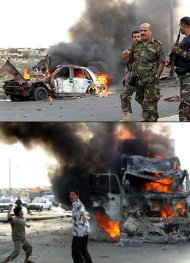
10/1/2004 September was one the deadliest months in Iraq since the start of the US occupation, with Iraq now being labeled the world's most hostile environment. While headlines around the world reported car bombs and kidnappings, the US backed Iraqi Health Ministry reported that the US has killed nearly twice as many Iraqis, most of them civilians, as attacks by the resistance.
"[T]he interim Iraqi government recorded 3,487 Iraqi deaths in 15 of the country's 18 provinces from April 5, when the ministry began compiling the data, until Sept. 19. Of those, 328 were women and children. An additional 13,720 Iraqis were injured."
The disaster in Iraq extends far beyond the fighting. Iraq's water and sanitation services are failing and Hepatitis is spreading in 2 Iraqi districts and the country as a whole faces a soaring toll of deadly disease. While Bush and Allawi tout reconstruction, Iraqis' report that "electricity is drastically less than pre-war levels", the cost of electricity is up and "on our better days" Baghdad gets only about 12 hours of electricity. The UN has also reported that thousands of schools in Iraq lack basics for decent education.
Falluja doctors decry civilian toll | Top Sunni cleric calls for Iraqis to unite against US terror
10/1/2004 September was one the deadliest months in Iraq since the start of the US occupation, with Iraq now being labeled the world's most hostile environment. While headlines around the world reported car bombs and kidnappings, the US backed Iraqi Health Ministry reported that the US has killed nearly twice as many Iraqis, most of them civilians, as attacks by the resistance.
"[T]he interim Iraqi government recorded 3,487 Iraqi deaths in 15 of the country's 18 provinces from April 5, when the ministry began compiling the data, until Sept. 19. Of those, 328 were women and children. An additional 13,720 Iraqis were injured."
The disaster in Iraq extends far beyond the fighting. Iraq's water and sanitation services are failing and Hepatitis is spreading in 2 Iraqi districts and the country as a whole faces a soaring toll of deadly disease. While Bush and Allawi tout reconstruction, Iraqis' report that "electricity is drastically less than pre-war levels", the cost of electricity is up and "on our better days" Baghdad gets only about 12 hours of electricity. The UN has also reported that thousands of schools in Iraq lack basics for decent education.
Falluja doctors decry civilian toll | Top Sunni cleric calls for Iraqis to unite against US terror
Mon Aug 30 2004
Najaf Siege Comes To An End
On August 19th, after days of US bombings and hundreds of deaths, Al-Sadr ordered his fighters to hand over keys to the Shrine of Ali to Iraq's top religious authorities. Unfortunately, Grand Ayatollah Ali al-Sistani was in the UK at the time receiving medical treatment for a bad heart, so fighting continued for another week until he finally returned on August 25th.
On Friday August 27th, the standoff in Najaf ended as thousands of Sistani's supporters flooded the mosque mixing with Sadr's supporters and giving them an opportunity to leave the Shrine without fear of attack from US forces.
so... after 569 Iraqis were killed and 785 injured, after attacking the most sacred Shia shrine, and after destroying parts of the biggest and most sacred Shia cemetery in the world... [in] comes the "Grand" Sistani and solves the crisis in 10 minutes. - Read in the Middle
While the Shiite leadership in Iraq claims to oppose the US occupation, Sistani has been largely silent about US actions and has focused more of his energy on the Shiite power struggle than on the occupation or Iraq's many other problems. The main result of the siege on Najaf was a brief increase in Sistani's popularity and a change in venue for the conflict between Shiite radicals and US forces. Within weeks of what was touted as a peace agreement, fighting was on the increase in Sadr City as well as in Basra.
On Friday August 27th, the standoff in Najaf ended as thousands of Sistani's supporters flooded the mosque mixing with Sadr's supporters and giving them an opportunity to leave the Shrine without fear of attack from US forces.
so... after 569 Iraqis were killed and 785 injured, after attacking the most sacred Shia shrine, and after destroying parts of the biggest and most sacred Shia cemetery in the world... [in] comes the "Grand" Sistani and solves the crisis in 10 minutes. - Read in the Middle
While the Shiite leadership in Iraq claims to oppose the US occupation, Sistani has been largely silent about US actions and has focused more of his energy on the Shiite power struggle than on the occupation or Iraq's many other problems. The main result of the siege on Najaf was a brief increase in Sistani's popularity and a change in venue for the conflict between Shiite radicals and US forces. Within weeks of what was touted as a peace agreement, fighting was on the increase in Sadr City as well as in Basra.
Wed Sep 15 2004
Community Appeals for Release of NGO Workers Captured in Baghdad
9/29: Four Women Freed After Italy Pays Ransom
9/16: Naomi Klein Reports: Kidnapping Has Mark of Undercover Operation
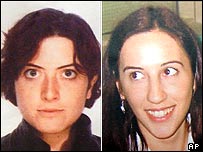
9/15: Tens of thousands marched in Italy today to demand the release of the Italian NGO workers and their Iraqi co-workers after their kidnapping last week, and to demand a full withdrawal of Italian forces from the US-led occupation of Iraq. Witnesses said about 20 men with AK-47 assault rifles and pistols fitted with silencers stopped their vehicles on September 7 in broad daylight in a busy commercial area of Baghdad and raided the offices of Un Ponter Per Baghdad (A Bridge to Baghdad), a volunteer association that was established after the end of the 1991 Gulf War to promote humanitarian aid to Iraq and to fight the sanctions imposed by the United States. They took Simona Pari and Simona Torretta, both Italians, out by their hair, along with Ra'ad Ali Abdul Azziz and Mahnoaz Bassam, both Iraqis - the first time a native Iraqi has been kidnapped since the occupation began. Eye-witness accounts stated that the men were dressed professionally and acted with swift efficiency, singling out the women as leaders in the organization. All of the kidnap victims were staunchly and openly anti-war and anti-occupation.
Local groups such as Global Exchange and independent journalists have been working on an appeal for the release of the humanitarian workers.
CLICK HERE TO SIGN THE APPEAL Democracy Now! 9/9 | Democracy Now! 9/15 | Democracy Now! 9/16 | Democracy Now! 9/17
9/16: Naomi Klein Reports: Kidnapping Has Mark of Undercover Operation
9/15: Tens of thousands marched in Italy today to demand the release of the Italian NGO workers and their Iraqi co-workers after their kidnapping last week, and to demand a full withdrawal of Italian forces from the US-led occupation of Iraq. Witnesses said about 20 men with AK-47 assault rifles and pistols fitted with silencers stopped their vehicles on September 7 in broad daylight in a busy commercial area of Baghdad and raided the offices of Un Ponter Per Baghdad (A Bridge to Baghdad), a volunteer association that was established after the end of the 1991 Gulf War to promote humanitarian aid to Iraq and to fight the sanctions imposed by the United States. They took Simona Pari and Simona Torretta, both Italians, out by their hair, along with Ra'ad Ali Abdul Azziz and Mahnoaz Bassam, both Iraqis - the first time a native Iraqi has been kidnapped since the occupation began. Eye-witness accounts stated that the men were dressed professionally and acted with swift efficiency, singling out the women as leaders in the organization. All of the kidnap victims were staunchly and openly anti-war and anti-occupation.
Local groups such as Global Exchange and independent journalists have been working on an appeal for the release of the humanitarian workers.
CLICK HERE TO SIGN THE APPEAL Democracy Now! 9/9 | Democracy Now! 9/15 | Democracy Now! 9/16 | Democracy Now! 9/17
Sat Aug 7 2004
Iraq Forces Al-Jazeera To Close Its Baghdad Office
8/7/2004: On Saturday August 7th, the Iraqi interim
government forced the closure
of the Baghdad office of Al-Jazeera.
Al-Jazeera is the only major non-state run news agency in the Arab world,
but its independence may be its undoing. While the US claims to support freedom of the press,
the moment the war in Iraq started to go against the US and images
of Americans bombing mosques and killing civilians started being
shown on television, the US demanded
that Al Jazeera censor its coverage.
Al Jazeera has pledged to continue covering news in
Iraq despite the closure of their office, but the US is working
to control teh network by putting pressure on Qatar
(the country where Al Jazeera is based) and going after the
companies hosting Al Jazeera's website.
"A funny thing happened after the United States transferred sovereignty over Iraq. On the ground, things didn't change, except for the worse," but "the cosmetic change in regime had the effect of 'Afghanizing' the media coverage" Mainstream US based news corporations have been unable to cover the war in Iraq for months due to the danger of leaving Baghdad. As Robert Fisk has written, "With journalists confined to Baghdad--several have not left their hotels for more than two weeks--a bomb-free day in the capital becomes a bomb-free day in Iraq." Al Jazeera has managed to get reporters in to cover what is really going on, but with the Bush/Allawi attacks on freedom of the press, its likely that even this coverage could dry up.
August 2004: Media watchdog criticises Iraq's Al Jazeera ban | March 2004: Censorship, American Style | August 2003: US menaces Al Jazeera over Iraq reportage | November 2001: US Bombs Al Jazeera's Office in Kabul | October 2001: U.S. Presses for Censorship of Jazeera TV | Is Al-Jazeera Being Targeted by the U.S. Government?
"A funny thing happened after the United States transferred sovereignty over Iraq. On the ground, things didn't change, except for the worse," but "the cosmetic change in regime had the effect of 'Afghanizing' the media coverage" Mainstream US based news corporations have been unable to cover the war in Iraq for months due to the danger of leaving Baghdad. As Robert Fisk has written, "With journalists confined to Baghdad--several have not left their hotels for more than two weeks--a bomb-free day in the capital becomes a bomb-free day in Iraq." Al Jazeera has managed to get reporters in to cover what is really going on, but with the Bush/Allawi attacks on freedom of the press, its likely that even this coverage could dry up.
August 2004: Media watchdog criticises Iraq's Al Jazeera ban | March 2004: Censorship, American Style | August 2003: US menaces Al Jazeera over Iraq reportage | November 2001: US Bombs Al Jazeera's Office in Kabul | October 2001: U.S. Presses for Censorship of Jazeera TV | Is Al-Jazeera Being Targeted by the U.S. Government?

Sun Aug 8 2004
Sadr's Uprising Re-Ignites
8/8/2004: On Jul. 23, Iraqi Shia leader Muqtada al-Sadr
gave his first public sermon in nearly two months
While his rhetoric was critical of the US appointed Iraqi government, it was noticeably
less militant than his earlier speeches. The lull in fighting and less militant
tone of Sadr's public statements lead US newspapers to speak of
Sadr's decreased influence outside of Sadr city.
An upsurge in fighting in early August has shown this to be untrue.
On July 29th, Italian troops stormed Sadr's offices in Nasiriya setting off several days of fighting. Several days later, Sadr's militia kidnapped 18 Iraqi police officers in an effort to force authorities to release detained militants. While Sadr soon released the police officers, fighting between his Mahdi Army and US troops soon began throughout southern Iraq. On August 5th, the Mahdi militia downed a US helicopter in Najaf as Sadr also declared war on British troops in Basra. Several days of fighting in Najaf resulted in many deaths, with US claims to have killed over 300 Iraqis. The brutality of the US attacks on Najaf even lead the normally pro-US Iraqi Vice President Ibrahim al-Jafari to declare the US attacks "uncivilized" and unjustified. But the Iraqi government's talk of a truce was quickly undermined by the attempted seizure of al-Sadr by Iraqi security forces. Backed by US helicopters and fixed wing aircrafts, Allawi visited Najaf on August 8th to demand the surrender of the Shiite militants. "Iyad Allawi was acting like Saddam the dictator when he went to Najaf today" a Shia cleric told the AFP. "Allawi has shown his true colours. He is determined to eliminate Sayed Moqtada and the movement he represents"
Riverbend and Juan Cole On The Renewed Najaf Clashes
On July 29th, Italian troops stormed Sadr's offices in Nasiriya setting off several days of fighting. Several days later, Sadr's militia kidnapped 18 Iraqi police officers in an effort to force authorities to release detained militants. While Sadr soon released the police officers, fighting between his Mahdi Army and US troops soon began throughout southern Iraq. On August 5th, the Mahdi militia downed a US helicopter in Najaf as Sadr also declared war on British troops in Basra. Several days of fighting in Najaf resulted in many deaths, with US claims to have killed over 300 Iraqis. The brutality of the US attacks on Najaf even lead the normally pro-US Iraqi Vice President Ibrahim al-Jafari to declare the US attacks "uncivilized" and unjustified. But the Iraqi government's talk of a truce was quickly undermined by the attempted seizure of al-Sadr by Iraqi security forces. Backed by US helicopters and fixed wing aircrafts, Allawi visited Najaf on August 8th to demand the surrender of the Shiite militants. "Iyad Allawi was acting like Saddam the dictator when he went to Najaf today" a Shia cleric told the AFP. "Allawi has shown his true colours. He is determined to eliminate Sayed Moqtada and the movement he represents"
Riverbend and Juan Cole On The Renewed Najaf Clashes
Thu Aug 5 2004
Fighting resumes in Falluja
8/5/2004
While fighting in Falluja slowed
down following a
truce
at the beginning of May,
US air strikes never really
stopped.
Clashes between Fallujans and US troops increased
during the last few weeks of July and there was a noticable increase in the
US aerial bombardment of the city.
While Fallujans have demanded that Iraq's oil money
be used to rebuild the city, the US has threated
to cut off all aid to the city if militants continue attacking US troops.
Tue Jul 20 2004
Kidnappings, Air Strikes and Carbombs
7/20/2004
The June
28th transfer of power changed little in the war ravaged country of Iraq.
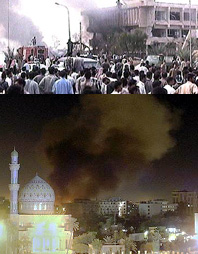
On June 29th, explosions shook Baghdad
and a video was released showing
the execution of a US solider.
On June 30th, at least 13 people were killed after
US military planes bombed a neighbouhood in the
Iraqi city of Falluja.
On July 5th US Air Strikes again struck Falluja
killing 15 civilians. Although he most likely had little say or
influence over the US attacks, Prime
Minister Allawi quickly spoke out publicaly in
support of the air strikes. On July 6th, a car bomb
exploded in Baquba killing 14th and wounding 70.
On July 7th, four Iraqi policemen were killed and 13 wounded
in fighting in central Baghdad
and the interim government signed an emergency law
seen by many as the
Iraqi version of
the Patriot Act.
On July 14th a carbomb exploded in the Iraqi capital and
the governor of the northern
Iraqi city of Mosul was assassinated. Fighting during the first few weeks
of July made Samarra a no-go area for US troops
While the is growing evidence that the Iraqi insurgency is secular nationalist not Islamist or Jihadist, unknown attackers have been systematically murdering Iraqi intellectuals and Alcohol shops have also been frequently attacked. Women's rights are also under attack and there is growing resentment among Kurds and the Christian minority which has been the target of a wave of carbombs.
While the is growing evidence that the Iraqi insurgency is secular nationalist not Islamist or Jihadist, unknown attackers have been systematically murdering Iraqi intellectuals and Alcohol shops have also been frequently attacked. Women's rights are also under attack and there is growing resentment among Kurds and the Christian minority which has been the target of a wave of carbombs.
Iraq:
 11
11

11