| About | Contact | Subscribe | Calendar | Publish | Donate |
|---|
East Bay | Global Justice and Anti-Capitalism | Police State and PrisonsACLU and NLG Ask Oakland Police Department If It Seeks to Abandon Key Protections for Demonstrators
For Immediate Release: April 24, 2012 Today, the American Civil Liberties Union of Northern California (ACLU-NC) and the San Francisco Bay Area Chapter of the National Lawyers Guild (NLG) demanded that the Oakland Police Department (OPD) explain if it plans to abandon its Crowd Control Policy, in favor of vague standards that fail to provide specific guidance to officers in the field and that invite a repetition of last fall’s botched handling of Occupy protests. OPD’s Crowd Control Policy provides essential guidance that aims to ensure demonstrators’ rights. “Even with clear directives in place last fall, OPD dramatically mishandled its response to the Occupy protests,” said ACLU-NC staff attorney Linda Lye. “If OPD eliminates important prohibitions against specific tactics from its Policy and replaces them with vague standards, it will invite a repetition or worse, rather than prevent a recurrence, of what happened last fall.” Protest activity is planned for May 1, 2012. The ACLU-NC and NLG have therefore demanded that OPD immediately explain whether it continues to adhere to the Crowd Control Policy or if has instead abandoned them for the more vague POST guidelines, in violation of the federal court order. Background: On October 25 and November 2-3, 2012, OPD and assisting agencies responded to two Occupy Oakland protests by blanketing crowds of peaceful protesters with flash bang grenades, lead-filled shotbags, “pepperballs,” and tear gas, resulting in widespread injuries. OPD’s response to these protests, the subject of a pending lawsuit brought by the ACLU-NC and NLG, systematically violated its own Crowd Control Policy, which articulates important crowd management principles – such as reliance on the minimal use of force – and contains key, common sense directives for officers in the field that protect protester safety – such as prohibiting officers from throwing flash bang grenades or other exploding projectiles directly at people, or shooting less lethal munitions directly into crowds. The Crowd Control Policy was the product of a federal court settlement agreement of a prior lawsuit brought by the ACLU and NLG, arising out of OPD’s handling of a peaceful anti-war protest at the Port of Oakland in 2003.
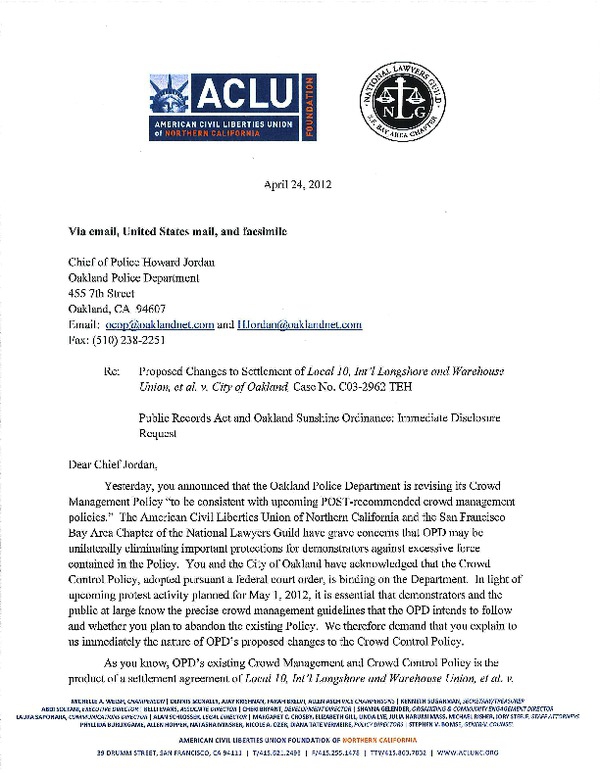
§ACLU-NC / NLG letter to Chief Jordan
[3-page PDF]
Via email, United States mail, and facsimile Chief of Police Howard Jordan Oakland Police Department 455 7th Street Oakland, CA 94607 Email: ocop [at] oaklandnet.com and HJorclan [at] oaklandnet.com Fax: (510) 238-2251 Re: Proposed Changes to Settlement of Local 10J Int '1 Longshore and Warehouse Union, et al. v. City ofOakland, Case No. C03-2962 TEH Public Records Act and Oakland Sunshine Ordinance: Immediate Disclosure Request Dear Chief Jordan, Yesterday, you announced that the Oakland Police Department is revising its Crowd Management Policy "to be consistent with upcoming POST-recommended crowd management policies." The American Civil Liberties Union of Northern California and the San Francisco Bay Area Chapter of the National Lawyers Guild have grave concerns that OPD may be unilaterally eliminating important protections for demonstrators against excessive force contained in the Policy. You and the City of Oakland have acknowledged that the Crowd Control Policy, adopted pursuant a federal court order, is binding on the Department. In light of upcoming protest activity planned for May 1,2012, it is essential that demonstrators and the public at large know the precise crowd management guidelines that the OPD intends to follow and whether you plan to abandon the existing Policy. We therefore demand that you explain to us immediately the nature of OPD's proposed changes to the Crowd Control Policy. As you know, OPD's existing Crowd Management and Crowd Control Policy is the product of a settlement agreement of Local 10, Int'l Longshore and Warehouse Union, et al. v. City of Oakland, Case No. C03-2962 TEH, a case brought by the ACLU and NLG challenging OPD's response to a peaceful anti-war protest at the Port of Oakland in 2003. The policy articulates important crowd management principles - such as reliance on the minimal use of force - and contains key directives for officers in the field that protect protester safety - such as prohibiting officers from throwing flash bang grenades or other exploding projectiles directly at people, or shooting less lethal munitions directly into crowds. The guidelines created by the Commission of Peace Officer Standards and Training, by contrast, merely identify criteria to be considered in formulating crowd management policies and fail to contain specific directives. The POST Guidelines on Use of Force contain very general standards (e.g ., "the force used must be objectively reasonable under the totality of the circumstances," Page 39) that, while a legally accurate statement of the Fourth Amendment law, fail to provide officers in the field with clear guidance. Moreover, the March, 2012 , POST Guidelines on Crowd Management, Intervention and Control appear to permit the use of so-called "less lethal" munitions to disperse crowds, whereas the OPD Crowd Management and Crowd Control Policy specifically prohibits the police from shooting such munitions into crowds as a means of crowd dispersal. There are good reasons for the specific prohibitions in the existing Crowd Control Policy. All so-called "less lethal" munitions are potentially deadly, as we have seen from the tragic death of college student Victoria Snelgrove when Boston police opened fire at an unruly crowd with pepperballs in 2004, and the near-fatal injury to veteran Scott Olsen when Oakland police opened fire on the crowd with shot filled "bean bags" on October 25,2011. The problem with OPD's handling of the Occupy protests last fall, on October 25 and November 2-3, 2012, was not the department's Crowd Control Policy. The problem was that OPD failed to adhere to its own Crowd Control Policy. Even with a strong Policy in place, the department last fall responded to these protests by engaging in highly dangerous and clearly unconstitutional practices that violate the Policy. These practices, extensively documented by the ACLU and NLG, included, for example, shooting less lethal munitions and throwing explosive devices directly into crowds. We are extremely concerned that if the department eliminates important prohibitions against these and other unsafe tactics from its Policy and replaces them with vague standards, it will invite a repetition - rather than prevent a recurrence of what happened last fall. In court pleadings, you and the City of Oakland have acknowledged you are bound by the OPD Crowd Management and Crowd Control Policy: "Defendants admit that the crowd-control policy that Oakland adopted as part of the settlement in two previous consolidated cases before this COUl1 remains in effect and the settlement obliges Oakland to follow it." See Camp bell v. City ofOakland, Case No. C11-05498 RS, Answer, Doc. 47. Further, the Local 10 settlement agreement requires you to meet and confer with us regarding "any material change to the term of [the Crowd Management and Crowd Control] Policy." Local 10 Stipulation & Order (entered December 24,2004), page 6, line 5-6. We therefore fail to understand why you now believe that OPD is free to alter or abandon that Policy without running afoul of the federal court order that adopted it, and to do so without even consulting with us beforehand. Please clarify whether OPD intends to continue to adhere to the Crowd Control Policy. Please also explain to us the nature of any proposed revision s to the Policy and to OPD crowd control training and provide us with any and all revisions you are considering to the Policy or training materials. The request for this information and documents is also made pursuant to the Public Records Act and constitutes an immediate disclosure request pursuant to the Oakland Sunshine Ordinance, which require, respectively, a response within ten and three days. See Cal. Gov. Code §6250 et seq., and Oakland Municipal Code Sec. 2.20.230. Because, however, the May 1 protests are rapidly approaching, we request a response immediately. Sincerely, Linda Lye ACLU of Northern California Rachel Lederman San Francisco Bay Area Chapter of the National Lawyers Guild Cc: Randy Hall , City Attorney' s Office (via email, facsimile and United States mail) Bill Simmons, City Attorney's Office (via email , facsimile and United States mail) [2-page PDF]
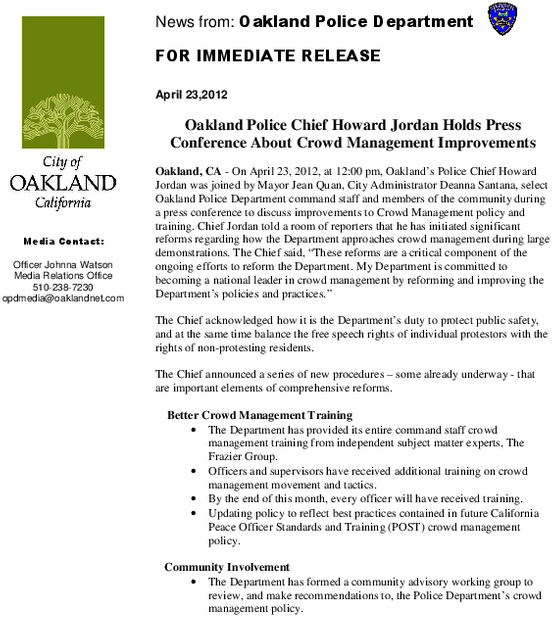
News from: City of Oakland FOR IMMEDIATE RELEASE April 23, 2012 Oakland Police Department Launches New Crowd Management Reforms Oakland, CA — The Oakland Police Department is committed to becoming a national leader in crowd management by reforming and improving its policies and practices. Today Chief Jordan, Mayor Jean Quan and City Administrator Deanna J. Santana announced a series of new procedures – some already underway – that OPD is adopting to reform its approach to crowd management. “It is our duty to protect public safety and at the same time balance the free speech rights of individual protestors with the rights of non-protesting residents,” said Police Chief Howard Jordan. “Since October 25, the Police Department has handled numerous Occupy Oakland events involving more than 60,000 people. Most events have gone without incident, but in the few individual cases of alleged and known police misconduct, I have acted quickly to investigate and hold officers accountable.” Additionally, last December the City of Oakland hired an outside investigator to look at the Department’s response to Occupy, and the Federal Monitor is conducting a separate review. “Even before the final results of these external reviews are complete, we recognize that there is room for improvement,” Chief Jordan continued. “We are committed to immediately improving our training, tactics, and policies in light of our experiences.” City Administrator Deanna J. Santana commended the Chief for initiating efforts to reform the Police Department: “As I have said before, I am committed to leading an organization that acknowledges when we do things right, and that equally acknowledges the areas that require improvement or corrective action.” “We are building a new police department with stronger ties to the community, so I thank Chief Jordan and City Administrator Santana for implementing new training, management practices and policy reforms week after week as we learn from our experiences,” said Mayor Jean Quan. “They have not waited for outside reports; our interactions with demonstrators and the community have already changed. This commitment to accountability is critical to build the trust necessary for real community policing.” The new crowd management procedures announced today – some of which are already underway – fall into five key categories: • Better Crowd Management Training. The Police Department has provided its entire command staff crowd management training, bringing in outside training from subject matter experts and exposing less experienced commanders to crowd control situations. Officers and supervisors have received additional training on crowd management movement and tactics. By the end of April, every officer will have received training. OPD is also revising its crowd management policy to be consistent with upcoming POST-recommended crowd management policies. • Community Involvement. Chief Jordan has formed a community advisory working group to review the Police Department’s crowd management policy and make recommendations on how to improve it. • Media and First Amendment Rights. Mayor Quan and her staff, and Police Department staff, have met with individual journalists, photographers, and their journalistic organizations and representatives. Training will be provided regarding media relations and press-related First Amendment Rights. By the end of April, every officer will have received training. • Use of Force Investigations. The Police Department has modified its use of force investigation strategy to make it more efficient and comprehensive. This includes assigning additional investigators to assess use of force incidents, improving the collection and review of evidence, and uses of force reports. • Use of Mutual Aid. The Police Department will be participating in tabletop exercises with outside agencies, has improved how it tracks their movement and uses of force, and met with them to discuss OPD’s crowd management policies. # # # [23-page PDF]
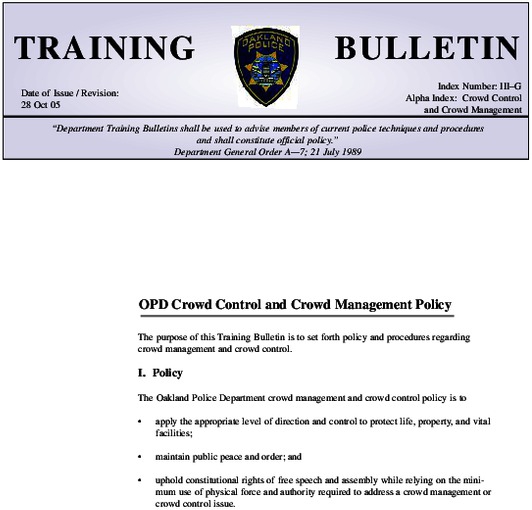
OPD Crowd Control and Crowd Management Policy The purpose of this Training Bulletin is to set forth policy and procedures regarding crowd management and crowd control. I. Policy The Oakland Police Department crowd management and crowd control policy is to • apply the appropriate level of direction and control to protect life, property, and vital facilities; • maintain public peace and order; and • uphold constitutional rights of free speech and assembly while relying on the minimum use of physical force and authority required to address a crowd management or crowd control issue. |