







 Publish to Newswire
 Add an Event
From the Open-Publishing Calendar
From the Open-Publishing Newswire
Indybay Feature
SFLC Labor Supported Prop C Attacks Low Paid City Workers-SF Billionaires&Union Tops
What Jeff Adachi and Interim Mayor Ed Lee Aren’t Telling Voters:
San Francisco Pension Reform Protects Top Earners,
Punishes Over Half of City Employees!
StraightFacts from Employees and Fixed-Income Retirees Whom Adachi, the Mayor,
Their Billionaire Backers, and the San Francisco Labor Council Refused to Meet With
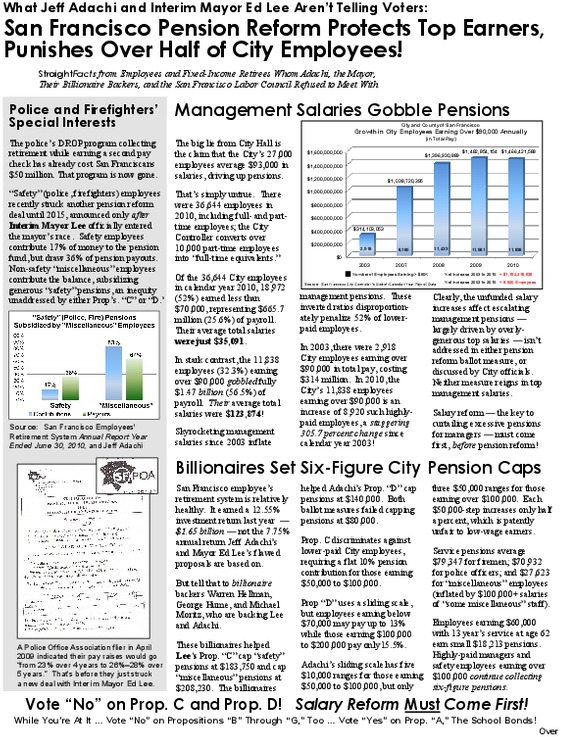
Management Salaries Gobble Pensions
Billionaires Set Six-Figure City Pension Caps
San Francisco Pension Reform Protects Top Earners,
Punishes Over Half of City Employees!
StraightFacts from Employees and Fixed-Income Retirees Whom Adachi, the Mayor,
Their Billionaire Backers, and the San Francisco Labor Council Refused to Meet With
Management Salaries Gobble Pensions
Billionaires Set Six-Figure City Pension Caps

What Jeff Adachi and Interim Mayor Ed Lee Aren’t Telling Voters:
San Francisco Pension Reform Protects Top Earners,
Punishes Over Half of City Employees!
StraightFacts from Employees and Fixed-Income Retirees Whom Adachi, the Mayor,
Their Billionaire Backers, and the San Francisco Labor Council Refused to Meet With
Management Salaries Gobble Pensions
Billionaires Set Six-Figure City Pension Caps
Vote “No” on Prop. C and Prop. D! Salary Reform Must Come First!
The big lie from City Hall is
the claim that the City’s 27,000
employees average $93,000 in
salaries, driving up pensions.
That’s simply untrue. There
were 36,644 employees in
2010, including full- and part-
time employees; the City
Controller converts over
10,000 part-time employees
into “full-time equivalents.”
Of the 36,644 City employees
in calendar year 2010, 18,972
(52%) earned less than
$70,000, representing $665.7
million (25.6%) of payroll.
Their average total salaries
were just $35,091.
In stark contrast, the 11,838
employees (32.3%) earning
over $90,000 gobbled fully
$1.47 billion (56.5%) of
payroll. Their average total
salaries were $123,874!
Skyrocketing management
salaries since 2003 inflate
management pensions. These
inverted ratios disproportion-
ately penalize 52% of lower-
paid employees.
In 2003, there were 2,918
City employees earning over
$90,000 in total pay, costing
$314 million. In 2010, the
City’s 11,838 employees
earning over $90,000 is an
increase of 8,920 such highly-
paid employees, a staggering
305.7 percent change since
calendar year 2003!
Clearly, the unfunded salary
increases affect escalating
management pensions —
largely driven by overly-
generous top salaries — isn’t
addressed in either pension
reform ballot measure, or
discussed by City officials.
Neither measure reigns in top
management salaries.
Salary reform — the key to
curtailing excessive pensions
for managers — must come
first, before pension reform!
San Francisco employee’s
retirement system is relatively
healthy. It earned a 12.55%
investment return last year —
$1.65 billion — not the 7.75%
annual return Jeff Adachi’s
and Mayor Ed Lee’s flawed
proposals are based on.
But tell that to billionaire
backers Warren Hellman,
George Hume, and Michael
Moritz, who are backing Lee
and Adachi.
These billionaires helped
Lee’s Prop. “C” cap “safety”
pensions at $183,750 and cap
“miscellaneous” pensions at
$208,230. The billionaires
helped Adachi’s Prop. “D” cap
pensions at $140,000. Both
ballot measures failed capping
pensions at $80,000.
Prop. C discriminates against
lower-paid City employees,
requiring a flat 10% pension
contribution for those earning
$50,000 to $100,000.
Prop “D” uses a sliding scale,
but employees earning below
$70,000 may pay up to 13%
while those earning $100,000
to $200,000 pay only15.5%.
Adachi’s sliding scale has five
$10,000 ranges for those earning
$50,000 to $100,000, but only
three $50,000 ranges for those
earning over $100,000. Each
$50,000-step increases only half
a percent, which is patently
unfair to low-wage earners.
Service pensions average
$79,347 for firemen; $70,932
for police officers; and $27,623
for “miscellaneous” employees
(inflated by $100,000+ salaries
of “some miscellaneous” staff).
Employees earning $60,000
with 13 year’s service at age 62
earn small $18,213 pensions.
Highly-paid managers and
safety employees earning over
$100,000 continue collecting
six-figure pensions.
Police and Firefighters’
Special Interests
The police’s DROP program collecting
retirement while earning a second pay
check has already cost San Franciscans
$50 million. That program is now gone.
“Safety” (police, firefighters) employees
recently struck another pension reform
deal until 2015, announced only after
Interim Mayor Lee officially entered
the mayor’s race. Safety employees
contribute 17% of money to the pension
fund, but draw 36% of pension payouts.
Non-safety “miscellaneous” employees
contribute the balance, subsidizing
generous “safety” pensions, an inequity
unaddressed by either Prop’s. “C” or “D.”
A Police Office Association flier in April
2009 indicated their pay raises would go
“from 23% over 4 years to 26%–28% over
5 years.” That’s before they just struck
a new deal with Interim Mayor Ed Lee.
Source: San Francisco Employees'
Retirement System Annual Report Year
Ended June 30, 2010, and Jeff Adachi
While You’re At It … Vote “No” on Propositions “B” Through “G,” Too … Vote “Yes” on Prop. “A,” The School Bonds!
Over
$0
$200,000,000
$400,000,000
$600,000,000
$800,000,000
$1,000,000,000
$1,200,000,000
$1,400,000,000
$1,600,000,000
2003 2007 2008 2009 2010
$314,103,053
$1,038,720,395
$1,396,930,889 $1,482,854,154 $1,466,421,588
City and County of San Francisco
Growth in City Employees Earning Over $90,000 Annually
(in Total Pay)
8,180 11,433 11,981
2,918
Number of Employees Earning > $90K
Source: San Francisco City Controller 's End-of-Calendar-Year Payroll Data
Net Increase 2003 to 2010: + $1,152,318,535
11,838
Net Increase 2003 to 2010: + 8,920 Empoyees
StraightFacts: What Jeff Adachi and Interim Mayor Ed Lee Aren’t Telling Voters
Prop. C Targets Health Service Board Membership
Scapegoating
Public Employees
Public employees didn’t cause the
national economic recession, and
shouldn’t be scapegoated for it,
here or nationally.
But the San Francisco Weekly just
published an article by reporter Joe
Eskenazi on August 31, in which he
claims the defeat of Jeff Adachi’s
pension reform measure “Prop. B”
in November 2010 led to a “direct
result” that Moody’s lowered the
City’s credit rating from Aa1 to
Aa2. Eskenazi blames the credit
rating downgrade only on defeat of
Prop. B, which is patently untrue!
By omission, Eskenazi doesn’t tell
the full story since Moody’s cited
numerous reasons, including in its
report that the credit downgrade:
• “Primarily reflected” the City’s
very narrow financial position.
• Occurred just before the City
sought to peddle $80 million in
new general obligation bonds, on
top of $2.6 billion in outstanding
general obligation.
• Involved “extraordinarily thin”
cash reserves, due in part to the
$1.3 billion in outstanding
principal and interest on another
long-term debt financing scheme
known as “Certificates of
Participation,” which spending
voters have no say over since it
requires just a stroke of the Board
of Supervisors pens to enact.
• Was due in part on the City’s
reliance on one-time solutions,
including draws on reserves to
close structural budget gaps.
• Was due to defeat of revenue
measures in 2010 that might have
helped stabilize the City’s budget
projections, and passage of the
volatile and unpredictable real
estate transfer tax.
Then there’s the $1.47 billion in
skyrocketing salaries noted on the
front of this flier. This represents
$5.4 billion between salaries and
long-term debt that City employees
didn’t create — that neither
Prop. “C” nor Prop. “D” addresses.
The City’s lowest-paid employees
shouldn’t be scapegoated for the
Moody’s credit rating downgrade.
Prop.’s “C” and “D” Punish Those Who Can Least Afford It
Vote “No” on Prop. C and Prop. D! For That Matter, Vote “No” on “B” Through “G”
In November 2004, San
Francisco voters approved a
City Charter change to
transfer the Health Service
Board (HSB) from the City’s
Human Resources Department
to a new City department —
the Health Services System.
Voters authorized changing
HSB’s membership in 2004,
converting the City Attorney
appointee into a fourth seat
elected by current employees
and retirees.
Millions in health benefit
funds “went missing” prior to
2004 when the HSB operated
under the four-member City
“management” majority.
The 2004 measure was put on
the ballot by then Board of
Supervisors Chris Daly, Tom
Ammiano, Fiona Ma, Bevan
Dufty, Jake McGoldrick, Matt
Gonzalez, Michela Alioto-
Pier, Tony Hall, and Gerardo
Sandoval.
The HSB selects medical and
dental plans for current City
employees and retirees, and the
amounts employees and retirees
pay for the health plans.
Supervisor Elsbernd helped
introduce into Mayor Lee’s
“consensus” pension reform
measure two poison pills.
The first poison is a provision
specifying if Prop. “C” gets the
most votes, it will make null
and void the entirety of Public
Defender Jeff Adachi’s pension
measure “D,” including sliding-
scale pension payment increases.
Elsbernd also talked Mayor Lee
into adding Prop. C’s second
poison: A Charter change to
convert the fourth elected HSB
member with a City Controller
appointee. Elsbernd wants the
City to get its hands on (to raid ?)
$65 million in the healthcare trust
fund’s assets, assets that belong to
plan members not to the City.
Help maintain fairness of HSB’s
membership: Vote “No” on “C”!
The San Francisco Labor
Council joined forces with
San Francisco’s Chamber of
Commerce, calling Prop. C a
“spirit of shared sacrifice,” or
alternatively, the “Fairness
Float,” ironically misnamed
since wholly unfair.
While they urge you to Vote
“Yes,” here’s why you should
“Vote No” on “C” and “D”:
The table below shows fully
half (50%) of the City’s
36,644 employees earned a
$65,000 average salary, or
less. Over one-third (37%)
of City employees average
salaries of less than $45,000.
Similarly, while the City’s
pension system data shows
1,218 retirees (6.1%) earned
pensions more than $100,000:
• 41% (8,143 retirees) earned
pensions less than $25,000.
• 32% (6,369 retirees) earned
pensions less than $20,000.
• 22.5% (4,480 retirees) —
nearly one quarter — earned
pensions less than $15,000.
• Another 30% (5,876 retirees)
earn pensions of between
$25,000 and $50,000.
Current employees may face
paying 16% to 20% of their
wages, plus unknown health care
cost increases, if either “C” or
“D” passes. Fixed-income
retirees will also see their health
care costs soar, and will lose the
supplemental COLA.
Those at the lowest end of City
salaries can least afford a 6%
pension contribution increase,
nor can retirees, who may be
forced into dropping dependent
coverage for minor children or
elderly parents, if either Prop.’s
“C” or “D” passes.
The “shared sacrifice” is a myth.
Top wage earners and top retiree’s
share little sacrifice!
Vote “No” on both measures!
Sources: City Controller’s payroll data year ending December 2010, and Retirement System pension amount data September 2011; extract showing 12 of some 40 unions.
Table 1: Average City Salaries and Pensions, by Union Representing Employees
Supervisor Sean Elsbernd snuck health
benefits changes onto Mayor Ed Lee’s
Prop. C “pension” reform ballot measure.
Labor Donated
Union Representing
# Current
Employees Average
Salary # of
Retirees Average
Pension
MEA - Police Department Chiefs 7 $ 271,408 12 $ 165,269
MEA - Fire Department Chiefs 9 $ 261,623 36 $ 148,008
Firefighters 1,464 $ 135,986 1,028 $ 79,347
Police Officers Association 2,359 $ 126,502 1,367 $ 70,932
Municipal Attorney's Association 454 $ 140,481 115 $ 68,306
Teamsters, Local 856 Supervising Nurses 129 $ 144,554 166 $ 60,341
TWU 200, SEAM (Transit Managers and Supervisors) 281 $ 110,929 273 $ 59,327
Municipal Executive Association 1,065 $ 120,417 464 $ 56,430
Local 21, Professional & Technical Engineers 3,976 $ 82,824 1,467 $ 41,849
SEIU Local 1021 Staff & Per Diem Nurses 2,929 $ 70,024 812 $ 39,453
TWU 250-A, 9163 Transit Operators 2,256 $ 65,649 1,352 $ 34,062
SEIU Local 1021, Miscellaneous 13,392 $ 45,710 6,289 $ 24,098
Photo Of Billionaire Warren Hellman-SF Union Officials Following lead of union buster
San Francisco Pension Reform Protects Top Earners,
Punishes Over Half of City Employees!
StraightFacts from Employees and Fixed-Income Retirees Whom Adachi, the Mayor,
Their Billionaire Backers, and the San Francisco Labor Council Refused to Meet With
Management Salaries Gobble Pensions
Billionaires Set Six-Figure City Pension Caps
Vote “No” on Prop. C and Prop. D! Salary Reform Must Come First!
The big lie from City Hall is
the claim that the City’s 27,000
employees average $93,000 in
salaries, driving up pensions.
That’s simply untrue. There
were 36,644 employees in
2010, including full- and part-
time employees; the City
Controller converts over
10,000 part-time employees
into “full-time equivalents.”
Of the 36,644 City employees
in calendar year 2010, 18,972
(52%) earned less than
$70,000, representing $665.7
million (25.6%) of payroll.
Their average total salaries
were just $35,091.
In stark contrast, the 11,838
employees (32.3%) earning
over $90,000 gobbled fully
$1.47 billion (56.5%) of
payroll. Their average total
salaries were $123,874!
Skyrocketing management
salaries since 2003 inflate
management pensions. These
inverted ratios disproportion-
ately penalize 52% of lower-
paid employees.
In 2003, there were 2,918
City employees earning over
$90,000 in total pay, costing
$314 million. In 2010, the
City’s 11,838 employees
earning over $90,000 is an
increase of 8,920 such highly-
paid employees, a staggering
305.7 percent change since
calendar year 2003!
Clearly, the unfunded salary
increases affect escalating
management pensions —
largely driven by overly-
generous top salaries — isn’t
addressed in either pension
reform ballot measure, or
discussed by City officials.
Neither measure reigns in top
management salaries.
Salary reform — the key to
curtailing excessive pensions
for managers — must come
first, before pension reform!
San Francisco employee’s
retirement system is relatively
healthy. It earned a 12.55%
investment return last year —
$1.65 billion — not the 7.75%
annual return Jeff Adachi’s
and Mayor Ed Lee’s flawed
proposals are based on.
But tell that to billionaire
backers Warren Hellman,
George Hume, and Michael
Moritz, who are backing Lee
and Adachi.
These billionaires helped
Lee’s Prop. “C” cap “safety”
pensions at $183,750 and cap
“miscellaneous” pensions at
$208,230. The billionaires
helped Adachi’s Prop. “D” cap
pensions at $140,000. Both
ballot measures failed capping
pensions at $80,000.
Prop. C discriminates against
lower-paid City employees,
requiring a flat 10% pension
contribution for those earning
$50,000 to $100,000.
Prop “D” uses a sliding scale,
but employees earning below
$70,000 may pay up to 13%
while those earning $100,000
to $200,000 pay only15.5%.
Adachi’s sliding scale has five
$10,000 ranges for those earning
$50,000 to $100,000, but only
three $50,000 ranges for those
earning over $100,000. Each
$50,000-step increases only half
a percent, which is patently
unfair to low-wage earners.
Service pensions average
$79,347 for firemen; $70,932
for police officers; and $27,623
for “miscellaneous” employees
(inflated by $100,000+ salaries
of “some miscellaneous” staff).
Employees earning $60,000
with 13 year’s service at age 62
earn small $18,213 pensions.
Highly-paid managers and
safety employees earning over
$100,000 continue collecting
six-figure pensions.
Police and Firefighters’
Special Interests
The police’s DROP program collecting
retirement while earning a second pay
check has already cost San Franciscans
$50 million. That program is now gone.
“Safety” (police, firefighters) employees
recently struck another pension reform
deal until 2015, announced only after
Interim Mayor Lee officially entered
the mayor’s race. Safety employees
contribute 17% of money to the pension
fund, but draw 36% of pension payouts.
Non-safety “miscellaneous” employees
contribute the balance, subsidizing
generous “safety” pensions, an inequity
unaddressed by either Prop’s. “C” or “D.”
A Police Office Association flier in April
2009 indicated their pay raises would go
“from 23% over 4 years to 26%–28% over
5 years.” That’s before they just struck
a new deal with Interim Mayor Ed Lee.
Source: San Francisco Employees'
Retirement System Annual Report Year
Ended June 30, 2010, and Jeff Adachi
While You’re At It … Vote “No” on Propositions “B” Through “G,” Too … Vote “Yes” on Prop. “A,” The School Bonds!
Over
$0
$200,000,000
$400,000,000
$600,000,000
$800,000,000
$1,000,000,000
$1,200,000,000
$1,400,000,000
$1,600,000,000
2003 2007 2008 2009 2010
$314,103,053
$1,038,720,395
$1,396,930,889 $1,482,854,154 $1,466,421,588
City and County of San Francisco
Growth in City Employees Earning Over $90,000 Annually
(in Total Pay)
8,180 11,433 11,981
2,918
Number of Employees Earning > $90K
Source: San Francisco City Controller 's End-of-Calendar-Year Payroll Data
Net Increase 2003 to 2010: + $1,152,318,535
11,838
Net Increase 2003 to 2010: + 8,920 Empoyees
StraightFacts: What Jeff Adachi and Interim Mayor Ed Lee Aren’t Telling Voters
Prop. C Targets Health Service Board Membership
Scapegoating
Public Employees
Public employees didn’t cause the
national economic recession, and
shouldn’t be scapegoated for it,
here or nationally.
But the San Francisco Weekly just
published an article by reporter Joe
Eskenazi on August 31, in which he
claims the defeat of Jeff Adachi’s
pension reform measure “Prop. B”
in November 2010 led to a “direct
result” that Moody’s lowered the
City’s credit rating from Aa1 to
Aa2. Eskenazi blames the credit
rating downgrade only on defeat of
Prop. B, which is patently untrue!
By omission, Eskenazi doesn’t tell
the full story since Moody’s cited
numerous reasons, including in its
report that the credit downgrade:
• “Primarily reflected” the City’s
very narrow financial position.
• Occurred just before the City
sought to peddle $80 million in
new general obligation bonds, on
top of $2.6 billion in outstanding
general obligation.
• Involved “extraordinarily thin”
cash reserves, due in part to the
$1.3 billion in outstanding
principal and interest on another
long-term debt financing scheme
known as “Certificates of
Participation,” which spending
voters have no say over since it
requires just a stroke of the Board
of Supervisors pens to enact.
• Was due in part on the City’s
reliance on one-time solutions,
including draws on reserves to
close structural budget gaps.
• Was due to defeat of revenue
measures in 2010 that might have
helped stabilize the City’s budget
projections, and passage of the
volatile and unpredictable real
estate transfer tax.
Then there’s the $1.47 billion in
skyrocketing salaries noted on the
front of this flier. This represents
$5.4 billion between salaries and
long-term debt that City employees
didn’t create — that neither
Prop. “C” nor Prop. “D” addresses.
The City’s lowest-paid employees
shouldn’t be scapegoated for the
Moody’s credit rating downgrade.
Prop.’s “C” and “D” Punish Those Who Can Least Afford It
Vote “No” on Prop. C and Prop. D! For That Matter, Vote “No” on “B” Through “G”
In November 2004, San
Francisco voters approved a
City Charter change to
transfer the Health Service
Board (HSB) from the City’s
Human Resources Department
to a new City department —
the Health Services System.
Voters authorized changing
HSB’s membership in 2004,
converting the City Attorney
appointee into a fourth seat
elected by current employees
and retirees.
Millions in health benefit
funds “went missing” prior to
2004 when the HSB operated
under the four-member City
“management” majority.
The 2004 measure was put on
the ballot by then Board of
Supervisors Chris Daly, Tom
Ammiano, Fiona Ma, Bevan
Dufty, Jake McGoldrick, Matt
Gonzalez, Michela Alioto-
Pier, Tony Hall, and Gerardo
Sandoval.
The HSB selects medical and
dental plans for current City
employees and retirees, and the
amounts employees and retirees
pay for the health plans.
Supervisor Elsbernd helped
introduce into Mayor Lee’s
“consensus” pension reform
measure two poison pills.
The first poison is a provision
specifying if Prop. “C” gets the
most votes, it will make null
and void the entirety of Public
Defender Jeff Adachi’s pension
measure “D,” including sliding-
scale pension payment increases.
Elsbernd also talked Mayor Lee
into adding Prop. C’s second
poison: A Charter change to
convert the fourth elected HSB
member with a City Controller
appointee. Elsbernd wants the
City to get its hands on (to raid ?)
$65 million in the healthcare trust
fund’s assets, assets that belong to
plan members not to the City.
Help maintain fairness of HSB’s
membership: Vote “No” on “C”!
The San Francisco Labor
Council joined forces with
San Francisco’s Chamber of
Commerce, calling Prop. C a
“spirit of shared sacrifice,” or
alternatively, the “Fairness
Float,” ironically misnamed
since wholly unfair.
While they urge you to Vote
“Yes,” here’s why you should
“Vote No” on “C” and “D”:
The table below shows fully
half (50%) of the City’s
36,644 employees earned a
$65,000 average salary, or
less. Over one-third (37%)
of City employees average
salaries of less than $45,000.
Similarly, while the City’s
pension system data shows
1,218 retirees (6.1%) earned
pensions more than $100,000:
• 41% (8,143 retirees) earned
pensions less than $25,000.
• 32% (6,369 retirees) earned
pensions less than $20,000.
• 22.5% (4,480 retirees) —
nearly one quarter — earned
pensions less than $15,000.
• Another 30% (5,876 retirees)
earn pensions of between
$25,000 and $50,000.
Current employees may face
paying 16% to 20% of their
wages, plus unknown health care
cost increases, if either “C” or
“D” passes. Fixed-income
retirees will also see their health
care costs soar, and will lose the
supplemental COLA.
Those at the lowest end of City
salaries can least afford a 6%
pension contribution increase,
nor can retirees, who may be
forced into dropping dependent
coverage for minor children or
elderly parents, if either Prop.’s
“C” or “D” passes.
The “shared sacrifice” is a myth.
Top wage earners and top retiree’s
share little sacrifice!
Vote “No” on both measures!
Sources: City Controller’s payroll data year ending December 2010, and Retirement System pension amount data September 2011; extract showing 12 of some 40 unions.
Table 1: Average City Salaries and Pensions, by Union Representing Employees
Supervisor Sean Elsbernd snuck health
benefits changes onto Mayor Ed Lee’s
Prop. C “pension” reform ballot measure.
Labor Donated
Union Representing
# Current
Employees Average
Salary # of
Retirees Average
Pension
MEA - Police Department Chiefs 7 $ 271,408 12 $ 165,269
MEA - Fire Department Chiefs 9 $ 261,623 36 $ 148,008
Firefighters 1,464 $ 135,986 1,028 $ 79,347
Police Officers Association 2,359 $ 126,502 1,367 $ 70,932
Municipal Attorney's Association 454 $ 140,481 115 $ 68,306
Teamsters, Local 856 Supervising Nurses 129 $ 144,554 166 $ 60,341
TWU 200, SEAM (Transit Managers and Supervisors) 281 $ 110,929 273 $ 59,327
Municipal Executive Association 1,065 $ 120,417 464 $ 56,430
Local 21, Professional & Technical Engineers 3,976 $ 82,824 1,467 $ 41,849
SEIU Local 1021 Staff & Per Diem Nurses 2,929 $ 70,024 812 $ 39,453
TWU 250-A, 9163 Transit Operators 2,256 $ 65,649 1,352 $ 34,062
SEIU Local 1021, Miscellaneous 13,392 $ 45,710 6,289 $ 24,098
Photo Of Billionaire Warren Hellman-SF Union Officials Following lead of union buster
Add Your Comments
We are 100% volunteer and depend on your participation to sustain our efforts!
Donate

$110.00 donated
in the past month
Get Involved
If you'd like to help with maintaining or developing the website, contact us.
Publish
Publish your stories and upcoming events on Indybay.
Topics
More
Search Indybay's Archives
Advanced Search
►
▼
IMC Network