







 Publish to Newswire
 Add an Event
From the Open-Publishing Calendar
From the Open-Publishing Newswire
Indybay Feature
SF Activists Protest Hebron closures
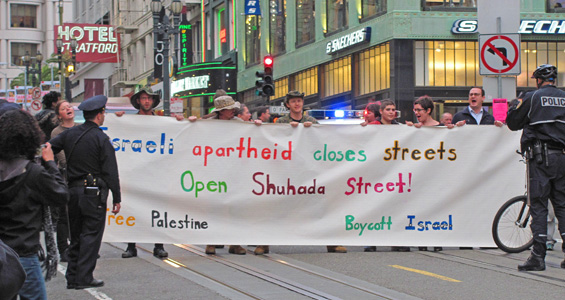
On a normal Thursday evening, a group of protesters transformed San Francisco's busiest shopping district into a scene which reflected the realities of Palestinian life in Hebron in the West Bank.
We closed a major street running through the financial heart of our
city, to call attention to Israeli road closures and restrictions of
movement that are imposed every day on Palestinians in Hebron.
The blocking of major thoroughfares in the city culminated in nine
arrests, after protesters holding a banner that read "Israeli
Apartheid closes streets" closed off Powell Street and refused police
orders to disperse, while a crowd of hundreds looked on chanting and
cheering.
The People of Colour Action Theatre group re-enacted apartheid
separation under Israeli occupation, and disrupted business in front
of flagship stores which profit from the Israeli occupation.
Handing out Palestinian and Israeli "identification documents", actors
playing Israeli soldiers in uniform forced "Palestinians" and
"Israelis" to walk on separate sides of the barrier; often roughing up
and harassing those playing Palestinians.
Unsuspecting passers-by were incorporated into the theatre performance
and forced to walk on one side or the other.
Business as usual
"Most protests are about disrupting business as usual. We want to show
that this IS business as usual for Palestinians in Israel," said Toby
Kramer of the International Jewish Anti-Zionist Network who was later
arrested by San Francisco police.
"Shuhada Street [in Hebron] is just one example of the larger Israeli
apartheid system that US tax dollars finance. We hope to bring
awareness about Palestinian daily life to Union Square shoppers."
The San Francisco direct action was organised by a diverse group of
Bay Area activists including Dialogues Against Militarism, People of
Colour Action Theater, International Jewish Anti-Zionist Network, Iraq
Veterans Against the War, the Catalyst Project and War Resisters
League. Participants came from a wide range of affiliations, including
members of Students for Justice in Palestine, Bay Area Campaign to End
Israeli Apartheid, and members of various anti-war and racial and
economic justice organizations.
This was one of 25 actions around the world, from Cape Town to Berlin
to Sydney to New York, on this international day of action to Open
Shuhada Street. Open Shuhada Street is a global campaign initiated by
Al-Khalil organizers from Youth Against Settlements, Ta'ayush and
other regional anti-occupation groups.
In Hebron itself, hundreds of Palestinians attempted to march down
Shuhada Street and were met by a heavy military presence that fired
tear gas and stun grenades at the crowd. More than 300 Palestinians
and 30 Israelis also demonstrated at the Ibrahimi Mosque/Tomb of the
Patriarchs, to protest Prime Minister Netanyahu's recent declaration
of this spot as an "Israeli national heritage site."
Palestinian homes and shops
Shuhada Street was once a bustling thoroughfare, filled with
Palestinian homes and shops, running through the center of the West
Bank City of Al-Khalil. Today it has been transformed into a virtual
ghost street, with boarded up storefronts and homes and a heavy
military and settler presence.
Just south of Jerusalem, this West Bank city is home to 170,000
Palestinians. Under Israeli military occupation since 1967, Hebron (or
Al-Khalil as it is known by the Palestinians) has seen a steady influx
of settlers since the 1970s, now numbering 800.
On February 25, 1994, an Israeli settler, Baruch Goldstein, entered
the Palestinian side of Al-Khalil's Ibrahimi mosque and sprayed
machine gun fire at Palestinians in prayer, killing 29. In response to
this massacre, the Israeli government imposed what it called "security
measures" upon the Palestinian residents of Al-Khalil, effectively
shutting down entire Palestinian neighborhoods and city centers.
A curfew for Palestinians was enforced, food markets and hundreds of
businesses were boarded up and closed, and a "system of separation"
was imposed. The city was cordoned off into Palestinian-controlled and
Israeli controlled areas, and matrices of barriers, walls, and razor
wire were built to keep these populations separate. A daily presence
of 1500 soldiers has since been deployed here under the guise of
maintaining security.
Evictions
As a result, most Palestinians living in the areas that have been
declared Israeli have been evicted from their homes, which are now
occupied by settlers and military installations. Everyday life for
Palestinians in Al-Khalil is delineated by military occupation,
control of movement, and settler violence.
Shuhada Street is a striking example of the apartheid policies that
have been built into this city. Walking down the street, one sees
Israeli soldiers on patrol, and on occasion, Palestinians peering out
of windows covered with screens to protect them from rocks thrown by
Israeli settlers. Those Palestinians who stayed are not allowed to
access their homes from Shuhada Street (most of their front doors have
been welded shut), and they are forced to climb over rooftops to get
inside.
We focused on raising awareness of Shuhada Street because it has
become a flashpoint for the systematic denial of Palestinian human
rights under the guise of what Israel calls "security." We brought
this reality home to our city streets because our own US government is
the largest military supporter of Israel, and we urge our peers to
confront the reality of what this support looks like on the ground in
Palestine.
American support
"The US is Israel's primary political and military patron, so it's US
tax dollars buying the weapons used against Palestinians in
Al-Khalil," says Clare Bayard of Dialogues Against Militarism and The
Catalyst Project, one of the organisers of the protest.
Bayard believes that it is this US support which has enabled Israel to
enforce its apartheid policies on the Palestinians.
"As people in the U.S. working to build global justice and real
security for all people, we know these will never be possible for
anyone, especially people in the Arab world who systematically have
these rights denied, with the continued expansion of so-called War on
Terror, and Israeli militarism and occupation."
"Here we're organising against U. S. militarism at home and abroad,
which means we have to act in solidarity with Palestinian movements
for justice, who have long led global movements against imperialism."
"To me, as a person who resides in the United States, it is my
responsibility to speak-out against the many levels of violence
perpetrated by this government I am a citizen under," said Mai Doan of
the People of Color Action Theater. "It is crucial to act here, in San
Francisco, where our local government is financially attacking and
militarizing poor and immigrant neighborhoods, to draw connections
between borders, across borders."
"In an act of international solidarity, we are disrupting the silence
and complicity of the day-to-day to vocalize and make unavoidably
visible the violence of apartheid in Palestine/Israel, and how we as
consumers are responsible, how our cities, peers, and local
governments are all responsible, and together must take collective
action."
written by Sarah Lazare
A slightly shorter version of this article was first published on Al Jazeera at
http://english.aljazeera.net/focus/2010/02/201022682541373685.html
city, to call attention to Israeli road closures and restrictions of
movement that are imposed every day on Palestinians in Hebron.
The blocking of major thoroughfares in the city culminated in nine
arrests, after protesters holding a banner that read "Israeli
Apartheid closes streets" closed off Powell Street and refused police
orders to disperse, while a crowd of hundreds looked on chanting and
cheering.
The People of Colour Action Theatre group re-enacted apartheid
separation under Israeli occupation, and disrupted business in front
of flagship stores which profit from the Israeli occupation.
Handing out Palestinian and Israeli "identification documents", actors
playing Israeli soldiers in uniform forced "Palestinians" and
"Israelis" to walk on separate sides of the barrier; often roughing up
and harassing those playing Palestinians.
Unsuspecting passers-by were incorporated into the theatre performance
and forced to walk on one side or the other.
Business as usual
"Most protests are about disrupting business as usual. We want to show
that this IS business as usual for Palestinians in Israel," said Toby
Kramer of the International Jewish Anti-Zionist Network who was later
arrested by San Francisco police.
"Shuhada Street [in Hebron] is just one example of the larger Israeli
apartheid system that US tax dollars finance. We hope to bring
awareness about Palestinian daily life to Union Square shoppers."
The San Francisco direct action was organised by a diverse group of
Bay Area activists including Dialogues Against Militarism, People of
Colour Action Theater, International Jewish Anti-Zionist Network, Iraq
Veterans Against the War, the Catalyst Project and War Resisters
League. Participants came from a wide range of affiliations, including
members of Students for Justice in Palestine, Bay Area Campaign to End
Israeli Apartheid, and members of various anti-war and racial and
economic justice organizations.
This was one of 25 actions around the world, from Cape Town to Berlin
to Sydney to New York, on this international day of action to Open
Shuhada Street. Open Shuhada Street is a global campaign initiated by
Al-Khalil organizers from Youth Against Settlements, Ta'ayush and
other regional anti-occupation groups.
In Hebron itself, hundreds of Palestinians attempted to march down
Shuhada Street and were met by a heavy military presence that fired
tear gas and stun grenades at the crowd. More than 300 Palestinians
and 30 Israelis also demonstrated at the Ibrahimi Mosque/Tomb of the
Patriarchs, to protest Prime Minister Netanyahu's recent declaration
of this spot as an "Israeli national heritage site."
Palestinian homes and shops
Shuhada Street was once a bustling thoroughfare, filled with
Palestinian homes and shops, running through the center of the West
Bank City of Al-Khalil. Today it has been transformed into a virtual
ghost street, with boarded up storefronts and homes and a heavy
military and settler presence.
Just south of Jerusalem, this West Bank city is home to 170,000
Palestinians. Under Israeli military occupation since 1967, Hebron (or
Al-Khalil as it is known by the Palestinians) has seen a steady influx
of settlers since the 1970s, now numbering 800.
On February 25, 1994, an Israeli settler, Baruch Goldstein, entered
the Palestinian side of Al-Khalil's Ibrahimi mosque and sprayed
machine gun fire at Palestinians in prayer, killing 29. In response to
this massacre, the Israeli government imposed what it called "security
measures" upon the Palestinian residents of Al-Khalil, effectively
shutting down entire Palestinian neighborhoods and city centers.
A curfew for Palestinians was enforced, food markets and hundreds of
businesses were boarded up and closed, and a "system of separation"
was imposed. The city was cordoned off into Palestinian-controlled and
Israeli controlled areas, and matrices of barriers, walls, and razor
wire were built to keep these populations separate. A daily presence
of 1500 soldiers has since been deployed here under the guise of
maintaining security.
Evictions
As a result, most Palestinians living in the areas that have been
declared Israeli have been evicted from their homes, which are now
occupied by settlers and military installations. Everyday life for
Palestinians in Al-Khalil is delineated by military occupation,
control of movement, and settler violence.
Shuhada Street is a striking example of the apartheid policies that
have been built into this city. Walking down the street, one sees
Israeli soldiers on patrol, and on occasion, Palestinians peering out
of windows covered with screens to protect them from rocks thrown by
Israeli settlers. Those Palestinians who stayed are not allowed to
access their homes from Shuhada Street (most of their front doors have
been welded shut), and they are forced to climb over rooftops to get
inside.
We focused on raising awareness of Shuhada Street because it has
become a flashpoint for the systematic denial of Palestinian human
rights under the guise of what Israel calls "security." We brought
this reality home to our city streets because our own US government is
the largest military supporter of Israel, and we urge our peers to
confront the reality of what this support looks like on the ground in
Palestine.
American support
"The US is Israel's primary political and military patron, so it's US
tax dollars buying the weapons used against Palestinians in
Al-Khalil," says Clare Bayard of Dialogues Against Militarism and The
Catalyst Project, one of the organisers of the protest.
Bayard believes that it is this US support which has enabled Israel to
enforce its apartheid policies on the Palestinians.
"As people in the U.S. working to build global justice and real
security for all people, we know these will never be possible for
anyone, especially people in the Arab world who systematically have
these rights denied, with the continued expansion of so-called War on
Terror, and Israeli militarism and occupation."
"Here we're organising against U. S. militarism at home and abroad,
which means we have to act in solidarity with Palestinian movements
for justice, who have long led global movements against imperialism."
"To me, as a person who resides in the United States, it is my
responsibility to speak-out against the many levels of violence
perpetrated by this government I am a citizen under," said Mai Doan of
the People of Color Action Theater. "It is crucial to act here, in San
Francisco, where our local government is financially attacking and
militarizing poor and immigrant neighborhoods, to draw connections
between borders, across borders."
"In an act of international solidarity, we are disrupting the silence
and complicity of the day-to-day to vocalize and make unavoidably
visible the violence of apartheid in Palestine/Israel, and how we as
consumers are responsible, how our cities, peers, and local
governments are all responsible, and together must take collective
action."
written by Sarah Lazare
A slightly shorter version of this article was first published on Al Jazeera at
http://english.aljazeera.net/focus/2010/02/201022682541373685.html

Add Your Comments
Latest Comments
Listed below are the latest comments about this post.
These comments are submitted anonymously by website visitors.
TITLE
AUTHOR
DATE
A Smoooooth Event
Fri, Feb 26, 2010 7:38PM
We are 100% volunteer and depend on your participation to sustain our efforts!
Donate

$155.00 donated
in the past month
Get Involved
If you'd like to help with maintaining or developing the website, contact us.
Publish
Publish your stories and upcoming events on Indybay.
Topics
More
Search Indybay's Archives
Advanced Search
►
▼
IMC Network