







 Publish to Newswire
 Add an Event
From the Open-Publishing Calendar
From the Open-Publishing Newswire
Indybay Feature
California
Central Valley
North Bay / Marin
North Coast
Santa Cruz Indymedia
U.S.
Environment & Forest Defense
Steve Evans: Post '08 Election Forecast for California Rivers
This is an excellent, balanced analysis of what the 2008 election will mean for California rivers by Steve Evans, conservation director of Friends of the River.
"The expected focus of the Obama Administration on energy and global warming is hugely positive given the previous administration’s position of denial," said Evans. "But President-Elect Obama’s views on some key issues do raise a few red flags in regard to rivers, including his strong support for water-consumptive ethanol as an alternative fuel, as well as on renewable energy (which could possibly include river-damaging hydroelectric energy produced by big dams). River champions should take every opportunity to educate the new administration on common sense enviromental solutions, before firm positions are made."
I would add that the environmental challengers of the incoming presidential administration and Congress include the unprecedented collapse of Central Valley fall chinook salmon, Delta smelt, longfin smelt, threadfin shad, striped bass and other California Delta fish populations. These dramatic population declines were spurred by record water exports by the state and federal Delta pumps, declining water quality and other factors. Will the new administration and Congress step up and begin the hard work to restore the fisheries - or will they side with Governor Arnold Schwarzegger and corporate agribusiness and allow these populations to descend into the abyss of extinction?
For more information, go to http://www.friendsoftheriver.org/site/PageServer?pagename=Post2008Election
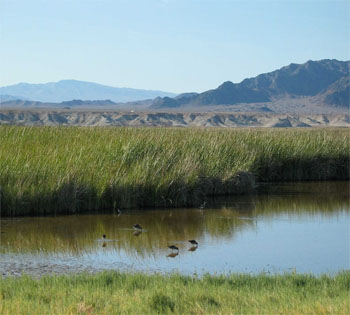
Photo: This picture is of the Amargosa River, now being considered for Wild & Scenic designation and protection through the Eastern Sierra Heritage Act.
"The expected focus of the Obama Administration on energy and global warming is hugely positive given the previous administration’s position of denial," said Evans. "But President-Elect Obama’s views on some key issues do raise a few red flags in regard to rivers, including his strong support for water-consumptive ethanol as an alternative fuel, as well as on renewable energy (which could possibly include river-damaging hydroelectric energy produced by big dams). River champions should take every opportunity to educate the new administration on common sense enviromental solutions, before firm positions are made."
I would add that the environmental challengers of the incoming presidential administration and Congress include the unprecedented collapse of Central Valley fall chinook salmon, Delta smelt, longfin smelt, threadfin shad, striped bass and other California Delta fish populations. These dramatic population declines were spurred by record water exports by the state and federal Delta pumps, declining water quality and other factors. Will the new administration and Congress step up and begin the hard work to restore the fisheries - or will they side with Governor Arnold Schwarzegger and corporate agribusiness and allow these populations to descend into the abyss of extinction?
For more information, go to http://www.friendsoftheriver.org/site/PageServer?pagename=Post2008Election
Photo: This picture is of the Amargosa River, now being considered for Wild & Scenic designation and protection through the Eastern Sierra Heritage Act.
Post '08 Election
Forecast for California Rivers
by Steve Evans
With the election of Barack Obama as President, the 2008 General Election produced historic results. But what does it all mean for California rivers? We take a look at the signs and our past experience to try to forecast what may be the opportunites and challenges for California's rivers.
The Obama Administration
Given the disastrous record of the Bush Administration, we have nowhere to go but up - in regard to the environment. It’s reasonable to expect the Obama Administration to discontinue the Bush Administration’s savage attacks on the nation’s environmental laws and regulations. It’s also likely that the new administration will be more involved and concerned about environmental issues opening discussion with environmental advocates. The fact that John Podesta, who was former Chief of Staff for President Bill Clinton, chairs President-Elect Obama’s transition team suggests that some of the best and the brightest of the Clinton Administration may return to fill key environmental posts in Washington DC. In addition, we may get some “out of the box” appointments like Robert Kennedy Jr. for EPA and Al Gore for climate change czar.
The expected focus of the Obama Administration on energy and global warming is hugely positive given the previous administration’s position of denial. But President-Elect Obama’s views on some key issues do raise a few red flags in regard to rivers, including his strong support for water-consumptive ethanol as an alternative fuel, as well as on renewable energy (which could possibly include river-damaging hydroelectric energy produced by big dams). River champions should take every opportunity to educate the new administration on common sense enviromental solutions, before firm positions are made.
Congressional Changes
Stronger majorities for the Democratic Party in both the House of Representatives and the Senate will likely make for easier passage of environmental legislation, including Wild & Scenic protection bills for California rivers. However, it is uncertain whether the Democrats could secure a filibuster-proof majority in the Senate. Re-counts and other issues are still in flux weeks after the election. If a large majority is not reached it will encourage continued cooperation with the minority Republicans. This is particularly important in California, where Republicans represent most of the National Forests, Bureau of Land Management (BLM) lands, and National Parks that are the headwaters for most of the state’s rivers.
All of California’s current and potential river champions in the House, including Mary Bono-Mack, Buck McKeon, Sam Farr, George Miller, Mike Thompson, and others were re-elected. Bono-Mack and McKeon currently have bills before Congress to protect more than 50 miles of Wild & Scenic Rivers and over 650,000 acres of Wilderness that may be considered in a post-election session. Our understanding is that a vote on Wild & Scenic bills may occur in January 2009.
California’s 4th Congressional District
Recently the water rights to the Auburn Dam were revoked! The long fight is not over, but the opposing general is retiring. Controversial Auburn Dam will loose its most active booster when Representative John Doolittle retires at the end of 2008 from representing California’s 4th Congressional District. Not only is the Auburn Dam site in the 4th Congressional District a poster-child for California’s chronic water wars, the district possesses some of the most outstanding rivers in the northern Sierra Nevada, including the Pit, Feather, Yuba, American, and Truckee. Doolittle’s impending exit will clear the stage for a knock-down, drag-out fight between right-wing Republican and Auburn Dam supporter Tom McClintock and moderate Democrat and Auburn Dam opponent Charlie Brown. A few weeks after the election, it’s still too close to call, with McClintock ahead of Brown by only about 700 votes, and with absentee and provisional ballots yet to be counted in many counties. This race may not be decided until early December or later, particularly if a recount is demanded.
California’s 11th Congressional District
A bright spot of the 2006 election was the defeat of the "prince-of-anti-environmentalism" Richard Pombo by Representative Jerry McNerny in California’s Central Valley. Despite a district that leans towards the Republican side. Opportunity has now opened to help California’s beleaguered Sacramento-San Joaquin Delta and its native fish.
California's State Legislature
The three-month stalemate over approval of the state budget this year underscores the vulnerability of the majority Democrats in both the Senate and Assembly to the 2/3rds super-majority voting rules on the budget and emergency legislation. This is problematic when the debate reaches far beyond simple fiscal issues and involves state funding for new river destroying dams as well as severe budget cuts to important environmental programs. Democrats needed two additional seats in the Senate to secure a super-majority in that chamber, but only the 19th Senate District seat remains in play. Former Democratic Assemblymember and strong environmental supporter Hannah Beth Jackson holds a tenuous 108 vote lead over Republican Tony Strickland. It may be weeks before a final winner is declared for the Senate district that encompasses much of Santa Barbara and parts of Ventura and Los Angeles counties. Democrats also needed to secure six new seats in the Assembly to achieve a super-majority, but are likely to win only two or three once all absentee and provisional ballots are counted. So don’t expect a whole lot of change when it comes to the state dealing effectively with its fiscal issues or environmental program funding.
State Bond Measures
Despite California’s looming budget deficit and deeply troubled economy, voters approved nearly $12 billion in general obligation bonds to fund high-speed rail, children’s hospitals, and veterans’ homes and farms. State taxpayers/voters tend to consider general obligation (GO) bonds as “free” money with little though about how voter passage of bonds contributes to the state’s rising debt. On average, for every $1 of GO bonds approved by the voters, we incur $2 in debt. This has dire implications for current and future state budgets, including environmental programs not funded by bonds. In addition, the voters’ approval of increasing the public debt in 2008 sends an undesirable message to Governor Schwarzenegger, who is expected to resurrect his proposal to place a multi-billion water bond that funds river-destroying dams on a 2009 ballot.
Forecast for California Rivers
by Steve Evans
With the election of Barack Obama as President, the 2008 General Election produced historic results. But what does it all mean for California rivers? We take a look at the signs and our past experience to try to forecast what may be the opportunites and challenges for California's rivers.
The Obama Administration
Given the disastrous record of the Bush Administration, we have nowhere to go but up - in regard to the environment. It’s reasonable to expect the Obama Administration to discontinue the Bush Administration’s savage attacks on the nation’s environmental laws and regulations. It’s also likely that the new administration will be more involved and concerned about environmental issues opening discussion with environmental advocates. The fact that John Podesta, who was former Chief of Staff for President Bill Clinton, chairs President-Elect Obama’s transition team suggests that some of the best and the brightest of the Clinton Administration may return to fill key environmental posts in Washington DC. In addition, we may get some “out of the box” appointments like Robert Kennedy Jr. for EPA and Al Gore for climate change czar.
The expected focus of the Obama Administration on energy and global warming is hugely positive given the previous administration’s position of denial. But President-Elect Obama’s views on some key issues do raise a few red flags in regard to rivers, including his strong support for water-consumptive ethanol as an alternative fuel, as well as on renewable energy (which could possibly include river-damaging hydroelectric energy produced by big dams). River champions should take every opportunity to educate the new administration on common sense enviromental solutions, before firm positions are made.
Congressional Changes
Stronger majorities for the Democratic Party in both the House of Representatives and the Senate will likely make for easier passage of environmental legislation, including Wild & Scenic protection bills for California rivers. However, it is uncertain whether the Democrats could secure a filibuster-proof majority in the Senate. Re-counts and other issues are still in flux weeks after the election. If a large majority is not reached it will encourage continued cooperation with the minority Republicans. This is particularly important in California, where Republicans represent most of the National Forests, Bureau of Land Management (BLM) lands, and National Parks that are the headwaters for most of the state’s rivers.
All of California’s current and potential river champions in the House, including Mary Bono-Mack, Buck McKeon, Sam Farr, George Miller, Mike Thompson, and others were re-elected. Bono-Mack and McKeon currently have bills before Congress to protect more than 50 miles of Wild & Scenic Rivers and over 650,000 acres of Wilderness that may be considered in a post-election session. Our understanding is that a vote on Wild & Scenic bills may occur in January 2009.
California’s 4th Congressional District
Recently the water rights to the Auburn Dam were revoked! The long fight is not over, but the opposing general is retiring. Controversial Auburn Dam will loose its most active booster when Representative John Doolittle retires at the end of 2008 from representing California’s 4th Congressional District. Not only is the Auburn Dam site in the 4th Congressional District a poster-child for California’s chronic water wars, the district possesses some of the most outstanding rivers in the northern Sierra Nevada, including the Pit, Feather, Yuba, American, and Truckee. Doolittle’s impending exit will clear the stage for a knock-down, drag-out fight between right-wing Republican and Auburn Dam supporter Tom McClintock and moderate Democrat and Auburn Dam opponent Charlie Brown. A few weeks after the election, it’s still too close to call, with McClintock ahead of Brown by only about 700 votes, and with absentee and provisional ballots yet to be counted in many counties. This race may not be decided until early December or later, particularly if a recount is demanded.
California’s 11th Congressional District
A bright spot of the 2006 election was the defeat of the "prince-of-anti-environmentalism" Richard Pombo by Representative Jerry McNerny in California’s Central Valley. Despite a district that leans towards the Republican side. Opportunity has now opened to help California’s beleaguered Sacramento-San Joaquin Delta and its native fish.
California's State Legislature
The three-month stalemate over approval of the state budget this year underscores the vulnerability of the majority Democrats in both the Senate and Assembly to the 2/3rds super-majority voting rules on the budget and emergency legislation. This is problematic when the debate reaches far beyond simple fiscal issues and involves state funding for new river destroying dams as well as severe budget cuts to important environmental programs. Democrats needed two additional seats in the Senate to secure a super-majority in that chamber, but only the 19th Senate District seat remains in play. Former Democratic Assemblymember and strong environmental supporter Hannah Beth Jackson holds a tenuous 108 vote lead over Republican Tony Strickland. It may be weeks before a final winner is declared for the Senate district that encompasses much of Santa Barbara and parts of Ventura and Los Angeles counties. Democrats also needed to secure six new seats in the Assembly to achieve a super-majority, but are likely to win only two or three once all absentee and provisional ballots are counted. So don’t expect a whole lot of change when it comes to the state dealing effectively with its fiscal issues or environmental program funding.
State Bond Measures
Despite California’s looming budget deficit and deeply troubled economy, voters approved nearly $12 billion in general obligation bonds to fund high-speed rail, children’s hospitals, and veterans’ homes and farms. State taxpayers/voters tend to consider general obligation (GO) bonds as “free” money with little though about how voter passage of bonds contributes to the state’s rising debt. On average, for every $1 of GO bonds approved by the voters, we incur $2 in debt. This has dire implications for current and future state budgets, including environmental programs not funded by bonds. In addition, the voters’ approval of increasing the public debt in 2008 sends an undesirable message to Governor Schwarzenegger, who is expected to resurrect his proposal to place a multi-billion water bond that funds river-destroying dams on a 2009 ballot.
Add Your Comments
We are 100% volunteer and depend on your participation to sustain our efforts!
Donate

$140.00 donated
in the past month
Get Involved
If you'd like to help with maintaining or developing the website, contact us.
Publish
Publish your stories and upcoming events on Indybay.
Topics
More
Search Indybay's Archives
Advanced Search
►
▼
IMC Network