







 Publish to Newswire
 Add an Event
Transportation, Land Use & the Environment: Election Forum 2008 (Berkeley Districts 3 & 4)
The three forums were filmed live at Berkeley Community Media, Channel 33, on Saturday, October 11.
They will be shown repeatedly on BCM Ch. 33 (and simultaneously webcast).
Check http://www.betv.org/
Written Questionnaires and Follow-up
Candidates also submitted written comments on even more questions than were able to be asked in the forums.
Check http://bfbc.org/issues/forum/ for those as well as other summary information and links.
Sponsoring Organizations
Sierra Club
http://sanfranciscobay.sierraclub.org/
The Bicycle Friendly Berkeley Coalition (BFBC)
http://www.bfbc.org/
Walk & Roll Berkeley
Friends of BRT
http://www.friendsofbrt.org/
Livable Berkeley
http://livableberkeley.org/
The Ecology Center
http://www.ecologycenter.org/
The Ella Baker Center for Human Rights
http://www.ellabakercenter.org/
Urban Habitat
http://urbanhabitat.org/
Bay Localize
http://www.baylocalize.org/
The Transportation and Land Use Coalition
http://www.transcoalition.org/
Aquatic Park Egret
http://www.egretpark.org/
Kyoto USA
http://www.kyotousa.org/
Ecocity Builders
http://www.ecocitybuilders.org/
Citizens for a Strawberry Creek Plaza
http://www.strawberrycreekplaza.org/
Questions Asked at this Forum
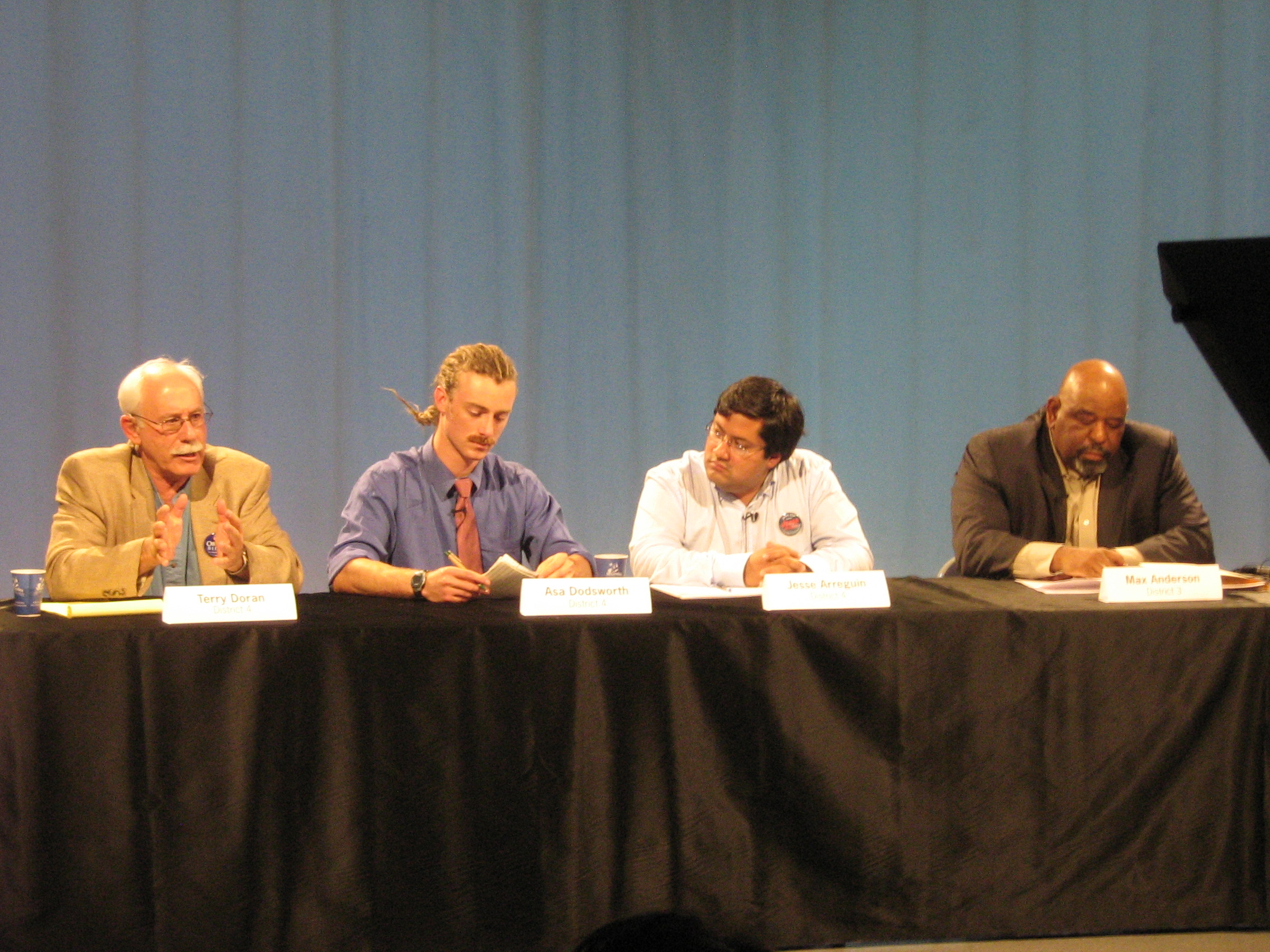
Forum # 2 City Council Districts 3 & 4 2:30 to 3:30 p.m.
Intro by Host Jason Meggs:
Hello I’m Jason Meggs and thank you for tuning in to our 2008 election
forum on Land Use, Transportation and the Environment for Berkeley City
Council candidates from districts 3 and 4. The election is taking
place on November 4 and we hope you will all help get out the vote. Among
the most important issues that city councilmembers have to address are
those related to land use, transportation and the environment. This
is particularly true in the context of global climate change and peak oil, things
that all the sponsors or this forum are very concerned about.
This forum is being sponsored by a variety
of environmental and community groups that are active in Berkeley and
the East Bay. These are the Sierra Club, The Bicycle-Friendly Berkeley
Coalition, Walk & Roll Berkeley, Friends of BRT (Friends of Bus Rapid Transit), Livable Berkeley,
the Ella Baker Center for Human Rights, Urban Habitat, Bay Localize,
the Transportation and Land Use Coalition, Aquatic Park Egret, Kyoto
USA, Ecocity Builders, and Citizens for a Strawberry Creek Plaza.
And now I’d like to turn it over to
our moderator Helen Burke, a former East Bay MUD director, a former
Berkeley Planning Commission chair and an active member of the Sierra
Club. Helen…
Intro by Moderator Helen Burke: Thank you Jason. For this forum, we are pleased to have candidates for the City Council from District 3 and District 4. From District 3, we have Councilmember Max Anderson, who is running unopposed. From District 4, we have, in alphabetical order, Jesse Arreguin, Fred Dodsworth, Terry Doran and N’Dji Jockin. One candidate in District 4, L.A Wood, was not able to attend due to a prior engagement. Members of the various groups that are sponsoring this forum will be asking the two candidates a variety of questions. Each candidate will have equal time to respond to each question; in most cases they will have a minute. With each question, we will start with a different candidate
Candidates, please keep an eye on our timekeeper who will be using flashcards to let you know when your allotted time is up. For 15 seconds remaining, she has a yellow card; and when your time is up, a red card.
Question #1
Moderator: Here to ask our first question is Andy Katz. Andy is an East Bay MUD director and a member of the Sierra Club California Executive Committee. Andy…
Andy Katz: To start off today’s
forum, we would like you to please introduce yourself, tell us briefly
why you are running, and tell us, if you are elected, what your priorities
will be with respect to land use, transportation and addressing global
climate change.
Moderator: For this first question, you will have up to two minutes and we will begin with ________
Question #1 Answers: one minute allowed per candidate
Question #2
Moderator: For our next question, we turn to Tom Kelly of Kyoto USA.
Tom Kelly: Kyoto USA is an all
volunteer, grassroots organization that encourages U.S. cities and their
residents to reduce the global warming greenhouse gas emissions for
which they are responsible. The City has just released the second
draft of its climate action plan. The Plan is the result of Measure
G, approved by Berkeley voters in 2006, which establishes a goal of
reducing Berkeley’s emissions by 80% by the year 2050. What measures
described in the Plan would be your top priority and why?
Helen Burke Moderator: This time
we’ll start with_____; candidates have up to a minute. ______
Question #2 Answers; one minute
allowed per candidate
Question # 3
Moderator: Our next question is from Kirstin Miller of Ecocity Builders.
Kirstin: Several years ago, with support from Ecocity Builders and others, Citizens for a Strawberry Creek Plaza was formed to advocate for creation of a pedestrian plaza on Center Street between Oxford and Shattuck in downtown. To create the plaza, that block of Center Street would be closed to traffic with provision made for deliveries and emergency vehicle access. A hotel and UC museum are planned for the block and both the City’s Hotel Task Force and the Downtown Area Plan Advisory Committee have supported creation of a plaza on that block.
Ecocity Builders has hired renowned local
landscape architect Walter Hood to create a design proposal for the
plaza that would be consistent with the draft Downtown plan and he is
preparing to present his proposed design to the Council later this year.
As Mayor/ As a member of the City Council,
would you support the proposed plaza on Center Street? Would you make
it a priority to find funding and what funding sources do you think
the city could utilize?
Helen Burke, Moderator: we’ll
begin with___ you have up to a minute
Question # 3 Answers: one minute allowed per candidate
Question #4
Helen Burke, Moderator: With transportation responsible for 46% of Berkeley’s greenhouse gas emissions, we will now have a series of questions related to transportation. The first of these will be posed by Andy Katz of the Sierra Club Bay Chapter’s Transportation Committee.
Andy Katz: In 2005, the City staff and the Transportation Commission proposed creation of a new transportation services fee. Many cities in California, including San Francisco, require developers to pay such fees. The required nexus study for the fee was completed by the same consultants who put together Palo Alto’s transportation fee. Developers would be required to pay a fee to cover the costs of dealing with new auto traffic generated by new development. The fee would pay for trip reduction efforts. Since 2005, the proposed fee has been in bureaucratic limbo and has not gone to the City Council for approval. Do you support establishing a transportation services fee?
And what other funding sources do you
think the city could use to support programs aimed at reducing transportation-related
greenhouse gas emissions by encouraging walking, bicycling and transit
use?
Helen Burke, Moderator: we’ll
start this time with_______
Question # 4 Answers: one minute allowed per candidate
Question #5
Moderator: And now we have Wendy
Alfsen of Walk & Roll Berkeley with a question about an innovative
transit subsidy program called Eco Pass. Wendy…
Wendy Alfsen : With Eco Pass,
employers pay transit agencies a relatively modest sum per employee
so that every employee has a bus pass allowing them to ride for free.
In most cases, employers don’t charge employees for the passes. The
City of Berkeley has an Eco Pass program for its employees. Some cities,
including Boulder, Colorado and Ann Arbor, Michigan, have Eco Pass programs
for people who work in their downtowns. This encourages transit use
and reduces employee demand for parking downtown leaving more parking
for customers of local businesses. When Donald Shoup, an acknowledged
parking pricing expert visited Berkeley, he said that Berkeley needed
to raise its parking rates in downtown to free up on-street parking
and suggested that the City should use some of the increased parking
revenue to help fund an Eco-Pass program for downtown business employees.
Do you support establishing a downtown Eco-Pass program to encourage
downtown employees to use transit? Would you support using parking revenues
to cover some of the cost of such a program as Shoup suggested?
Helen Burke Moderator: We’ll
begin with ___________
Question #5 Answers: one minute allowed per candidate
Question #6
Wendy: This
next question is a short answer question about the Pedestrian Plan. Walk & Roll Berkeley has been working for
eight years to increase pedestrian safety and promote walking in Berkeley.
A big priority for us is the Pedestrian Plan. Will you support adoption
and implementation of Berkeley’s Pedestrian Plan? Will you vote to
allocate funds for its implementation at least equal to the City’s
bicycle account?
Helen Burke, Moderator: For short answer questions, you get 30 seconds. This time, it’s _________ turn to start.
Question #6 answers: 30 seconds allowed per candidate
Question # 7
Helen Burke, Moderator: If walking is one mode of getting around, riding a bicycle
is another mode that’s good for the environment and good exercise too.
Our next question will be asked by Sarah Syed of the Bicycle-
Friendly Berkeley Coalition.
Sarah Syed of BFBC: The mission of BFBC is to make Berkeley a more bicycle-friendly city. We want to help make bicycling so safe, convenient,
and pleasant that it becomes a preferred
way of getting around town.
Berkeley was a national leader in 2000
with the adoption of the Bicycle Plan, which detailed a network of bicycle
priority streets. However, throughout this decade, little progress on
the network has been made. Berkeley is falling behind.
Bicycle improvements can be very inexpensive,
yet they do require significant planning and tradeoffs between other
road users. We do not currently have one full time employee (FTE) working
on bicycle issues, when many cities have multiple staff, including bicycle
engineers and planners.
Cities with the highest rates of cycling
have addressed these challenges, restoring miles of streets to non-motorized
use with bold leadership to address environmental and equity goals.
Do you support the City mobilizing to
update and implement the Bicycle Plan and make Berkeley a place where
residents of all ages and abilities find cycling safe, comfortable,
and convenient? How will you react when faced with tough choices
such as should the city prioritize bicycle lanes over auto travel lanes?
Helen Burke, Moderator:
This time we’ll start with___________
Question #7 Answers:
one minute allowed per candidate
Question #8
Helen Burke, Moderator: Besides improving conditions for pedestrians and bicyclists, our sponsoring groups also want to improve transit. Our next question concerns Bus Rapid Transit, or BRT for short, and comes jointly from Joel Ramos of the Transportation and Land Use Coalition and from Len Conly of Friends of BRT.
Joel Ramos: The Transportation and Land Use Coalition, or TALC, is a partnership of 110 groups working for a sustainable and socially just Bay Area. Bus Rapid Transit is part of TALC’s program for a comprehensive and integrated regional transportation plan. As proposed, the Bus Rapid Transit (or BRT) service would start on Shattuck in downtown Berkeley, and run to downtown Oakland via Telegraph Avenue and then on to San Leandro. BRT, with dedicated lanes for buses, would provide more frequent, faster, and more reliable bus service on this heavily-used bus route. City staff have calculated that BRT would make a significant contribution toward the City’s goal of reducing greenhouse gas emissions. AC Transit is awaiting the City’s response to the BRT Draft Environmental Impact Report. They want the City to choose what’s called a “locally preferred alternative” that would spell out how BRT could be implemented in Berkeley. AC would further study the alternative to get a more detailed understanding of its impacts, possible mitigations or plan changes. Opponents want the city to reject dedicated bus lanes altogether with no further analysis. They have put a measure on the ballot, KK, which would require an additional plan and an election before BRT could proceed, which the City Attorney’s impartial analysis of KK states could cost the City as much as $1.2 million. Len Conly of Friends of BRT has our question:
Len Conly: Do you support or oppose Measure KK? If it’s defeated, do you support AC Transit's plan for further study of dedicated lanes for BRT? Should the City move forward with developing a preferred alternative?
Helen Burke, Moderator:
This time we’ll start with___________
Question #8 Answers: one minute allowed per candidate
Question # 9
Helen Burke, Moderator:
our next question, from Alan Tobey of Livable Berkeley, deals with Berkeley’s
largest property owner and employer, the University of California.
Alan Tobey: Livable
Berkeley is a coalition of citizens, environmental leaders, social equity
advocates, design professionals, city planners and progressive builders
that has, since our formation in 2002, been promoting sustainable land
use and transportation choices in Berkeley.
Our question is:
In order to reduce greenhouse
gases, new city policies and actions are needed to help people live
where they work, shop where they live, and reduce travel. How will you
work with the University to reduce single occupant auto travel to the
campus from and through Berkeley neighborhoods?
Moderator: this time
we’ll start with______
Question # 9 Answers:
one minute allowed per candidate
Question #10
Helen Burke, Moderator:
Energy is the subject of this short-answer question by Kirsten Schwind
of Bay Localize.
Kirsten Schwind: Bay Localize is working to build a more self-reliant, sustainable, and socially just Bay Area. We work to catalyze a shift from a globalized, fossil fuel-based economy that enriches a few and weakens most, to a localized green economy that strengthens all Bay Area communities. We seek to build a cooperative, inclusive movement toward regional self-reliance. One step in that direction is Community Choice Energy, whereby a city can become a buyers' coop for electricity and contract for higher levels of renewable power.
Will you support Community
Choice Energy in Berkeley?
Helen Burke, Moderator:
So, candidates, you have 30 seconds. let’s begin with ________
Question #10 Answers: 30 seconds allowed per candidate
Question #11
Helen Burke, Moderator:
Our next question, also a short answer question related to energy was
submitted by the Ella Baker Center for Human Rights.
Helen Burke, Moderator:
The Ella Baker Center is a strategy and action center working for justice,
opportunity and peace in urban America. Based in Oakland, we promote
positive alternatives to violence and incarceration and policies that
create pathways out of poverty into the growing green economy.
Our question is about the innovative
Berkeley FIRST program.Berkeley FIRST will provide much-needed
assistance to property owners by helping them pay the up-front costs
of installing solar energy systems on their homes and businesses. However,
we are concerned that this program does not address the need to reduce
energy consumption and may not sufficiently benefit low-income residents.
Would you support expanding
the program to include energy efficiency retrofits and measures to ensure
access for low-income households?
Helen Burke Moderator: We’ll begin with_____________
Question #11 answers: 30 seconds per candidate
Question # 12
Helen Burke, Moderator: And now we have a question from Martin
Bourke of the Ecology Center, about zero waste:
Martin Bourke: In 2003
the Berkeley City Council passed one of the county's first Zero Waste
Policies setting a goal of 75 percent waste diversion by 2010 and Zero
Waste (or darn close) by 2020. The Zero Waste Commission is creating
a strategic plan that includes the development of new policies
(such as the plastic bags ordinance), programs (such as multi family
and commercial recycling) and key infrastructure focused on the creation
of a world class Zero Waste Enterprise facility. The City Council has
approved a feasibility study to explore funding mechanisms for what
is likely to be the largest infrastructure development project in this
next term. How would you work with city staff to reach our Zero Waste
Goal? What are your priorities for Zero Waste and how will you champion
the investment in infrastructure required to meet our goal?
Helen Burke Moderator: This time we’ll with _________
Question # 12 Answers:
Assume 1 minute per candidate
Question # 13
Helen Burke, Moderator:
And now we have another question from Bay Localize.
Kirsten Schwind: The City of Berkeley is taking pioneering initial steps in planning for the impacts of climate change and peak oil on Berkeley residents. Global impacts we are already seeing include more expensive energy and increasingly unpredictable weather, which contribute to rising food prices. These are expected to be long-term trends. According to the Bureau of Labor Statistics, the price of food in the United States increased by at least 7.5% over the past year, outpacing general inflation. Many Berkeley residents are looking ahead to strengthening our food system through local food sourcing and urban food production in conventional as well as rooftop gardens.
As mayor/a council member, how will you
work to guarantee access to a healthy food supply for all Berkeley
residents into the future? And what do you see as the role for local
food production?
Helen Burke, Moderator:
We’ll start with_____________
Question # 13 Answers:
Assume 1 minute each
Question # 14
Helen Burke, Moderator:
As a follow-up, we have a question specifically on Berkley's existing
city food policy, this time from Mark Gorrell of the Ecology Center.
Mark Gorrell: The Ecology
Center’s mission is to promote environmentally and socially responsible
practices through programs that educate, demonstrate and provide direct
services. We operate the city’s curbside recycling program and the
farmers’ markets along with other programs and projects.
Our question is about the City’s
Food and Nutrition Policy, which has been touted as a model across the
planet. However according to the 2007 health status report, diet-related
diseases remain the number one killers in our community, disproportionately impacting low-income
people and people of color. What skills, knowledge, and experience would
you bring to the Council to help move our city forward in this area?
And what specific initiatives would youlead or support to advance the city’s
policy?
Helen Burke, Moderator: We’ll begin with _________
Question # 14 answers: one
minute allowed per candidate
Question # 15
Helen Burke, Moderator:Urban Habitat has submitted a question about
AC Transit service. Urban Habitat works to build power in low-income
communities and communities of color by combining education, advocacy,
research and coalition building to advance environmental, economic and
social justice goals in the Bay Area. Their question
While AC Transit ridership has been increasing, the agency faces a $20 million operating shortfall in the coming fiscal year and similar shortfalls out into the
future. (This is due in large part to systematic underfunding of AC Transit
from local, regional, state and federal funds, as well as rising fuel costs
and the shrinking state budget.) What do you plan on doing to increase
service of AC Transit to both serve those who most depend on its service, as
well as to attract "choice"
riders out of their cars?
Helen Burke Moderator:
We’ll start with _________
Question # 15 answers
Move to Extra Questions
and Audience Questions
up until the there are only 2.5 minutes left.
Moderator or host: And
now we are out of time. I want to thank all the candidates for participating
in today’s forum. Thanks also to the sponsoring groups for their questions.
And thanks to Berkeley Community Media for making this forum possible
and for broadcasting it. We hope that his forum was informative
for the audience and for those of you who have watching it on B-TV or
on the Internet .
Closing credits with list of
sponsoring groups and their Web addresses
Donate

$115.00 donated
in the past month
Get Involved
If you'd like to help with maintaining or developing the website, contact us.
Publish
Publish your stories and upcoming events on Indybay.