







 Publish to Newswire
 Add an Event
From the Open-Publishing Calendar
From the Open-Publishing Newswire
Indybay Feature
Cuba Confronts Global Warming Now: Drought, Hurricanes and Threat of Rising Oceans
In a very short period of time Cuba has suffered the impact of four cyclonic storms: Fay, which struck Cuba on August 18; Gustav, a near-category 5 hurricane which tore through the western provinces on August 30; Hannah, which caused flooding in eastern Cuba as it devastated Haiti on September 1; and Ike, which hit Cuba as a category 3 hurricane on September 7.
Gustav slammed into Isla de la Juventud with winds of 150mph — the most devastating storm in 50 years. Roads were washed away and homes, food and crops were destroyed amidst heavy flooding.
The country was still assessing the damages from Gustav when hurricane Ike made landfall eight days later with 120-mph winds on the northern coast of Holguin Province in eastern Cuba. The category 3 hurricane and slowed to a category 2 as it moved over the center of the island with 100-mph winds and torrential rains destroying buildings, toppling electrical towers, tearing out trees and leveling sugarcane. It passed just south of Havana as it crossed the length of the island, hitting the in the still-flooded Pinar del Rio province in the west on September 9.
Cuban state television reported some 2.6 million people were evacuated. Although there were no deaths from Gustav it damaged 140,000 buildings in western Cuba — 90,000 of them homes. Hurricane Ike claimed only seven lives, testimony to the government's internationally recognized storm-preparedness, which was in full swing as medical teams, food and potable water were mobilized, fuel and power generators prepared and homes secured across the country.
Damages of $5 billion
In spite of the minimal loss of life, the economic damages are formidable, estimated to be around US$5 billion. Approximately 444,000 homes were damaged with more than 63,250 totally destroyed according to the National Housing Institute. In addition to homes, there was damage to schools, health facilities, cultural facilites and industrial buildings and warehouses. Communications and energy infrastructure were also affected.
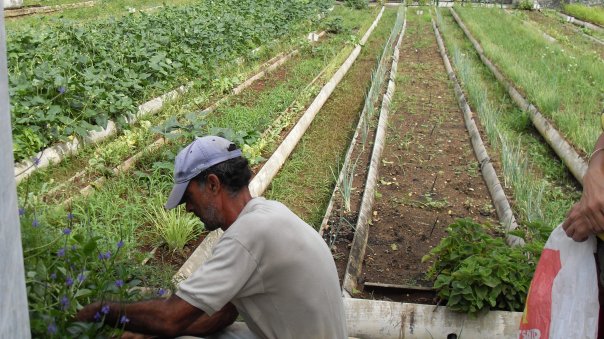
The island’s agricultural sector was heavily impacted. According to different sources, 5.840 tons of warehoused food and half-a-million chickens and other poultry were lost. There was extensive damage to sugar and diversified crops, with 32.000 hectares of plantain lost, plus more than 10.000 hectares of other crops such as rice, beans and organic vegetables. All coffee growing areas in the eastern provinces were affected, with a total loss of the harvest in the most productive areas. Many covered growing houses and 200 greenhouses were damaged or destroyed. Cubans have organized volunteer brigades to go out into the fields to try to recover some of the crops before they rotted and the Ministry of Agriculture and Sugar announced an 85-measure package on September 18 to boost the recovery of both sectors. The already-extensive network of urban and periurban farms may have ameliorated potential food shortages by increasing overall production, by spreading production over a greater geographical area and by reducing the problem of transportation as production is localized in the same area as consumption.
Worldwide aid immediate At a September 18 press conference (http://www.ipsnews.net/news.asp?idnews=43930), Foreign Minister Felipe Perez Roque said the most pressing needs were for food and housing assistance and materials to restore electricity. He reported that 23 countries had offered assistance. Russia was in the lead, sending construction materials and tents and 14.7 tons of food. Ecuador sent nine tons of canned tuna through the World Food Program and Venezuela shipped 6.600 of food to Haiti and Cuba. The Venezuelan government is also sending construction brigades and said the donation drive would continue as long as necessary. Spain responded with a flight of aid worth $400,000 and offers of future assistance. Among nonprofits, Oxfam had already raised $200,000 and the UN had so far mobilized 3.5 million dollars in aid, according to IPS. Poor countries responded as well, with Vietnam sending $200,000 worth of rice and $120,000, East Timor donating $500,000, Trinidad and Tobago pledging $1 million and Tanzania pledging $100,000. In addition, many people-to-people offers of aid have been received. The Bush administration initially offered $100,000 on condition that Cuba accept an “assessment team.” Later it offered $5 million, which Cuba rejected as it twice repeated its request that the United States suspend the blockade to allow the country to purchase construction materials on credit.
Cubans make the connection to global warming
Global warming causes increased oceanic temperatures, which increases the intensity of tropical storms. Other current effects are changes in rainfall, causing drought in some areas. Cuba has been concerned about global warming for many years: in 1992 Fidel Castro warned at the UN Conference on the Environment and Development that “An important biological species is at risk of disappearing due to the rapid and progressive elimination of its natural habitat: man. … If we want to save humanity from that self-destruction, there must be a better distribution of the available wealth and technologies on the plantet. There must be less luxury and less squandering in a few countries so that there will be less impoverishment and less famine in a large portion of the Earth.” On Sept. 24, 2007, Foreign Minister Felipe Pérez Roque commented that in the 15 years since that conference almost nothing was done (http://embacuba.cubaminrex.cu/Default.aspx?tabid=6165): “The situation is now a lot more critical, the dangers are greater and we are running out of time.“The scientific evidence is clear. Practical observation is overwhelming. These could only be called into question by irresponsible people. The last ten years have been the warmest. There is a decrease in the thickness of artic ice. Glaciers are receding. Sea level is on the rise. Also increasing is the frequency and intensity of hurricanes.
“The future looks worse: some 30% of all species will disappear if global temperature increases by 1.5 to 2.5 degrees centigrade. Small island states are running the risk of disappearing under the waters.”
According to economist Minqi Li, the world may be already committed to a 2˚C warming relative to pre-industrial times, which is widely considered to be a critical threshold in climate change. (http://www.monthlyreview.org/080721li.php) What this means is that far from being alarmist, Cuban officials have been honest about the gravity of the situation.
READ THE ENTIRE ARTICLE:
The country was still assessing the damages from Gustav when hurricane Ike made landfall eight days later with 120-mph winds on the northern coast of Holguin Province in eastern Cuba. The category 3 hurricane and slowed to a category 2 as it moved over the center of the island with 100-mph winds and torrential rains destroying buildings, toppling electrical towers, tearing out trees and leveling sugarcane. It passed just south of Havana as it crossed the length of the island, hitting the in the still-flooded Pinar del Rio province in the west on September 9.
Cuban state television reported some 2.6 million people were evacuated. Although there were no deaths from Gustav it damaged 140,000 buildings in western Cuba — 90,000 of them homes. Hurricane Ike claimed only seven lives, testimony to the government's internationally recognized storm-preparedness, which was in full swing as medical teams, food and potable water were mobilized, fuel and power generators prepared and homes secured across the country.
Damages of $5 billion
In spite of the minimal loss of life, the economic damages are formidable, estimated to be around US$5 billion. Approximately 444,000 homes were damaged with more than 63,250 totally destroyed according to the National Housing Institute. In addition to homes, there was damage to schools, health facilities, cultural facilites and industrial buildings and warehouses. Communications and energy infrastructure were also affected.
The island’s agricultural sector was heavily impacted. According to different sources, 5.840 tons of warehoused food and half-a-million chickens and other poultry were lost. There was extensive damage to sugar and diversified crops, with 32.000 hectares of plantain lost, plus more than 10.000 hectares of other crops such as rice, beans and organic vegetables. All coffee growing areas in the eastern provinces were affected, with a total loss of the harvest in the most productive areas. Many covered growing houses and 200 greenhouses were damaged or destroyed. Cubans have organized volunteer brigades to go out into the fields to try to recover some of the crops before they rotted and the Ministry of Agriculture and Sugar announced an 85-measure package on September 18 to boost the recovery of both sectors. The already-extensive network of urban and periurban farms may have ameliorated potential food shortages by increasing overall production, by spreading production over a greater geographical area and by reducing the problem of transportation as production is localized in the same area as consumption.
Worldwide aid immediate At a September 18 press conference (http://www.ipsnews.net/news.asp?idnews=43930), Foreign Minister Felipe Perez Roque said the most pressing needs were for food and housing assistance and materials to restore electricity. He reported that 23 countries had offered assistance. Russia was in the lead, sending construction materials and tents and 14.7 tons of food. Ecuador sent nine tons of canned tuna through the World Food Program and Venezuela shipped 6.600 of food to Haiti and Cuba. The Venezuelan government is also sending construction brigades and said the donation drive would continue as long as necessary. Spain responded with a flight of aid worth $400,000 and offers of future assistance. Among nonprofits, Oxfam had already raised $200,000 and the UN had so far mobilized 3.5 million dollars in aid, according to IPS. Poor countries responded as well, with Vietnam sending $200,000 worth of rice and $120,000, East Timor donating $500,000, Trinidad and Tobago pledging $1 million and Tanzania pledging $100,000. In addition, many people-to-people offers of aid have been received. The Bush administration initially offered $100,000 on condition that Cuba accept an “assessment team.” Later it offered $5 million, which Cuba rejected as it twice repeated its request that the United States suspend the blockade to allow the country to purchase construction materials on credit.
Cubans make the connection to global warming
Global warming causes increased oceanic temperatures, which increases the intensity of tropical storms. Other current effects are changes in rainfall, causing drought in some areas. Cuba has been concerned about global warming for many years: in 1992 Fidel Castro warned at the UN Conference on the Environment and Development that “An important biological species is at risk of disappearing due to the rapid and progressive elimination of its natural habitat: man. … If we want to save humanity from that self-destruction, there must be a better distribution of the available wealth and technologies on the plantet. There must be less luxury and less squandering in a few countries so that there will be less impoverishment and less famine in a large portion of the Earth.” On Sept. 24, 2007, Foreign Minister Felipe Pérez Roque commented that in the 15 years since that conference almost nothing was done (http://embacuba.cubaminrex.cu/Default.aspx?tabid=6165): “The situation is now a lot more critical, the dangers are greater and we are running out of time.“The scientific evidence is clear. Practical observation is overwhelming. These could only be called into question by irresponsible people. The last ten years have been the warmest. There is a decrease in the thickness of artic ice. Glaciers are receding. Sea level is on the rise. Also increasing is the frequency and intensity of hurricanes.
“The future looks worse: some 30% of all species will disappear if global temperature increases by 1.5 to 2.5 degrees centigrade. Small island states are running the risk of disappearing under the waters.”
According to economist Minqi Li, the world may be already committed to a 2˚C warming relative to pre-industrial times, which is widely considered to be a critical threshold in climate change. (http://www.monthlyreview.org/080721li.php) What this means is that far from being alarmist, Cuban officials have been honest about the gravity of the situation.
READ THE ENTIRE ARTICLE:
For more information:
http://haitianalysis.com/2008/10/11/cuba-c...
Add Your Comments
Latest Comments
Listed below are the latest comments about this post.
These comments are submitted anonymously by website visitors.
TITLE
AUTHOR
DATE
Cuba Confronts Global Warming Now: Drought, Hurricanes and Threat of Rising Oceans
Sun, Oct 12, 2008 3:45PM
We are 100% volunteer and depend on your participation to sustain our efforts!
Donate

$140.00 donated
in the past month
Get Involved
If you'd like to help with maintaining or developing the website, contact us.
Publish
Publish your stories and upcoming events on Indybay.
Topics
More
Search Indybay's Archives
Advanced Search
►
▼
IMC Network