







 Publish to Newswire
 Add an Event
From the Open-Publishing Calendar
From the Open-Publishing Newswire
Indybay Feature
9/26/2008 Puerto Rico Film Screening-Benefit For FMPR Puerto Rican Teachers
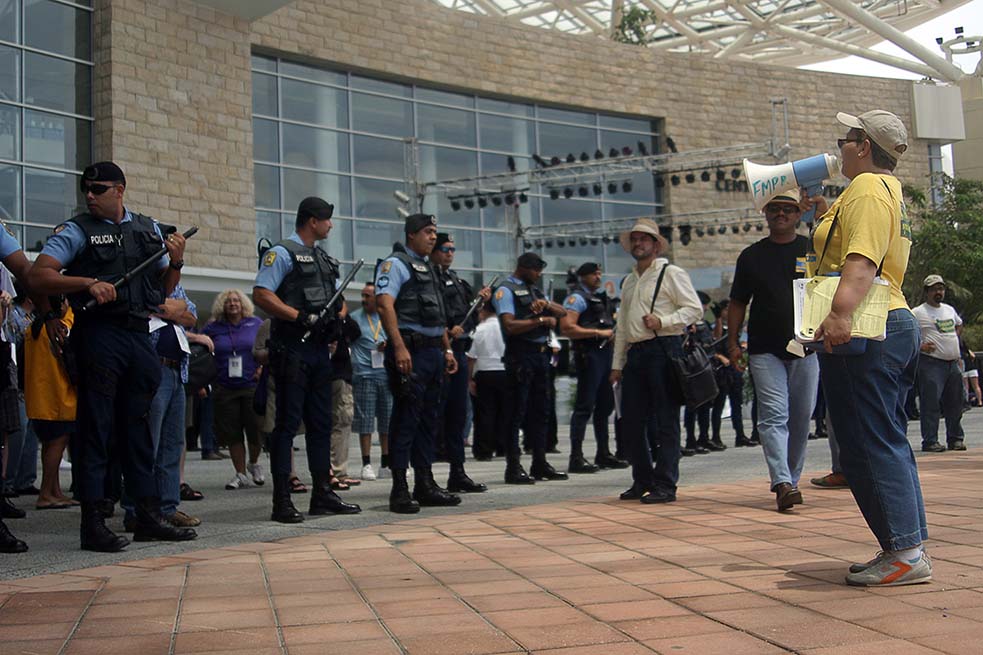
This benefit for the Puerto Rican teachers union FMPR will screen two films "Operation Bootstrap" and Plena For Work, Plena for Song both by Pedro Rivera and Susan Zeig
Friday 9/26/2008 7:00 PM
522 Valencia St./16th St.
San Francisco, CA
Puerto Rico Film Screening-Benefit For FMPR Puerto Rican Teachers
Screening of
Manos a la Obra: The Story of Operation Bootstrap by Pedro Rivera and Susan Zeig
Plena is Work, Plena is Song by Pedro Rivera and Susan Zeig
Puerto Rican teachers are under attack by the government and the SEIU international. They went on strike against privatization and in response the government is seeking to destroy the union and preventing it from running in a representation election. We will have speakers,
music and discussion.
Donation
$5.00 No one turned away due to inability to contribute
Sponsored by
Labor Video Project and others.
Labor Video Project
P.O. Box 720027
San Francisco, CA 94172
(415)282-1908
http://www.laborvideo.org
http://www.amdoc.org/projects/truelives/pg_plena.html
It is difficult to sit still when the rattlesnake makes a "scratch, scratch, scratch." Sound from a guiro syncopates against the rhyming lyrics of a Puerto Rican plena. Pedro Rivera and Susan Zeig's film, Plena Is Work, Plena Is Song, travels from the sugar plantations of Puerto Rico to the docks of San Juan to the streets of New York's barrio, in search of this unique musical form.
Everywhere the camera roams it finds plena singers, pleneros, combining a rhythmic mix of politics, comments on daily life and love, to create a spicy Caribbean stew of protest, satire, and joy.
The plena's roots go back to the early 1900s when the majority of Puerto Ricans were peasants, artisans, or farmers. By the late 1920s RCA had created its first plena recording star, Canario. One woman, who recalls working for only 50-cents a day, says, "In those days the poor person's only source of enjoyment and news was the plena."
New pleneros, like Mon Rivera and Rafael Cortijo, donned suits and bowties in an effort to move their songs off the streets and into venues like New York's Palladium and the Tropicana, or into American living rooms through television during the 1950s. Their plenas still enlivened every imaginable topic: unrequited love, mechanization, funerals, unsafe factory conditions, and many more.
During the 1960s the form's commercial viability declined, but the film captures its continuing influence as a large, plena-throbbing throng of people attend the 1985 funeral of popular singer Ismael Rivera. A young man takes the filmmakers on a tour of his shanty town in the shadow of San Juan's skyscrapers. He tells how his father taught him the meaning of plenas, how the pleneros helped build the city, leaving lingering rhythms in the slabs of concrete and in the hearts of the people.
(1991, 29 min.)
Plena Is Work, Plena Is Song will be shown with the short film, Marc and Ann.
Caption:
Musicians in the Bronx get together to socialize and sing the "plena," the blues music of Puerto Rico
Credit:
Carlos DeJesus
Susan Zeig and Pedro Riveraco-directed Manos a la Obra: The Story of Operation Bootstrap, which was funded by the NEH, the NEA, and New York State Councils for the Arts and Humanities. Together they directed the Young Filmmakers Super-8 Workshop on New York's Lower East Side. Zeig is an Associate Professor of Film at Long Island University and co-directs a project for the University Satellite Network. Rivera holds a Masters Degree in American Studies and has been awarded an Artist-in-Residence at El Museo del Barrio in New York City.
http://media.http://www.theticker.org/media/storage/paper909/news/2007/10/01/News/La.Operacin.Documents.Sterilization-3001800.shtml
La Operación documents sterilization
By: Sherry Mazzocchi
Posted: 10/1/07
As part of the Latina/o Heritage Month program at Baruch, the Omicron Chapter of The Senoritas Latinas Unidas Sorority, Inc. presented a screening of La Operación (The Operation). The film, produced and directed by Ana Maria Garcia, is a fascinating look at the systematic sterilization of Puerto Rican women by their government, often without their knowledge.
The forty-minute documentary explores how sterilization was a government-sponsored method-not only of population control-but also economic reform. Beginning in the 1930's and well into the 1980's, the Puerto Rican government, with the full knowledge and blessing of the U.S., began a systematic program called Operation Bootstrap. Aimed primarily at low-income women, the plan was designed to keep poverty at bay.
Puerto Rico was undergoing a transformation - moving from an agrarian economy to an industrial society. During wartime, large factories employed women, particularly in needlecraft industries. Where a farming culture could sustain larger families, it was felt that a modern, industrial society could not. The government instituted a plan that paid for the widespread tubal ligation of women.
Vanessa Gonzalez, President of the graduate chapter of the sorority, quoted her mother, who grew up in Puerto Rico, who said, "Women were having children at alarming rates." Gonzalez said her grandmother had ten children, one great aunt had eleven and yet another had eighteen children. One student in the audience said both of her grandmothers had twelve children. Gonzalez's grandmother, who still lives in Puerto Rico, confirmed that a majority of the women there cannot have children. Both her grandmother and mother say that women were given birth control before it was approved in the US.
A woman in the film said men feel they lose their "energy" if they are sterilized. "And you know what that 'energy' means," she said. After the film, Xinia Bermudez, President of the Sorority, said that the machismo Latino culture was a big factor in why the program was aimed solely at women. "If you take away the ability to have kids, it's like taking away a piece of their soul. It essentially takes away their manhood," she said.
The film ran through startling statistics. In 1936, 6.5 percent of Puerto Rican women had been sterilized. By 1953, 20 percent of women had the operation. By 1980, one-third of the women on the island had been sterilized. Sterilization was not only provided by government clinics, but also by factories where women provided cheap labor for overseas corporations. Rather than pay women maternity leave and benefits, factories did the calculations and found by providing operations they would save millions.
Often, women were not even told what kind of surgery they were having. Some women thought it would easily be reversed. In fact, very few tubal ligations can be successfully reversed. If they are, pregnancies are usually dangerous, and in some cases, fatal to both the fetus and the mother. Even more disturbing than the high rates of sterilization were the birth control products that were freely distributed to the population. Women in the film recall a nurse coming to their homes and providing birth control pills. They were assured it was a good product. Those pills, 20 times stronger than medication legally available today, caused women to pass out after ingested.
Students were struck by the widespread implications of the sterilization policy. One student summed it up well and said, "They would rather fund a quick fix than fund education."
http://www.cinemaguild.com/catalog/catalog_search.htm
MANOS A LA OBRA: THE STORY OF OPERATION BOOTSTRAP
Examines Puerto Rico's `Operation Bootstrap,' the highly vaunted economic development plan undertaken in the 1950s to provide a role model for economic development throughout Latin America. Using newsreels, rare archival photos and footage, numerous interviews, and excerpts from government propaganda films, it examines the historical background to Operation Bootstrap, from the 1930s through the rise to power of Luiz Munoz Marin and the Popular Democratic Party in the 1940s, to the '60s when U.S. officials proudly displayed Puerto Rico as the `Showcase of the Americas.'
Directed by Pedro Rivera and Susan Zeig
1983, color, 59 mins.
"...a powerful as well as an informative film...an invaluable teaching aid."--Jean Franco, author, Modern Culture in Latin America
"...a sophisticated socio-political analysis...an excellent film for classroom use."--Bill Tabb, Professor of Economics and Sociology, City University of New York
Puerto Rican Government & SEIU In Collusion To Disenfranchise FMPR In Upcoming Election: No Democratic Choice For 40,000 Teachers
From FMPR President Rafael Feliciano
Dear Fellow Workers:
Attached is my report to the Board of Directors of the FMPR, made up of the presidents and vice presidents of the 84 locals which constitute the Federation. As you can observe, the same speaks for itself.
Events are moving at hurricane speed in the schools of Puerto Rico. Last week:
We began with an avalanche of new members, approximately one hundred a day, which reflects that our process of recuperation, based on voluntary work, has gained velocity.
Our executive committee met.
We developed an intense campaign against corruption in the Department of Education. This resulted in a front page article of the newspaper El Vocero last Friday and great difficulties for the government.
Dozens of controversies were resolved in the schools. The Puerto Rican Independence Party presented their support for the FMPR actions in favor of the legislated wage increases (Wednesday) at their press conference.
Friday:
Our petition for reconsideration on the matter of the biometric time clocks as unconstitutional was rejected. The case will have to be taken to the Court of Appeals.
The Department of Education’s reconsideration against the FMPR on the matter of the “MANDAMUS” to force the payment of what is owed the teachers was rejected; the Department of Education has initiated the payments.
The Commission on Labor Relations for the Public Sector (CRTSP) has convened union elections between September 30 and October 15 and excluded the FMPR from the election.
We held a press conference and next Monday we will go to court to ask for an urgent order so that the FMPR be included in the election.
The government-boss obviously and the SEIU-Association are trying by all means to exclude the FMPR since they know that they will be defeated if it participates.
We expect to prevail in court and appear on the ballot because:
The CRTSP resolution is a determination without a legal basis. The law of unionization, Number 45, does not state that an organization which has been decertified cannot compete in a union election if it has the endorsements required by the law; in this case it is 8,000 and the FMPR submitted 12,000.
In the case of the decertification which has gone to trial, there was no disposition which prohibits the organization from participating in a new election.
The CRTSP Resolution violates the due process of the law because it deprives us of our right to participate.
The group UNETE solicited participation, after the FMPR, and their endorsement cards were accepted. Yet, they did not collect the minimum necessary. They collected less than 1,500.
It is important to denounce internationally the conspiracy of the government-boss and the SEIU-Association to deny that the teachers can freely select the labor organization they desire to represent them.
Our strong point: the people. Our weak point: the lack of material resources. Any help in solidarity is welcome. It is necessary to compliment the network of volunteers with an organizational network.
Fraternally,
Rafael Feliciano Hernández
Presidente FMPR
To Support The FMPR Funds should be sent to:
Please send check to FMPR, Urb, El Caribe 1572 Ave. Ponce de Leon, San Juan, Puerto Rico 00926-2710
FEDERACIÓN DE MAESTROS DE PUERTO RICO
Declaración de Prensa
(7 de septiembre de 2008)
La Federación de Maestros de Puerto Rico repudia como una patraña discriminatoria y antidemocrática la reciente decisión de la Comisión de Relaciones del Trabajo del Servicio Público que pretende excluir arbitrariamente a la Federación de Maestros para poder participar en las elecciones para representante exclusivo del magisterio.
La acción de la Comisión es ilegal y engañosa pues en la Ley 45 no existe prohibición alguna para que un sindicato que haya sido desertificado pueda participar en unas elecciones sindicales. Peor aun, en la Orden de Descertificación de la Comisión que advino final y firme no se incluyó nada sobre esa prohibición, por lo tanto la agencia se está extralimitando en sus prerrogativas pretendiendo enmendar la Ley 45 con el único propósito de ayudar a ganar unas elecciones al sindicato patronal de la Asociación.
Más importante aún, la resolución de la Comisión es un brutal asalto a la democracia sindical y a los derechos de los miles de maestros que firmaron las peticiones de endoso para que la Federación de Maestros participe en las elecciones para la representación exclusiva. La Ley 45 establece que para poder participar como interventor en unas elecciones sindicales la organización tiene que recoger el 20% de endosos, unos 8,000. En apenas dos meses, la FMPR recogió y entregó más de 11,000 endosos, cerca del 30%. La Comisión pretende despojar a miles de maestros del derecho a seleccionar democráticamente a su representante exclusivo, arrogándose poderes que no le corresponden.
En su burdo interés por descalificar a la Federación de Maestros, la Comisión se tardó casi seis (6) meses en contestar la petición de intervención de la FMPR y la deniega sin citarnos a una vista y sin escuchar nuestras alegaciones, en franca violación al debido proceso de ley. A sabiendas de que está violando la ley convoca la elección sindical para celebrarse entre el 30 de septiembre y el 15 de octubre con el Sindicato patronal de la Asociación como única alternativa, sin siquiera comunicárselo a la FMPR que es sin duda parte interesada en esta controversia.
Ante las acciones ilegales de la Comisión, La Federación de Maestros acudirá mañana, lunes 8 de septiembre, al Tribunal de Primera Instancia con un recurso legal para impugnar la exclusión de la Federación y exigir que se nos garantice el derecho a participar en las elecciones sindicales. No le quepa duda a nadie, vamos a agotar todos los recursos y acciones necesarias para evitar que el patrono-gobierno se salga con la suya.
Hacemos un llamado urgente a nuestra matrícula a mantenerse alerta a los próximos acontecimientos y a movilizarse para repudiar el intento del gobierno-patrono de arrebatarnos el derecho a representar, como lo hemos hecho durante muchos años, al magisterio puertorriqueño. Todos los dirigentes, delegados y contactos deben reunirse inmediatamente para cumplir el Plan de Trabajo aprobado por la Junta de Dirigentes y asegurar la victoria de nuestro instrumento de lucha.
Rafael Feliciano Hernández
Presidente de la FMPR
¡NO HAY TRIUNFO SIN LUCHA; NI LUCHA SIN SACRIFICIO!
Rafael Feliciano Hernández
Presidente
Federación de Maestros
Labor Imperialism, Corporate Unionism & The SEIU Convention
http://www.youtube.com/watch?v=M0sFjqmld5I
This video is an edited part of a 60 minute labor TV show the Labor Video Project is producing on the 2008 SEIU convention in Puerto Rico.
To find out more about the issue of the Puerto Rican teachers and the struggle against privatization you can go to:
http://www.fmprlucha.org
http://mysite.verizon.net/vze2kxcd/fmprsupportcommitteenewyork/
http://www.coordinadorasindical.org/
UTIER - http://www.utier.org/estructuras/index.php
MoreVideos About the Struggle In Puerto Rico and the SEIU Issues
FMPR Teachers Picket SEIU Convention
http://www.youtube.com/watch?v=syfv0tEZcuc&feature=related
522 Valencia St./16th St.
San Francisco, CA
Puerto Rico Film Screening-Benefit For FMPR Puerto Rican Teachers
Screening of
Manos a la Obra: The Story of Operation Bootstrap by Pedro Rivera and Susan Zeig
Plena is Work, Plena is Song by Pedro Rivera and Susan Zeig
Puerto Rican teachers are under attack by the government and the SEIU international. They went on strike against privatization and in response the government is seeking to destroy the union and preventing it from running in a representation election. We will have speakers,
music and discussion.
Donation
$5.00 No one turned away due to inability to contribute
Sponsored by
Labor Video Project and others.
Labor Video Project
P.O. Box 720027
San Francisco, CA 94172
(415)282-1908
http://www.laborvideo.org
http://www.amdoc.org/projects/truelives/pg_plena.html
It is difficult to sit still when the rattlesnake makes a "scratch, scratch, scratch." Sound from a guiro syncopates against the rhyming lyrics of a Puerto Rican plena. Pedro Rivera and Susan Zeig's film, Plena Is Work, Plena Is Song, travels from the sugar plantations of Puerto Rico to the docks of San Juan to the streets of New York's barrio, in search of this unique musical form.
Everywhere the camera roams it finds plena singers, pleneros, combining a rhythmic mix of politics, comments on daily life and love, to create a spicy Caribbean stew of protest, satire, and joy.
The plena's roots go back to the early 1900s when the majority of Puerto Ricans were peasants, artisans, or farmers. By the late 1920s RCA had created its first plena recording star, Canario. One woman, who recalls working for only 50-cents a day, says, "In those days the poor person's only source of enjoyment and news was the plena."
New pleneros, like Mon Rivera and Rafael Cortijo, donned suits and bowties in an effort to move their songs off the streets and into venues like New York's Palladium and the Tropicana, or into American living rooms through television during the 1950s. Their plenas still enlivened every imaginable topic: unrequited love, mechanization, funerals, unsafe factory conditions, and many more.
During the 1960s the form's commercial viability declined, but the film captures its continuing influence as a large, plena-throbbing throng of people attend the 1985 funeral of popular singer Ismael Rivera. A young man takes the filmmakers on a tour of his shanty town in the shadow of San Juan's skyscrapers. He tells how his father taught him the meaning of plenas, how the pleneros helped build the city, leaving lingering rhythms in the slabs of concrete and in the hearts of the people.
(1991, 29 min.)
Plena Is Work, Plena Is Song will be shown with the short film, Marc and Ann.
Caption:
Musicians in the Bronx get together to socialize and sing the "plena," the blues music of Puerto Rico
Credit:
Carlos DeJesus
Susan Zeig and Pedro Riveraco-directed Manos a la Obra: The Story of Operation Bootstrap, which was funded by the NEH, the NEA, and New York State Councils for the Arts and Humanities. Together they directed the Young Filmmakers Super-8 Workshop on New York's Lower East Side. Zeig is an Associate Professor of Film at Long Island University and co-directs a project for the University Satellite Network. Rivera holds a Masters Degree in American Studies and has been awarded an Artist-in-Residence at El Museo del Barrio in New York City.
http://media.http://www.theticker.org/media/storage/paper909/news/2007/10/01/News/La.Operacin.Documents.Sterilization-3001800.shtml
La Operación documents sterilization
By: Sherry Mazzocchi
Posted: 10/1/07
As part of the Latina/o Heritage Month program at Baruch, the Omicron Chapter of The Senoritas Latinas Unidas Sorority, Inc. presented a screening of La Operación (The Operation). The film, produced and directed by Ana Maria Garcia, is a fascinating look at the systematic sterilization of Puerto Rican women by their government, often without their knowledge.
The forty-minute documentary explores how sterilization was a government-sponsored method-not only of population control-but also economic reform. Beginning in the 1930's and well into the 1980's, the Puerto Rican government, with the full knowledge and blessing of the U.S., began a systematic program called Operation Bootstrap. Aimed primarily at low-income women, the plan was designed to keep poverty at bay.
Puerto Rico was undergoing a transformation - moving from an agrarian economy to an industrial society. During wartime, large factories employed women, particularly in needlecraft industries. Where a farming culture could sustain larger families, it was felt that a modern, industrial society could not. The government instituted a plan that paid for the widespread tubal ligation of women.
Vanessa Gonzalez, President of the graduate chapter of the sorority, quoted her mother, who grew up in Puerto Rico, who said, "Women were having children at alarming rates." Gonzalez said her grandmother had ten children, one great aunt had eleven and yet another had eighteen children. One student in the audience said both of her grandmothers had twelve children. Gonzalez's grandmother, who still lives in Puerto Rico, confirmed that a majority of the women there cannot have children. Both her grandmother and mother say that women were given birth control before it was approved in the US.
A woman in the film said men feel they lose their "energy" if they are sterilized. "And you know what that 'energy' means," she said. After the film, Xinia Bermudez, President of the Sorority, said that the machismo Latino culture was a big factor in why the program was aimed solely at women. "If you take away the ability to have kids, it's like taking away a piece of their soul. It essentially takes away their manhood," she said.
The film ran through startling statistics. In 1936, 6.5 percent of Puerto Rican women had been sterilized. By 1953, 20 percent of women had the operation. By 1980, one-third of the women on the island had been sterilized. Sterilization was not only provided by government clinics, but also by factories where women provided cheap labor for overseas corporations. Rather than pay women maternity leave and benefits, factories did the calculations and found by providing operations they would save millions.
Often, women were not even told what kind of surgery they were having. Some women thought it would easily be reversed. In fact, very few tubal ligations can be successfully reversed. If they are, pregnancies are usually dangerous, and in some cases, fatal to both the fetus and the mother. Even more disturbing than the high rates of sterilization were the birth control products that were freely distributed to the population. Women in the film recall a nurse coming to their homes and providing birth control pills. They were assured it was a good product. Those pills, 20 times stronger than medication legally available today, caused women to pass out after ingested.
Students were struck by the widespread implications of the sterilization policy. One student summed it up well and said, "They would rather fund a quick fix than fund education."
http://www.cinemaguild.com/catalog/catalog_search.htm
MANOS A LA OBRA: THE STORY OF OPERATION BOOTSTRAP
Examines Puerto Rico's `Operation Bootstrap,' the highly vaunted economic development plan undertaken in the 1950s to provide a role model for economic development throughout Latin America. Using newsreels, rare archival photos and footage, numerous interviews, and excerpts from government propaganda films, it examines the historical background to Operation Bootstrap, from the 1930s through the rise to power of Luiz Munoz Marin and the Popular Democratic Party in the 1940s, to the '60s when U.S. officials proudly displayed Puerto Rico as the `Showcase of the Americas.'
Directed by Pedro Rivera and Susan Zeig
1983, color, 59 mins.
"...a powerful as well as an informative film...an invaluable teaching aid."--Jean Franco, author, Modern Culture in Latin America
"...a sophisticated socio-political analysis...an excellent film for classroom use."--Bill Tabb, Professor of Economics and Sociology, City University of New York
Puerto Rican Government & SEIU In Collusion To Disenfranchise FMPR In Upcoming Election: No Democratic Choice For 40,000 Teachers
From FMPR President Rafael Feliciano
Dear Fellow Workers:
Attached is my report to the Board of Directors of the FMPR, made up of the presidents and vice presidents of the 84 locals which constitute the Federation. As you can observe, the same speaks for itself.
Events are moving at hurricane speed in the schools of Puerto Rico. Last week:
We began with an avalanche of new members, approximately one hundred a day, which reflects that our process of recuperation, based on voluntary work, has gained velocity.
Our executive committee met.
We developed an intense campaign against corruption in the Department of Education. This resulted in a front page article of the newspaper El Vocero last Friday and great difficulties for the government.
Dozens of controversies were resolved in the schools. The Puerto Rican Independence Party presented their support for the FMPR actions in favor of the legislated wage increases (Wednesday) at their press conference.
Friday:
Our petition for reconsideration on the matter of the biometric time clocks as unconstitutional was rejected. The case will have to be taken to the Court of Appeals.
The Department of Education’s reconsideration against the FMPR on the matter of the “MANDAMUS” to force the payment of what is owed the teachers was rejected; the Department of Education has initiated the payments.
The Commission on Labor Relations for the Public Sector (CRTSP) has convened union elections between September 30 and October 15 and excluded the FMPR from the election.
We held a press conference and next Monday we will go to court to ask for an urgent order so that the FMPR be included in the election.
The government-boss obviously and the SEIU-Association are trying by all means to exclude the FMPR since they know that they will be defeated if it participates.
We expect to prevail in court and appear on the ballot because:
The CRTSP resolution is a determination without a legal basis. The law of unionization, Number 45, does not state that an organization which has been decertified cannot compete in a union election if it has the endorsements required by the law; in this case it is 8,000 and the FMPR submitted 12,000.
In the case of the decertification which has gone to trial, there was no disposition which prohibits the organization from participating in a new election.
The CRTSP Resolution violates the due process of the law because it deprives us of our right to participate.
The group UNETE solicited participation, after the FMPR, and their endorsement cards were accepted. Yet, they did not collect the minimum necessary. They collected less than 1,500.
It is important to denounce internationally the conspiracy of the government-boss and the SEIU-Association to deny that the teachers can freely select the labor organization they desire to represent them.
Our strong point: the people. Our weak point: the lack of material resources. Any help in solidarity is welcome. It is necessary to compliment the network of volunteers with an organizational network.
Fraternally,
Rafael Feliciano Hernández
Presidente FMPR
To Support The FMPR Funds should be sent to:
Please send check to FMPR, Urb, El Caribe 1572 Ave. Ponce de Leon, San Juan, Puerto Rico 00926-2710
FEDERACIÓN DE MAESTROS DE PUERTO RICO
Declaración de Prensa
(7 de septiembre de 2008)
La Federación de Maestros de Puerto Rico repudia como una patraña discriminatoria y antidemocrática la reciente decisión de la Comisión de Relaciones del Trabajo del Servicio Público que pretende excluir arbitrariamente a la Federación de Maestros para poder participar en las elecciones para representante exclusivo del magisterio.
La acción de la Comisión es ilegal y engañosa pues en la Ley 45 no existe prohibición alguna para que un sindicato que haya sido desertificado pueda participar en unas elecciones sindicales. Peor aun, en la Orden de Descertificación de la Comisión que advino final y firme no se incluyó nada sobre esa prohibición, por lo tanto la agencia se está extralimitando en sus prerrogativas pretendiendo enmendar la Ley 45 con el único propósito de ayudar a ganar unas elecciones al sindicato patronal de la Asociación.
Más importante aún, la resolución de la Comisión es un brutal asalto a la democracia sindical y a los derechos de los miles de maestros que firmaron las peticiones de endoso para que la Federación de Maestros participe en las elecciones para la representación exclusiva. La Ley 45 establece que para poder participar como interventor en unas elecciones sindicales la organización tiene que recoger el 20% de endosos, unos 8,000. En apenas dos meses, la FMPR recogió y entregó más de 11,000 endosos, cerca del 30%. La Comisión pretende despojar a miles de maestros del derecho a seleccionar democráticamente a su representante exclusivo, arrogándose poderes que no le corresponden.
En su burdo interés por descalificar a la Federación de Maestros, la Comisión se tardó casi seis (6) meses en contestar la petición de intervención de la FMPR y la deniega sin citarnos a una vista y sin escuchar nuestras alegaciones, en franca violación al debido proceso de ley. A sabiendas de que está violando la ley convoca la elección sindical para celebrarse entre el 30 de septiembre y el 15 de octubre con el Sindicato patronal de la Asociación como única alternativa, sin siquiera comunicárselo a la FMPR que es sin duda parte interesada en esta controversia.
Ante las acciones ilegales de la Comisión, La Federación de Maestros acudirá mañana, lunes 8 de septiembre, al Tribunal de Primera Instancia con un recurso legal para impugnar la exclusión de la Federación y exigir que se nos garantice el derecho a participar en las elecciones sindicales. No le quepa duda a nadie, vamos a agotar todos los recursos y acciones necesarias para evitar que el patrono-gobierno se salga con la suya.
Hacemos un llamado urgente a nuestra matrícula a mantenerse alerta a los próximos acontecimientos y a movilizarse para repudiar el intento del gobierno-patrono de arrebatarnos el derecho a representar, como lo hemos hecho durante muchos años, al magisterio puertorriqueño. Todos los dirigentes, delegados y contactos deben reunirse inmediatamente para cumplir el Plan de Trabajo aprobado por la Junta de Dirigentes y asegurar la victoria de nuestro instrumento de lucha.
Rafael Feliciano Hernández
Presidente de la FMPR
¡NO HAY TRIUNFO SIN LUCHA; NI LUCHA SIN SACRIFICIO!
Rafael Feliciano Hernández
Presidente
Federación de Maestros
Labor Imperialism, Corporate Unionism & The SEIU Convention
http://www.youtube.com/watch?v=M0sFjqmld5I
This video is an edited part of a 60 minute labor TV show the Labor Video Project is producing on the 2008 SEIU convention in Puerto Rico.
To find out more about the issue of the Puerto Rican teachers and the struggle against privatization you can go to:
http://www.fmprlucha.org
http://mysite.verizon.net/vze2kxcd/fmprsupportcommitteenewyork/
http://www.coordinadorasindical.org/
UTIER - http://www.utier.org/estructuras/index.php
MoreVideos About the Struggle In Puerto Rico and the SEIU Issues
FMPR Teachers Picket SEIU Convention
http://www.youtube.com/watch?v=syfv0tEZcuc&feature=related
Add Your Comments
We are 100% volunteer and depend on your participation to sustain our efforts!
Donate

$140.00 donated
in the past month
Get Involved
If you'd like to help with maintaining or developing the website, contact us.
Publish
Publish your stories and upcoming events on Indybay.
Topics
More
Search Indybay's Archives
Advanced Search
►
▼
IMC Network