







 Publish to Newswire
 Add an Event
From the Open-Publishing Calendar
From the Open-Publishing Newswire
Indybay Feature
Nader, the Greens and 2008
Todd Chretien, the Green party candidate who ran for the Senate against Dianne Feinstein in 2006, looks at where the Green Party has been and where it is today.
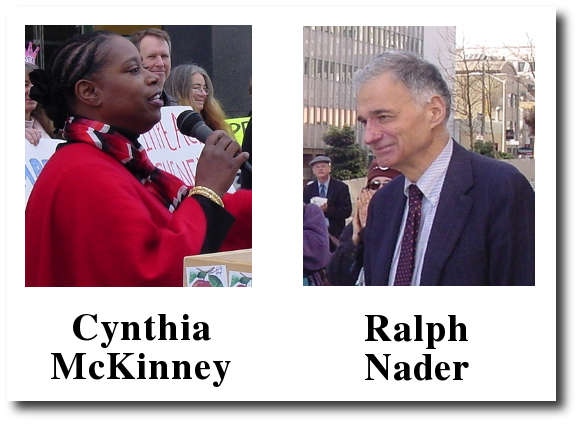
Nader, the Greens and 2008
SocialistWorker.org
January 25, 2008
TODD CHRETIEN, the Green Party candidate for senator from California in 2006, looks at the difficult prospects for a left-wing presidential challenge in 2008.
LESS THAN eight years ago, Ralph Nader's 2000 presidential campaign was electrifying U.S. politics.
Nader won almost 3 million votes, the best showing in at least 50 years for a left-wing presidential candidate running against the Republican-Democrat duopoly. Running on the Green Party ticket, Nader had support from significant sections of progressives and social activists--an important break from the long history of the U.S. left falling behind the “lesser evil” of the Democratic Party at election time.
Today, the picture is very different. Nader will probably run for president again, but neither he nor any other independent candidate to the left of the Democrats can expect to win more than a token number of votes. His support among people on the left has crumbled. And the Green Party that nominated Nader in 2000 is in a state of crisis, weakened significantly in terms of both voter registration and active membership.
So what happened?
- - - - - - - - - - - - - - - -
A reaction against eight years of Clinton
THE YEARS before 2000 saw some important struggles begin to develop on a number of fronts.
In August 1997, 185,000 Teamsters struck for two weeks and beat UPS, one of the most powerful corporations in the country. A few weeks after, transit workers and garbage workers struck and won in the Bay Area, and a strike by GM workers in a single brake plant shut down the auto giant's entire North American operation.
Meanwhile, the global justice movement was taking shape. In November 1999, 40,000 activists marched in Seattle and took direct action to shut down the World Trade Organization (WTO) talks.
Why was all this happening? Despite the hopes placed in him, Bill Clinton didn't bring fundamental change after a decade of Reagan-Bush trickle-down economics and conservative politics.
Instead, corporations continued to dominate a “one-sided class struggle.” Clinton himself displayed a Republican-like zeal for privatization, which shredded what remained of the social safety net. The prison population doubled, and 1 million Iraqis were starved to death by sanctions.
Anger with the failure of the Democrats to do much of substance for the majority of people was expressed in these still modest but growing mobilizations, culminating in Los Angeles in August 2000, when 40,000 activists protested outside the Democratic National Convention.
These struggles didn't translate automatically into a break with the Democrats--in fact, most people who took part in them continued to look to the Democrats as the “lesser evil.” Although the fact that Democratic Party delegates and officials looked on from the balcony of the Staples Center while the LAPD launched canisters of tear gas at the crowd certainly did help make the point that the party was still an evil.
In the months before the election, more than 100,000 people attended a dozen indoor “super-rallies” supporting Nader. Nader's stump speech called for the abolition of the WTO, tearing up NAFTA, slicing the military budget, investing dramatically in education, a national health care system, ending the death penalty and three-strikes laws, and defending abortion rights.
Nader slammed the Democrats as a corporate party, wholly owned by the richest of the rich. He ended every speech by invoking the struggles of the anti-slavery abolitionists, the suffragettes, the industrial unionists and the civil rights movement.
Socialists and radicals were welcomed into the campaign. On stage at the super-rallies, Michael Moore, Phil Donahue, Patti Smith, Medea Benjamin, Susan Sarandon and other well-known figures supported him. The California Nurses Association and the United Electrical Workers endorsed his candidacy and campaigned for him.
When it was all over, Nader won 2,883,105 votes, the best showing for a left-wing candidate since Eugene Debs ran for president from prison in 1920 for the Socialist Party and won 6 percent of the vote.
- - - - - - - - - - - - - - - -
The Florida fiasco and September 11
AFTER THE Republican theft of the 2000 election that installed Bush--the loser of the popular vote--in the White House, and then the September 11 attacks and the start of the “war on terror,” many of Nader's former supporters turned on him.
Liberal writer Eric Alterman explicitly blamed Nader for Bush's crimes: “Thank you, Ralph, for the Iraq war. Thank you, Ralph, for the tax cuts. Thank you, Ralph, for the destruction of the environment. Thank you, Ralph, for the destruction of the Constitution.”
Most 2000 Nader supporters weren't nearly as snotty as Alterman, but the fact was that the momentum built up by the global justice movement and other struggles didn't survive the nationalist fury whipped up by politicians of both parties after September 11.
Only one Democrat in Congress, Barbara Lee, voted against the rush to war against Afghanistan. The invasion and occupation of Afghanistan in October 2001 was met by only very small protests.
When the Bush administration began its drive to war on Iraq, there was a massive outpouring in February 2003 to try to stop the invasion. But there was little organizational continuity with the global justice movement and the 2000 Nader campaign. Nader didn't involve himself in antiwar organizing, and the Green Party played almost no role.
After the invasion and Bush's “Mission Accomplished” speech, it looked as if progressive politics would be beaten back for a long time.
There were some exceptions in terms of relatively successful political campaigns. Green Party member and socialist Peter Camejo ran in the California recall governor's race and got into the TV debates. The Green Party's Matt Gonzalez came within a whisker of winning the 2003 race for mayor of San Francisco. Both these campaigns generated enthusiastic responses reminiscent of the Nader's 2000 run, and it looked as if the Green Party might recover, at least in California.
- - - - - - - - - - - - - - - -
2004: Anybody But Bush
THE 2004 election exposed the Green Party's internal political damage. Although registration figures continued to increase after September 11 (for instance, in California, the Greens grew from about 100,000 in 1999 to 165,000 in early 2004), much of the leadership of the party was in full retreat from openly fighting against the two-party “duopoly,” as Nader called it.
Please read the rest:
SocialistWorker.org
January 25, 2008
TODD CHRETIEN, the Green Party candidate for senator from California in 2006, looks at the difficult prospects for a left-wing presidential challenge in 2008.
LESS THAN eight years ago, Ralph Nader's 2000 presidential campaign was electrifying U.S. politics.
Nader won almost 3 million votes, the best showing in at least 50 years for a left-wing presidential candidate running against the Republican-Democrat duopoly. Running on the Green Party ticket, Nader had support from significant sections of progressives and social activists--an important break from the long history of the U.S. left falling behind the “lesser evil” of the Democratic Party at election time.
Today, the picture is very different. Nader will probably run for president again, but neither he nor any other independent candidate to the left of the Democrats can expect to win more than a token number of votes. His support among people on the left has crumbled. And the Green Party that nominated Nader in 2000 is in a state of crisis, weakened significantly in terms of both voter registration and active membership.
So what happened?
- - - - - - - - - - - - - - - -
A reaction against eight years of Clinton
THE YEARS before 2000 saw some important struggles begin to develop on a number of fronts.
In August 1997, 185,000 Teamsters struck for two weeks and beat UPS, one of the most powerful corporations in the country. A few weeks after, transit workers and garbage workers struck and won in the Bay Area, and a strike by GM workers in a single brake plant shut down the auto giant's entire North American operation.
Meanwhile, the global justice movement was taking shape. In November 1999, 40,000 activists marched in Seattle and took direct action to shut down the World Trade Organization (WTO) talks.
Why was all this happening? Despite the hopes placed in him, Bill Clinton didn't bring fundamental change after a decade of Reagan-Bush trickle-down economics and conservative politics.
Instead, corporations continued to dominate a “one-sided class struggle.” Clinton himself displayed a Republican-like zeal for privatization, which shredded what remained of the social safety net. The prison population doubled, and 1 million Iraqis were starved to death by sanctions.
Anger with the failure of the Democrats to do much of substance for the majority of people was expressed in these still modest but growing mobilizations, culminating in Los Angeles in August 2000, when 40,000 activists protested outside the Democratic National Convention.
These struggles didn't translate automatically into a break with the Democrats--in fact, most people who took part in them continued to look to the Democrats as the “lesser evil.” Although the fact that Democratic Party delegates and officials looked on from the balcony of the Staples Center while the LAPD launched canisters of tear gas at the crowd certainly did help make the point that the party was still an evil.
In the months before the election, more than 100,000 people attended a dozen indoor “super-rallies” supporting Nader. Nader's stump speech called for the abolition of the WTO, tearing up NAFTA, slicing the military budget, investing dramatically in education, a national health care system, ending the death penalty and three-strikes laws, and defending abortion rights.
Nader slammed the Democrats as a corporate party, wholly owned by the richest of the rich. He ended every speech by invoking the struggles of the anti-slavery abolitionists, the suffragettes, the industrial unionists and the civil rights movement.
Socialists and radicals were welcomed into the campaign. On stage at the super-rallies, Michael Moore, Phil Donahue, Patti Smith, Medea Benjamin, Susan Sarandon and other well-known figures supported him. The California Nurses Association and the United Electrical Workers endorsed his candidacy and campaigned for him.
When it was all over, Nader won 2,883,105 votes, the best showing for a left-wing candidate since Eugene Debs ran for president from prison in 1920 for the Socialist Party and won 6 percent of the vote.
- - - - - - - - - - - - - - - -
The Florida fiasco and September 11
AFTER THE Republican theft of the 2000 election that installed Bush--the loser of the popular vote--in the White House, and then the September 11 attacks and the start of the “war on terror,” many of Nader's former supporters turned on him.
Liberal writer Eric Alterman explicitly blamed Nader for Bush's crimes: “Thank you, Ralph, for the Iraq war. Thank you, Ralph, for the tax cuts. Thank you, Ralph, for the destruction of the environment. Thank you, Ralph, for the destruction of the Constitution.”
Most 2000 Nader supporters weren't nearly as snotty as Alterman, but the fact was that the momentum built up by the global justice movement and other struggles didn't survive the nationalist fury whipped up by politicians of both parties after September 11.
Only one Democrat in Congress, Barbara Lee, voted against the rush to war against Afghanistan. The invasion and occupation of Afghanistan in October 2001 was met by only very small protests.
When the Bush administration began its drive to war on Iraq, there was a massive outpouring in February 2003 to try to stop the invasion. But there was little organizational continuity with the global justice movement and the 2000 Nader campaign. Nader didn't involve himself in antiwar organizing, and the Green Party played almost no role.
After the invasion and Bush's “Mission Accomplished” speech, it looked as if progressive politics would be beaten back for a long time.
There were some exceptions in terms of relatively successful political campaigns. Green Party member and socialist Peter Camejo ran in the California recall governor's race and got into the TV debates. The Green Party's Matt Gonzalez came within a whisker of winning the 2003 race for mayor of San Francisco. Both these campaigns generated enthusiastic responses reminiscent of the Nader's 2000 run, and it looked as if the Green Party might recover, at least in California.
- - - - - - - - - - - - - - - -
2004: Anybody But Bush
THE 2004 election exposed the Green Party's internal political damage. Although registration figures continued to increase after September 11 (for instance, in California, the Greens grew from about 100,000 in 1999 to 165,000 in early 2004), much of the leadership of the party was in full retreat from openly fighting against the two-party “duopoly,” as Nader called it.
Please read the rest:
For more information:
http://www.socialistworker.org/2008-1/659/...
Add Your Comments
Latest Comments
Listed below are the latest comments about this post.
These comments are submitted anonymously by website visitors.
TITLE
AUTHOR
DATE
To ad hominem marc
Sat, Feb 9, 2008 7:17PM
Its Gots to be Trots
Fri, Feb 1, 2008 12:38PM
Comment to reader about McKinney, the purpose of Chretien's essay, and my opinion
Mon, Jan 28, 2008 2:55AM
"I do not think Chretien's essay was biased in any direction"
Sun, Jan 27, 2008 4:44PM
reply to reader
Sun, Jan 27, 2008 1:15PM
"misunderstanding"
Sun, Jan 27, 2008 10:03AM
We are 100% volunteer and depend on your participation to sustain our efforts!
Donate

$85.00 donated
in the past month
Get Involved
If you'd like to help with maintaining or developing the website, contact us.
Publish
Publish your stories and upcoming events on Indybay.
Topics
More
Search Indybay's Archives
Advanced Search
►
▼
IMC Network