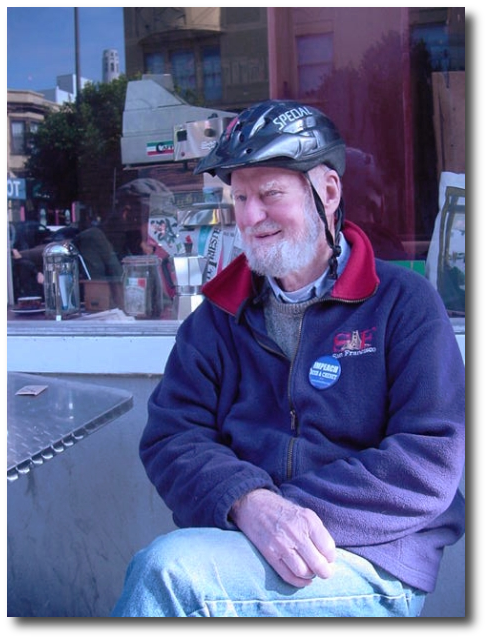
You have to decide if bird cries are cries of ecstasy or cries of despair, by which you will know if you are a tragic or a lyric poet. Lawrence FerlinghettiThe complete interview Any Goodman, one of the many lucky individuals to get the cooks tour of Prairie Lights Bookstore with Lawrence Ferlinghetti - but on a special occasion:
AMY GOODMAN: Fifty years ago this week, Viking Press published Jack Kerouac’s novel On the Road. The book was an immediate hit and remains one of the key works of the Beat Generation. On the Road was a fictionalized account of Kerouac’s travels across the country in the late 1940s. He originally wrote the book over a three-week stretch in the early 1950s. Kerouac typed it on a scroll, single-spaced with no margins or paragraph breaks.
JACK KEROUAC: So Dean and I raced on to the East Coast. At one point we drove a 1947 Cadillac limousine across the state of Nebraska 110 miles an hour, beating hot-shot passenger trains and steel-wheel freights in one nervous, shuddering snap up of the gas. We told stories and zoomed East. There were hobos by the tracks, wino bottles, the moon shining on wood fires. There were white-faced cows out in the plains, dim as nuns. There was dawn, Iowa, Mississippi River at Davenport, Chicago by nightfall. “Ho, man,” said Dean to me as we stood in front of a bar on North Clark Street on a hot summer night, “Dig these old Chinamen that cut by Chicago. What a weird town! And what women in that window up there, just looking down, you know, and they’re standing there in the window, those big wide eyes waiting. Sal, we’ve gotta go and never stop going ’til we get there.” I said, “Where we going, Dean?”
AMY GOODMAN: Jack Kerouac. As the literary world marks the fiftieth anniversary of the publication of On the Road, we will spend the hour with Lawrence Ferlinghetti, leading literary figure of the Beat Generation. He’s part-poet, bookseller, book publisher, artist and activist. In 1953, with Peter Martin he founded City Lights Bookstore in San Francisco, the first all-paperbound bookshop in the country. Two years later, Lawrence Ferlinghetti launched the City Lights publishing house. Both institutions are still running half a century later.
City Lights might be best known as the publisher of Allen Ginsberg’s landmark poem “Howl.” It revolutionized American poetry and American consciousness, but it also led to Ferlinghetti and his publishing partner being arrested and put on trial for obscenity.
Lawrence Ferlinghetti is a poet himself, and his 1958 collection, A Coney Island of the Mind, has sold over a million copies. And he’s a former Poet Laureate of San Francisco. At the age of eighty-eight, Lawrence Ferlinghetti is still going strong. He continues to write poetry and run City Lights.
I met up with him recently in San Francisco. He gave me a brief tour of his bookstore, City Lights.
LAWRENCE FERLINGHETTI: This is a section called “Stolen Continents.” In other words, books like Eduardo Galeano, The Open Veins of Latin America—that’s a great book—and generally the results of colonialism and imperialism.
You can see this is a huge section of muckraking, anarchism, class war, political science, sociology: people’s history.
AMY GOODMAN: Just before he took me on that tour, I sat down with Lawrence Ferlinghetti for an extended conversation. I began by asking him to read an excerpt from his new book, Poetry as Insurgent Art.
LAWRENCE FERLINGHETTI: And the book begins—this is a prose book, Poetry as Insurgent Art:
I am signaling you through the flames. The North Pole is not where it used to be. Manifest Destiny is no longer manifest. Civilization self-destructs. The goddess Nemesis is knocking at the door…
What are poets for in such an age? What is the use of poetry? If you would be a poet, create works capable of answering the challenge of Apocalyptic times, even if this means sounding apocalyptic. You have to decide if bird cries are cries of ecstasy or cries of despair, by which you will know if you are a tragic or a lyric poet. Conceive of love beyond sex. Be subversive, constantly questioning reality and the status quo. Strive to change the world in such a way that there’s no further need to be a dissident. Read between the lives, and write between the lines. Be committed to something outside yourself. Be passionate about it. But don’t destroy the world, unless you have something better to replace it.
If you would snatch fame from the flames, where is your burning bow, where are your arrows of desire, where your wit on fire?
The master class starts wars. The lower classes fight it. Governments lie. The voice of the government is often not the voice of the people.
Speak up, act out! Silence is complicity. Be the gadfly of the state and also its firefly. And if you have two loaves of bread, do as the Greeks did: sell one with the coin of the realm, and with the coin of the realm buy sunflowers.
Wake up! The world’s on fire!
Have a nice day!
This is coming out in a little smaller format than this. This is a proof copy. It’s actually going to be close to the size of Chairman Mao’s Little Red Book.
AMY GOODMAN: Poetry as Insurgent Art.
LAWRENCE FERLINGHETTI: Yes.
AMY GOODMAN: Lawrence Ferlinghetti, eighty-eight years old, still continuing to publish, still going to work every day at the City Lights Bookstore that you co-founded in 1953.
LAWRENCE FERLINGHETTI: It was this very small bookstore for many years, a one-room bookstore with our publishing in a room in the cellar. It was really an underground press.
AMY GOODMAN: This book and the poetry, Poetry as Insurgent Art, where did you write it?
LAWRENCE FERLINGHETTI: Oh, this is an ongoing project. A book came out a few years—about ten years ago called What is Poetry?, and I keep adding to it. As far as definitions of poetry goes, that’s an inexhaustible subject. And—
AMY GOODMAN: Where do you write?
LAWRENCE FERLINGHETTI: Oh, anywhere. Anywhere a thought strikes me. I’m not very systematized that way.
AMY GOODMAN: Let’s go back in time to when you were born. Give us a story about where you were born, who your parents were.
LAWRENCE FERLINGHETTI: Oh, I was born in South Yonkers, and—
AMY GOODMAN: In New York.
LAWRENCE FERLINGHETTI: In New York City, just north of Van Cortlandt Park. But my mother had—my father had died just before I was born, and my mother already had four sons. And I was just to much for her to take care of, and she flipped out and had to be hospitalized. And a French relative—actually, the wife of my mother’s uncle took me to France in swaddling clothes, and I lived in Strasbourg for about—I’m not sure—three to four years and spoke French before English, before we came back to the States. And then I grew up an all-American boy.
AMY GOODMAN: Well, a not-quite-typical childhood, because then that mother, too, your aunt, who you thought at the time was your mother?
LAWRENCE FERLINGHETTI: Yes. And she got a job as a French governess in a huge mansion that belonged to the daughter of the founder of Sarah Lawrence College, whose name was William Van Duzer Lawrence in Bronxville. And the house that my mother got a job as a governess in was just a half a mile from there. It was a big mansion. It’s still there. And she disappeared after—on one of her days off, she never came, evidently from pretty bad amnesia. And then, I never heard from her again until I was in the Navy and got a call from a Navy social worker saying that she had died in a Central Islip mental institution and listed me as her only survivor.
AMY GOODMAN: So you were raised by the family that established Sarah Lawrence College.
LAWRENCE FERLINGHETTI: Yeah, it was the Bisland family, Anna Lawrence Bisland.
AMY GOODMAN: Like Howard Zinn, you fought in World War II.
LAWRENCE FERLINGHETTI: I did. I was—
AMY GOODMAN: Like many others, too.
LAWRENCE FERLINGHETTI: I was a skipper of a United States subchaser in the Normandy invasion, the first morning, 6:00 a.m., anti-submarine screen around the beaches of Normandy. And so then I went to the Pacific the last year. I was a navigator on a troop transport, and we were steaming toward Japan. And in the military, you don’t learn anything except what you need to carry out your part of the master plan. So we hardly knew what we were going to Japan for, except with all the other ships heading in the same direction loaded with troops, it was obvious that we were an occupation force. No, it was supposed to be an attack force first, and then when the atomic bombs were dropped, the occupation force was changed into a—I mean, the invasion force was changed to an occupation operation. And we went into Sasebo in southern Japan. And that was about—we went in on captured aerial photographs of the harbor. We didn’t have any charts for the harbor.
And one day ashore, we took a train over to Nagasaki. It was just a few hours away. And I think it must have been about seven weeks after the bomb was dropped on Nagasaki. And there had been time to “clean things up,” quote/unquote, for some time, but still it was a devastating scene. It made me an instant pacifist. There was just three square miles of mulch with human hair and bones sticking out, and on the horizon a sort of—a landscape you’d find in the painting of Anselm Kiefer these days: blackened unrecognizable shapes sticking up on the horizon and teacups full of flesh, teacups—
AMY GOODMAN: Did you understand what had happened?
LAWRENCE FERLINGHETTI:—with flesh melted onto the teacup. Oh, we had no idea what—no one knew what radiation was. We walked around. I never had any ill effects, but maybe some of the others I was with did. It was just—
AMY GOODMAN: Did you see any live Japanese?
LAWRENCE FERLINGHETTI: No. In the port of Sasebo, we thought there would be a lot of Japanese there, but they were all gone. The whole town was like a ghost town. It was all boarded up, and the Japanese had all fled to the hills. Not a Japanese anywhere.
AMY GOODMAN: So when you came back to the United States, how did you begin to process this and also become aware of politics?
LAWRENCE FERLINGHETTI: I think Nagasaki did it. I mean, I had grown up as an all-American boy. I had been a Boy Scout in the suburbs, an Eagle Scout, except I got busted for stealing pencils from the five- and ten-cent store the same week I made Eagle Scout. But besides little incidents like that, I was a true blue American boy, and I—
AMY GOODMAN: So they sent you away to—
LAWRENCE FERLINGHETTI: I had no idea—I don’t remember ever even hearing of a conscientious objector on the East Coast during the Second World War. It was only when I came to San Francisco and I started listening to KPFA, which had been founded by conscientious objectors, and—
AMY GOODMAN: Did you know Lou Hill?
LAWRENCE FERLINGHETTI: Yes, I met Lou Hill. I think I was on the air while he was still around. And I knew Kenneth Rexroth through—you could say I was totally illiterate politically until I ran into these guys. I mean, that’s where I got my political education from, KPFA and from listening to Kenneth Rexroth and his Friday night soirees. And he considered himself a philosophical anarchist. I mean—
AMY GOODMAN: Explain who Kenneth Rexroth is, especially for young people.
LAWRENCE FERLINGHETTI: Well, Rexroth was the leading elder poet in San Francisco in the 1950s when I arrived, and he had a program on KPFA. And he didn’t review just literature. He reviewed every subject—geology, anthropology, astronomy, philosophy—and it seemed as he had this encyclopedic knowledge. And I used to go to his house on his Friday night soirees. I would just sit in the—the first six months I didn’t even dare open my mouth. I was totally out of my depth. I didn’t know what he was talking about most of the time.
And then, when we started the City Lights Bookstore in 1953, from the—my original partner was Peter Dean Martin, whose idea it was to have an all-paperback bookstore, because at that time paperback books weren’t even considered real books by the book trade, but New York publishers were starting to publish quality paperbacks, and there was nowhere to buy them, because the old paperbacks were mysteries and cheap pocketbooks that were pasted together. And so, it was a brilliant idea to open up a store where you could get these new quality paperbacks, 1953.And Peter Martin was a son of Carlo Tresca, the Italian anarchist who was murdered on the streets of New York, probably by fascists. And so we had this anarchist-pacifist orientation right from the beginning at City Lights. I was getting mine from Kenneth Rexroth and KPFA.
AMY GOODMAN: Why did you name the bookstore City Lights?
LAWRENCE FERLINGHETTI: After the Chaplin film.
AMY GOODMAN: Charlie Chaplin.
LAWRENCE FERLINGHETTI: And we actually got a telegram from the Chaplin Estates giving us permission to use the title. And that’s how the bookstore got started.
AMY GOODMAN: Lawrence Ferlinghetti. We’ll come back to our conversation after this break.
[break]
AMY GOODMAN: We return now to book publisher and poet, Lawrence Ferlinghetti. In the time we spent together in San Francisco, I asked about the Beat Generation and why it’s a term he has not always embraced.
LAWRENCE FERLINGHETTI: Well, we didn’t use the word “beat” out on the back of any City Lights publication, including Allen Ginsberg’s books. I wasn’t a member of the original Beat Generation. I was—when they were in Columbia College, I was in graduate school at Columbia. I didn’t know any of them. And it was only after I came to San Francisco that I started meeting the poets, because a bookstore is a natural place for poets to congregate. And right from the beginning we tried to make City Lights a community center, which it soon became. And so, Ginsberg came in. I got associated with the Beats by publishing them. And that’s—
AMY GOODMAN: What does “the Beats” mean? What does it mean to you?
LAWRENCE FERLINGHETTI: Well, I never liked the term, and especially the word “beatnik” was never used by any of the poets, because that was a term evidently invented by Herb Caen, the San Francisco gossip columnist. It was the time of Sputnik, so this was a handy way for straight people to put down these dirty unwashed bohemians, call them “beatniks.”
AMY GOODMAN: Kerouac coined the term?
LAWRENCE FERLINGHETTI: He didn’t coin—he turned the—
AMY GOODMAN: Not “beatnik,” but the Beat Generation.
LAWRENCE FERLINGHETTI: Yeah. He had more in mind—being a Catholic, he had more in mind a beatitude. But then, he talked about it as jazz also. But there’s this whole romanticization of the black culture and the music that came out of black culture. And in our generation, there was also just a part of the general glorification of the natural man, because we had all been reading D.H. Lawrence, and the native unspoiled man and the gatekeeper in Lady Chatterley and the people in D.H. Lawrence’s Mexican book, The Plumed Serpent. And this was kind of what was in the consciousness of my generation, including Kerouac’s.
AMY GOODMAN: Lawrence Ferlinghetti, you start the bookstore in’53. In ‘57, you and Allen Ginsberg, you’re already involved in an obscenity trial. Talk about that.
LAWRENCE FERLINGHETTI: Well, the first printing was done in England, because the presses—it was much better printing and much better binding and cheaper to print in England. And we were just a little one-room press. And so, it was letterpress. The first copies of Howl were stopped by customs—Allen Ginsberg’s Howl and Other Poems. And then, customs in San Francisco were holding the books, and they finally released them after the US attorney refused to prosecute. And then—
AMY GOODMAN: Explain the significance of Howl and why you published Allen Ginsberg’s poem.
LAWRENCE FERLINGHETTI: Well, it was that reaction when I first read it and when I first heard it: I’ve never seen the world before like this. It’s just a new reality I’m seeing and hearing. And I think that’s the way it is with great works. When you first read it, you say, “I’ve never known this was the way things are. I never realized that’s the way the world really is.”
AMY GOODMAN: How did you first meet Allen Ginsberg?
LAWRENCE FERLINGHETTI: Well, he came in the bookstore and gave me the manuscript. And then he gave a reading just a few days later—it became quite famous—in a garage storefront in the Mission District. It was called the Six Gallery. And I went home. I didn’t know any of the Beats well enough to go out carousing with them afterward, and I was leading a respectable married life living on Potrero Hill. So I went home after the reading, and I sent Allen a telegram—this was before there was any other means to communicate quickly, there was no email or fax or anything like that—so a Western Union telegram to Allen Ginsberg, copying what I had heard: Emerson had written to Whitman upon receiving a first copy of Whitman’s Leaves of Grass, which was “I greet you at the beginning of a great career,” to which I added, “When do we get the manuscript?” So I was a born publisher.
AMY GOODMAN: How would you describe Allen Ginsberg?
LAWRENCE FERLINGHETTI: Oh, I think Allen—the primary quality that people remember about Allen was his compassion, extraordinary compassion for everyone. And I think a lot of that came from his conversion to Buddhism. And he was a very gentle person. He was also a genius poet and a genius publicist. I feel that without Allen Ginsberg there would not have been any Beat Generation recognized as such. It would just have been great separate writers in the landscape. But Allen is—he created the whole thing himself.
AMY GOODMAN: So explain what happened, what the obscenity trial was.
LAWRENCE FERLINGHETTI: Well, we had a trial in municipal court in San Francisco, and it went on all one summer. And we had Al Bendich of the American Civil Liberties Union trying his first case defending us. Without—I mean, thank God for the American Civil Liberties Union. We would have been out of business in no time. We’re just a little one-room bookstore. We didn’t have any money for legal defenses. And then Jake Ehrlich, a famous criminal lawyer, associated himself with the case and used up most of the program, quoting from old classics like Moll Flanders and leaving just about the last five minutes of the last day for the ACLU attorney Al Bendich to make the constitutional case upon which—the constitutional parts upon which the case was won.
And the judge ruled that if there’s the slightest redeeming social importance, the book could not be censored. And that precedent, even though it was only in municipal court, has held up all these years, so that you have—well, the floodgates were opened. It allowed the Grove Press, for instance, just a few years later to publish Lady Chatterley’s Lover and Jean Genet and Henry Miller’s Tropics, and etc. And that challenge still holds up today—I mean, that precedent.
AMY GOODMAN: I was reading a biography of you, a wonderful biography with photos of the trial, Ferlinghetti: A Biography by Neeli Cherkovski, and it describes two years after the trial, May 27, 1959, your letter to the San Francisco Chronicle—you’re a fierce media critic—lambasting them for not reporting on Allen Ginsberg reading his next major work after “Howl” called “Kaddish.” Do you remember the letter?
LAWRENCE FERLINGHETTI: I think it’s probably pretty—
AMY GOODMAN: Do you want to read it?
LAWRENCE FERLINGHETTI: Sure. Where does it start? Right here.
AMY GOODMAN: Right there.
LAWRENCE FERLINGHETTI: Oh, yeah. I was pretty brash back then.
“Dear Editor: It’s a crying shame when a major American poet has to write to you to point out the importance of his own poetry, as Allen Ginsberg did yesterday in a letter to the Chronicle. He said, ‘The Chronicle perhaps had completely missed the major news item in its report of last Saturday’s benefit poetry reading in North Beach, San Francisco.’” This item, concerning himself, he said, “I gave a very extraordinary reading of the first major poem I have written since ‘Howl.’ This is an event of considerable importance to San Francisco,” unquote. Well, Allen wasn’t short on ego.
AMY GOODMAN: And then you went on to go after them, saying, “The Chronicle’s sneering report only underlined the ignorance of many literate San Franciscans as to the most important development in modern poetry, both here and across the country today.” You write, “If the words of a small publisher, such as myself, have no effect, perhaps various New York publishers, New Directions, Grove Press, would be able to enlighten you. Any of their editors would be glad to let San Franciscans know what is going on in their city.”
LAWRENCE FERLINGHETTI: That’s very good. I couldn’t have said that any better today. I mean, San Francisco was a very provincial place, you know? When I arrived over land by train and then by ferry to the ferry building and talked to the first people here, first people I ran into, I had the idea that they thought of themselves as a—San Francisco as this offshore republic that really didn’t belong to the United States and that they were San Franciscans first and then Americans, sort of like the Neopolitans considering themselves Neopolitans first and then Italian. And it’s sort of an island mentality. I’m talking about 1951. And I think that island mentality was sort of a frontier mentality, and it’s kind of gone now, what with the internet and all the other electronic communications media.
AMY GOODMAN: Why did you choose San Francisco?
LAWRENCE FERLINGHETTI: Well, I tried to make it in New York. I had a degree in journalism. Right after the Second World War, I tried to get on New York newspapers, but there were two people for every New York newspaper job: the one that had it before the war and the one that filled in. And so, when I went to France on the GI Bill and got a doctorate at the Sorbonne, by then it was 1951, and I figured, well, I’d just try some other city. New York was impossible. Everything seemed to be sewed up. And the West was still the last frontier.
AMY GOODMAN: It’s the fiftieth anniversary of On the Road. Talk about Jack Kerouac.
LAWRENCE FERLINGHETTI: Well, Kerouac was—he couldn’t handle fame at all. As soon as On the Road made him famous, he cut out very soon and didn’t go—he didn’t go on the road anymore with other Beat poets. He stayed—he went home to take care of his mother, and he lived with his mother the rest of his life in various places up and down the East Coast mostly, also a couple attempts to come to settle in San Francisco. And he had nothing more to do with the, quote, “the Beat Generation,” end-quote. He still wrote—
AMY GOODMAN: You met him before—
LAWRENCE FERLINGHETTI:—he still wrote voluminous letters to Ginsberg.
AMY GOODMAN: You met him before publication of On the Road?
LAWRENCE FERLINGHETTI: Oh, I don’t know quite when I did meet him. It was much later that he borrowed my cabin in Big Sur to get over being an alcoholic—thought he’d go down there and dry out. That was in the late ’60s.
AMY GOODMAN: And he wrote a book, Big Sur.
LAWRENCE FERLINGHETTI: Yeah, a very depressing book, compared to his early writing. I mean, his early writing and On the Road had this gusto for life, this joie de vivre, which is what appealed to Henry Miller in Kerouac’s writing. And Miller wanted to meet him. But that’s the descriptive passages—On the Road is marvelous, like they’re hungry for life. And in a book twenty years later, like On the Road—it’s an old tired prose compared to the early writing.
AMY GOODMAN: But you chose not to publish On the Road.
LAWRENCE FERLINGHETTI: Oh, we didn’t have a chance. He was already hooked up with New York publishers. I mean, the manuscript of On the Road had been kicking around—what was it? Scribner’s? In New York, he—we eventually published several books of his poetry, but we never really had a chance to publish any of his novels.
AMY GOODMAN: What effect would you say On the Road had on you, on your writing? Did it?
LAWRENCE FERLINGHETTI: No, it didn’t have much effect on mine. Mine was more—my writing was more in the European tradition, like I would say some of the same authors that affected Kerouac greatly affected me, like Marcel Proust and James Joyce, and we had the same backgrounds, and we both spoke French. That was one of the bonds we had between us. And we would talk French, because both of us had talked French with our mothers. But he—where were we?
AMY GOODMAN: Just talking about meeting Jack Kerouac and the influence—if he had an influence on you.
LAWRENCE FERLINGHETTI: Not really. Allen Ginsberg claimed that Kerouac’s writing had a huge influence on his writing, but I really don’t see it. I think Allen admired Kerouac for his muscular prose and his descriptive powers.
AMY GOODMAN: There’s a film of Allen Ginsberg and Neal Cassady in the City Lights—the basement of City Lights, 1965. First of all, talk about Neal Cassady also, and then talk about that gathering place and those moments in City Lights.
LAWRENCE FERLINGHETTI: Well, Neal was sort of a prototypical American hero or anti-hero. You could put him in the tradition of the heroes of great cowboy movies, where in so many of the classic cowboy movies the hero is an outsider also, and he’s a—for instance, Sam Shepard circling the airbase where he had been a test pilot, circling the airbase on his horse, he’s not quite of—he’s still an outsider, even though he succeeded in the establishment. And in the earlier cowboy movies, the hero will ride into town an independent free spirit, and he’ll be confronted with some terrible scene in this little town where some evil has to be gotten rid of, some villain has to be silenced, and so they temporarily deputize the cowboy, and he disposes of the evil, and then at the end they offer him a permanent job as sheriff, and he says, “No, thank you,” and he throws the police badge on the ground and then rides off into the sunset, leaving both the badge and the girlfriend behind. And so, it’s—in the case of Kerouac, he’s doing the same thing, always on the outside. In his case, his horse was his hotrod. And it was the same type of character.
AMY GOODMAN: You published—City Lights published The First Third, Neal Cassady’s book.
LAWRENCE FERLINGHETTI: We did.
AMY GOODMAN: Explain what The First Third means.
LAWRENCE FERLINGHETTI: Well, it started out—practically all of The First Third was raps that Neal Cassady did and that were recorded on old tape recorders. And we started out with just a couple of the manuscripts, transcriptions of talks he had done, and just spontaneous talking. He was a wild and fantastic talker. He could talk all night on people like Edgar Cayce, the mystic. He was an associative talker, so that he would go from an Egyptian pyramid to a car in East Denver in the same sentence.
And he was such a fascinating talker that people were always recording him. So we started out—the first edition of The First Third was quite thin, but as the years went by, more and more old friends of his would send in transcriptions or send in tapes that they had of him, usually from some old girlfriend, of which he had many, and luckily they all were literate. And so, gradually the book grew, so now it’s a half an inch or more thick. We’re probably going to get more sent in.
AMY GOODMAN: Lawrence Ferlinghetti. We’re spending the hour with him. If you’d like a copy of today’s broadcast, you can go to our website at democracynow.org. We’ll be back with Lawrence Ferlinghetti in a minute.
JACK KEROUAC: So in the last page of On the Road, I describe how the hero Dean Moriarty has come to see me all the way from the West Coast just for a day or two. We’d just been back and forth across the country several times in cars, and now our adventures are over. We’re still great friends, but we have to go into later phases of our lives. So there he goes, Dean Moriarty, ragged in a motheaten overcoat he brought specially for the freezing temperatures of the East, walking off alone, and last I saw of him he rounded the corner of Seventh Avenue, eyes on the street ahead and bent to it again. Gone. So in America when the sun goes down and I sit on the old broken-down river pier watching the long, long skies over New Jersey and sense all that raw land that rolls in one unbelievable huge bulge over to the West Coast, and all that road going, and all the people dreaming in the immensity of it, and in Iowa I know by now the children must be crying in the land where they let the children cry—
AMY GOODMAN: Jack Kerouac, accompanied on piano by Steve Allen. This is Democracy Now!, democracynow.org, the War and Peace Report. I’m Amy Goodman.
As the world marks the fiftieth anniversary of Jack Kerouac’s On the Road, I asked Lawrence Ferlinghetti to talk about Kerouac, as well as Richard Brautigan and Lou Hill and Neal Cassady, who died at such early ages.
LAWRENCE FERLINGHETTI: Well, Neal, he never stopped running, and he didn’t live long enough to have to stop running. I mean, he died running along the railroad track in San Miguel de Allende, probably on uppers and downers at the same time.
AMY GOODMAN: In Mexico, when he was forty-one.
LAWRENCE FERLINGHETTI: In Mexico, yeah. But “burn, burn, burn” was one of the—almost a motto or a battle cry for the whole generation. It’s like ‘burn, burn, burn, like a Roman candle’—I think that’s a paraphrase of a passage in Kerouac. And that’s what they all did, where I was staying at home, minding the store, leading a conventional life.
AMY GOODMAN: What were you telling them? I mean, here you are now at eighty-eight, but you’re living through all of that time, you see what they’re doing, you’re reading them, you’re knowing them.
LAWRENCE FERLINGHETTI: Well, quite often writers—at least with the poet, the poet’s greatest poetry is done quite young. That’s the way it was with Dylan Thomas and with—
AMY GOODMAN: Drank himself to death in New York outside the White Horse Tavern.
LAWRENCE FERLINGHETTI: Oh, yes. And many other—like Rimbaud died at a very young age, but he didn’t write—his great poetry he wrote was when he was under twenty years old. And I don’t think Allen Ginsberg ever wrote a poem as moving or as great as “Howl,” which he wrote when he was in his thirties.
AMY GOODMAN: What about women? What about women then, women in the Beat Generation, women poets, writers?
LAWRENCE FERLINGHETTI: Well, I mean, the Beat Generation was at least half-gay. And Allen was really afraid of women, I felt, and he tended to look through them. I have a friend who went on a trip through the Southwest with him, and she ran into him a year later. They had been traveling in this car together with others for several months, and the year later he looked right through her at some other occasion. It’s as if they weren’t there for him.
But there were a few writers that did manage to get published with the Beats, and that was Diane di Prima, for instance, and then a little later Anne Waldman, who’s going strong now as head of the Naropa Institute, the part of the Naropa Institute that’s the poetics institute. But generally you could say that perhaps—
AMY GOODMAN: I remember interviewing her right after Allen Ginsberg died in New York.
LAWRENCE FERLINGHETTI: Oh yeah. You could say that generally, even though the women were ignored, the women they went around with were ignored by the Beats mostly, but, as in Greek tragedy, it was often the women that determined the men’s fate.
AMY GOODMAN: What do you mean?
LAWRENCE FERLINGHETTI: Well, just the way their lives worked out.
AMY GOODMAN: I’m sitting here, Lawrence Ferlinghetti, with many of your books, not nearly—not nearly all of them, but, for example, Coney Island of the Mind, what is it? The biggest-selling poetry book of all time?
LAWRENCE FERLINGHETTI: I think so.
AMY GOODMAN: Talk about when you wrote that.
LAWRENCE FERLINGHETTI: Well, it all came out at once. And another case that if I had died shortly thereafter—I wrote it when I was in my mid-thirties. That would probably be considered my best book, and it’s as I was saying before, the best poetry is written when one is fairly young. To me now, it seems that the mid-thirties as being—is very young. But—
AMY GOODMAN: Why is it, then? I mean, you’ve got the wisdom of a lifetime now.
LAWRENCE FERLINGHETTI: Well, you haven’t have time to be acclimated or acclimated in the worst ways by modern industrial corporate monoculture, for instance, or American consumer society, which the way American consumer society is worked out, it seems to me the suburbs of America are the great American death.
You know, I’d like to read one poem that I just wrote. I really want to get this out.
AMY GOODMAN: Read.
LAWRENCE FERLINGHETTI: Especially since Khalil Gibran has been in the news lately, including yesterday or the day before on your program. “Pity the Nation,” after Khalil Gibran.
Pity the nation whose people are sheep,
and whose shepherds mislead them.
Pity the nation whose leaders are liars, whose sages are silenced,
and whose bigots haunt the airwaves.
Pity the nation that raises not its voice,
except to praise conquerors and acclaim the bully as hero
and aims to rule the world with force and by torture.
Pity the nation that knows no other language but its own
and no other culture but its own.
Pity the nation whose breath is money
and sleeps the sleep of the too well fed.
Pity the nation—oh, pity the people who allow their rights to erode
and their freedoms to be washed away.
My country, tears of thee, sweet land of liberty.
AMY GOODMAN: Lawrence Ferlinghetti. So what about the state of the world today and our role in it?
LAWRENCE FERLINGHETTI: It’s rushing over the cliff. I think practically all of Congress is totally ignoring the ecological crisis fast ascending on us. I mean, and so many people have even refused to see Al Gore’s movie—and I’m looking forward to seeing the new one, The Eleventh Hour—because people think that, “Oh, the calamities aren’t going to happen in my little corner right now. It might happen fifty years or a hundred years from now. I mean, my house isn’t going to be swept away. Or my house isn’t—or my life isn’t going to change. I’m always going to be able to drive to work.”
But it could change overnight. The ecosystem is so finely balanced that it could go out of balance overnight and crash like a computer by tomorrow morning. And not a single presidential candidate for the next election seems to have any really potent ecological program to save the world from this ecological disaster.
AMY GOODMAN: Do you think poetry is a tool to save the world?
LAWRENCE FERLINGHETTI: Well, that’s about—I think it’s quite possible. But, as I said, poetry has to strive to change the world in such a way that we don’t have to be dissident anymore. Now, can you imagine Democracy Now! not having to be dissident anymore?
AMY GOODMAN: Speaking of dissidence, I have to ask you about your visit with Pablo Neruda in Cuba.
LAWRENCE FERLINGHETTI: Oh, yeah.
AMY GOODMAN: When was that?
LAWRENCE FERLINGHETTI: Well, I was there—I went to the Virgin Islands to trace down my mother’s Sephardic Jewish Portuguese family. The name was Mendes Monsanto, and I found many of her ancestors’ Mendes Monsanto tombstones in St. Thomas.
But on the way back, I stopped in Cuba. It was perfectly legal. I’m talking about 1959, late ‘59. And it was the first or second anniversary of the Cuban Revolution, and they had invited Pablo Neruda to come to address a convocation of the Fidelistas in the great assembly hall, legislature, where the dictators, senators, had sat in velvet armchairs. And so, we went into the hall, and there’s 10,000 Fidelistas sitting there. And there was this atmosphere, this fantastic throbbing atmosphere in this hall. It’s what—it was obviously—it’s a revolutionary euphoria, the early days of any revolution. And in this one, it was fantastic. The whole place was throbbing with this vitality and, of course—I mean, the Fidelistas were in there still in their combat boots, sitting in these velvet armchairs with their feet up, smoking cigars. And then when Neruda came on stage, of course, he got an enormous ovation.
And so, I had met him at his hotel before. He was staying on the top floor of the Habana Libre, which had been the Havana Hilton, and he had huge notebooks spread in front of him—I think his eyesight must have been bad by then—I mean, big quarto-sized books like that that he was writing in with very big handwriting. And his wife [Matilde], who was French-speaking, she was there. And so, I was there about twenty minutes with him before he had to go to the reading.
But he was well acquainted with the Beat poets evidently. That’s how I happened to be able to meet him, because some of the young Cuban poets were working on the Monday literary supplement of the daily newspaper, Revolucion. Lunes de Revolucion had a lot of young poets working on it, and I met a couple of them in a waterfront dump where I was staying, and they took us—took me to a restaurant, where—a cafeteria, where they said Fidel Castro often came to eat. And sure enough, halfway through the meal, this big guy in combat fatigues and a hat came out of the kitchen. And I said, “Isn’t that Fidel?” And they said, “Yes, that’s”—“Well, how about introducing me?” And they said, “Oh, we couldn’t do that. We don’t know him.” So like unknown poets in front of any celebrity. So I just walked up, and I could have been—he was completely unarmed and nobody with him. I could have been a hired assassin. It would have been all over. And at that time my Spanish was very limited, and all I could think of to say was “Soy un amigo de Allen Ginsberg,” because he had met Ginsberg—
AMY GOODMAN: “I am a friend of Allen Ginsberg.”
LAWRENCE FERLINGHETTI: Yeah. He had met Ginsberg at the Hotel Lenox. So Castro gets a very silly smile on his face and shakes my hand. He had a very limp handshake, which I was surprised. I thought he would have this enormous militaristic shake or something. And that made me realize that he and his original group were students when they started the revolution. They weren’t necessarily communists. They had gone to New York and Washington to get money, financial aid, and they were turned down, and then he was desperate for money, and he turned to the Soviet Union for money.
Bob Scheer wrote his first book, Cuba: An American Tragedy, when Bob Scheer was working as a clerk at City Lights in the 1960s. It was the first pro-Fidel book published, and “an American tragedy” was the tragedy of our stupid foreign policy. And, for instance, when I was in Nicaragua years later, I read in a Spanish newspaper in Nicaragua an interview with Fidel Castro, in which he said, “I am not a follower of Moscow. I am its victim.” This was like 1979, he said this. So that’s where we are today with him, continuing our murderous policies.
AMY GOODMAN: Well, Lawrence Ferlinghetti, as we wrap up this hour, your advice to young people, young poets, to citizens of the world.
LAWRENCE FERLINGHETTI: Do you have to be a poet? If you don’t have to be a poet, be a prose writer. You’ll get further faster. Poetry—there’s probably more poetry published today than any time in the history of the world. Nevertheless, there is this—people think they have this blindness when they see a line in the typography of poetry, and it just blocks them. So if you can say the same thing in prose, you’ll probably be better off. For instance, this, my little book, Poetry as Insurgent Art, that’s written in prose, trying to break down the barrier.
AMY GOODMAN: Lawrence Ferlinghetti, founder of City Lights Bookstore and City Lights Publishing in San Francisco. His latest book is Poetry as Insurgent Art. If you’d like to see photos and videos of Lawrence Ferlinghetti through the years, you can go to our website.
http://www.democracynow.org/2007/12/24/legendary_beat_generation_bookseller_and_poet
There, you can also get the DVD of today’s broadcast, at democracynow.org.
DOGSPOT








 Publish to Newswire
 Add an Event