







 Publish to Newswire
 Add an Event
Study Reveals Hidden Costs of Iraq War, Excerpt details cost to US families
According to the report that was released this morning:
Through 2008, the True Cost of the War has been Double the Administration’s Budgeted Cost
To date, the President has requested a total of $607 billion for the Iraq war alone since 2003. This is over ten times higher than the $50 to $60 billion cost estimated by the Administration prior to the start of the war. Costs have increased every year since the start of the war in 2003. The Administration has requested $804 billion for the Iraq and Afghanistan wars combined (CRS 2007, Bumiller 2003)To provide some perspective on these figures, just the funds requested for the Iraq war through 2008 would have been sufficient to provide health insurance coverage to all of America’s uninsured for the 2003-2008 period. (There were approximately 45 million uninsured Americans at the start of the war in 2003 and this number rose to 47 million by 2006, which is the latest figure available from the U.S. Census Bureau).
But even beyond these direct fiscal impacts, there are a large number of costs that do not appear directly in Administration funding requests for the Iraq war. The most important of these include the following:
Borrowed money to finance the Iraq War has displaced productive investment. Since taxes have been cut and other spending has increased since the beginning of the Iraq war, it seems clear that the war has been and continues to be funded using borrowed money. The increase in government borrowing displaces substantial amounts of productive investment by U.S. businesses, thus reducing productivity in the economy over many future years. Interest costs paid by taxpayers are only a subset of these costs. Substantial Iraq-related costs have been borrowed from foreigners. The interest payments on this debt constitute a flow of funds from Americans to those foreigners who have bought our debt.
If We Don’t Change Course, the Cost of the War will Balloon to $3.5 Trillion
The costs described above represent only the impacts of the Iraq war through the close of FY 2008 (if the President’s current budget requests are approved in full). Yet at least some spending on the war will continue beyond FY 2008. Assumptions about the future course of the war are necessary to forecast the full eventual fiscal and economic impacts. Because the Administration has not been clear about future plans for U.S. forces in Iraq, these assumptions must be hypothetical. This study mainly examines potential future costs over a ten year window, up to the year 2017, similar to the budget spending window that the CBO used. The paper focuses on a scenario corresponding to the recent statement by Secretary of Defense Robert Gates that a protracted “Korealike” presence would be required in Iraq. This scenario involves a drawdown in Iraq troop levels of 66 percent by the year 2013, and a smaller drawdown of 33 percent in Afghanistan forces. The scenario also assumes that some active conflict with insurgents continues over the period (CBO 2007a).In recent testimony, the nonpartisan CBO detailed Federal direct appropriations and interest costs for this scenario (CBO 2007b). These CBO estimates are used as a base for the analysis in this report. Once the full economic costs of the war are added to the approximately $2.4 trillion in Federal spending forecast under the CBO scenario, the total economic cost of the wars in Iraq and Afghanistan rise by over $1 trillion to $3.5 trillion.
Costs could far exceed these projections if the significant drawdown assumed in this scenario does not materialize. This CBO budgetary scenario projects that appropriations for the Iraq war will begin to drop significantly in 2009. But historically appropriations for the Iraq war have increased every year since the invasion, by between 12 and 40 percent annually (CRS 2007).
This report also presents costs for several alternative budgetary scenarios (Appendix A). These include costs for a rapid withdrawal from Iraq while maintaining troops in Afghanistan, and the costs to maintain current (post-surge) troop levels in Iraq for the next decade. These scenarios generate very different economic costs over the next decade. For example, maintaining post-surge troop levels in Iraq over the next ten years would result in costs of $4.5 trillion.
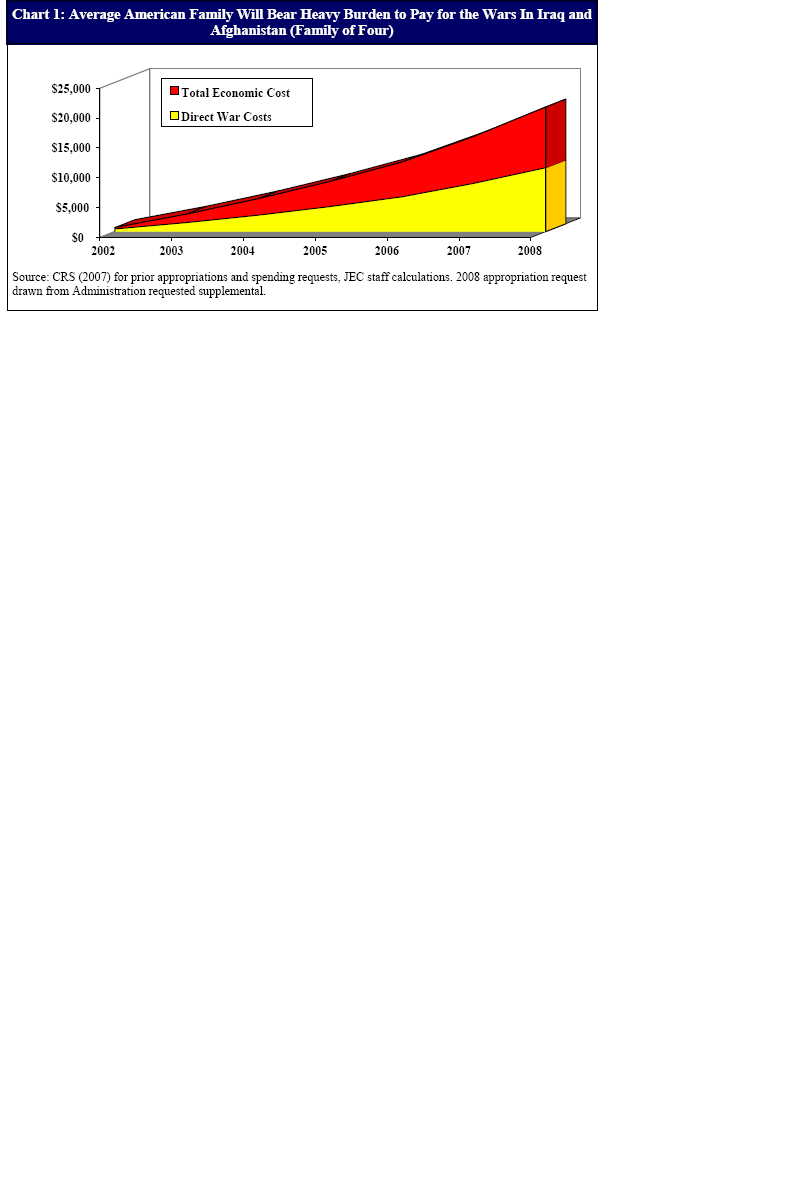
I'll shortly upload text versions of the press release and the full report, but meanwhile the original pdfs linked below are not very burdensome to download: the full report includes graphs and charts suitable for printing, I've uploaded the chart that shows the growing cost of this war to US families.
Here is the press release from the Joint Economic Committee:
http://jec.senate.gov/Documents/Releases/11.13.07IraqReportRelease.pdf
and the full report is here:
http://jec.senate.gov/Documents/Releases/11.13.07IraqReportRelease.pdf
More details are available at the senate website: http://jec.senate.gov/
David Roknich,
DOGSPOT
Donate

$115.00 donated
in the past month
Get Involved
If you'd like to help with maintaining or developing the website, contact us.
Publish
Publish your stories and upcoming events on Indybay.