







 Publish to Newswire
 Add an Event
Ecuador: New President sets Sights on Free Software
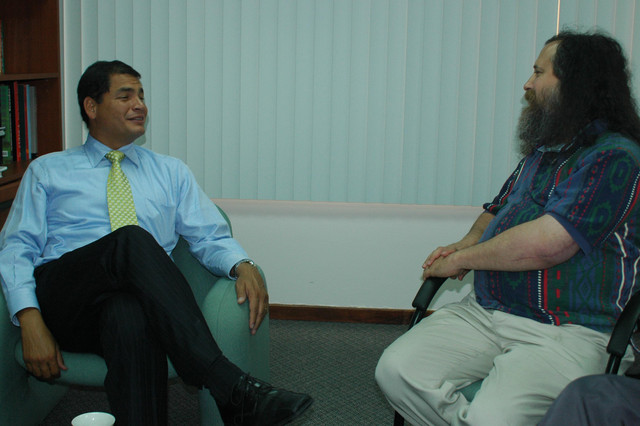
[…] Stallman spoke [to Correa] for almost 20 minutes nonstop, without Correa saying anything, just listening. After Stallman was finished speaking, there were a few questions and a small conversation ensued, in which both completely agreed and Correa asked his advisors if Ecuador should migrate to free software. Without hesitation, they said yes, and everyone parted with a full-blown smile on their faces, Stallman included […]According to another report, the president-elect, Rafael Correa in the meeting with Richard Stallman, committed Ecuador to eliminating the censorship of free software in the country.
Richard Stallman was touring Ecuador attending Universities talking about Free Software and the problems of copyright. Stallman rejects the application of copyright laws to ideas and computer science. The GNU General Publication Licence was the first 'copyleft' licence which enabled the Open Source and Free Software/Software Libre Movements to cooperatively build software that respects the freedom of software users.
Of course, making a decision in principle, and succeeding in the implementation are worlds apart. Obstruction by software companies is likely, as well as bureacratic resistance to migrating to new systems.
According to the Rzone Blog page, the challenge is now to form the Ecuadorian Association of Software Libre.
The RZone blog forecasts obstruction: "Initially, proprietary software companies will wield the flag of 'market economies and the freedom to choose'. Which we all know to be duckspeak, because freedom in software is not a matter of dollars but principles."
"Later on in the game, Rafael Correa, and the rest of the free software movement in Ecuador, will face enormous pressure from foreign organizations. That pressure will come in the form of threats of economic sanctions, withholding of privileges, and it might even escalate to blatant coup d’etat attempts."
But the RZone blog is optimistic for the future: "But make no mistake: we will succeed. We will leverage every legal and morally just resource to get there. It’s not just a battle for software: it’s a battle for free culture. Our free culture, which is slowly being eaten away by monopoly interests from unscrupulous people and corporations."
Background
Correa was elected President of Ecuador on November 27, 2006, on a leftist platform with support from much of the countries poor and indigenous. He received 56.7% of the votes against the 43.3% for right-wing opponent, banana tycoon Álvaro Noboa. His presidency will formaly start on Jan 15, 2007 and run for 4 years.
But the Ecuador parliament remains hostile to his program. Correa has repeatedly referred to it as a "sewer" of corruption. Reforming the constitution will also be an up hill battle with a legislature that has sufficient votes to impeach him.
Correa's plan for Government includes the development of the country's transport infrastructure network to boost commercial trade, developing potable water and sewerage services, and other basic services, increasing energy production, and improving Ecuador's agricultural production.
On December 10, Rafael Correa, said that he will not sign a free trade agreement with the United States but will seek extended trade preferences under an anti-drug agreement. This comes after Trade agreement talks between the U.S. and Ecuador derailed in May, after Ecuador canceled the operating contract of California-based Occidental Petroleum Corp.
Correa has also threatened to not renew the lease on a US military base in Ecuador, currently with 400 soldiers stationed and the staging ground for drug surveillance flights. "If they want," Correa has said ironically, "we won't close the base in 2009, but the United States would have to allow us to have an Ecuadoran base in Miami in return."
Ecuador is an oil exporter and Corea has already announced the need to renegotiate contracts, according to a Bloomberg report: "Conditions have changed and some contracts do not reflect that; some old contracts pay almost nothing on producing wells," Correa told reporters at a summit of Latin American leaders in Cochabamba, Bolivia. "We need to make sure that the average returns are sufficient for the needs of the country."
Some commentators belief that Correa will be a pragmatic leader with a number of symbolic and rhetorical gestures to satisfy his supporters while not defaulting on debt or seizing corporate assets. Joseph Stiglitz, a former chief economist at The World Bank said "He knows the realities of global economics,". Indeed, Correa is a US trained economist.
Sources
- RZone 13 Dec, 2006 : Success for free software in Latin America!
- RZone 13 Dec, 2006 : ¡Excelentes noticias para el Ecuador! ¡Richard Stallman habla con el presidente electo, Rafael Correa!
- Correa se comprometió a liberar las barreras del software libre en el país
- Open Ecuador - Photos: Richard Stallman in Ecuador
- Counterpunch via Znet, Nov 29 2006: The Rise of Rafael Correa Ecuador and the Contradictions of Chavismo
- Forbes Dec 11 , 2006: Ecuador's Correa On The Hot Seat
- Bloomberg Dec 9, 2006: Ecuador Plans `Case By Case' Oil-Lease Renegotiation
- See also Free Software Foundation and GNU project
Donate

$85.00 donated
in the past month
Get Involved
If you'd like to help with maintaining or developing the website, contact us.
Publish
Publish your stories and upcoming events on Indybay.