







 Publish to Newswire
 Add an Event
From the Open-Publishing Calendar
From the Open-Publishing Newswire
Indybay Feature
Fri May 14 2004
Battles in Najaf and Karbala Could Spark A Shi'ite Civil War
najaf
5/14/2004:
On May 6th, the US began its first major assault on Shi'ite insurgents. Troops entered Diwaniya and Karbala and attacking strongholds of Sadr's Mehdi militia. Also on the 6th, the US appointed Adnan al-Dhurfi as the governor for the city
of Najaf, moving tanks into the city to "secure" the
governor's offices. Sadr's initial response was in Basra where hundreds of militia men took over portions of the city, but within a day the
British claimed to have quelled the revolt.
On Friday May 7th, Sadr's Shi'ite supporters were invited to pray at Sunni mosques in
Baghdad in a show of unity against the US occupation. Sadr himself spoke at a mosque in Kufa
demanding that Bush face trial for the abuse of
Iraqi prisoners at Abu Ghraib.
The US assault on Karbala continued into the
weekend.
On Saturday May 8th, the US attacked the Sadr City
neighborhood in Baghdad and destroyed offices
belonging to Sadr's supporters. While dozens were
killed in the US raid, Iraqis stood strong in the face of the US assault, as Baghdad residents quickly gathered to help rebuild the buildings destroyed by the US.
Unrest continued throughout the week in Najaf and Karbala. Insurgents also blasted an oil pipeline, slashing Iraq's daily oil exports by about 25 per cent.
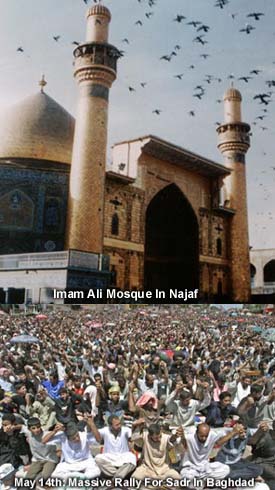
On Thursday May 13th, fighting in Karbala intensified with battles taking place near the Imam Abbas and Imam Hussein shrines. On Friday May14th, US tanks attacked Sadr militia members in the cemetary in Najaf. As US tanks moved in, fire from the tanks damaged the dome of the Shrine of Ali, the most sacred Shi'ite holy site.
"Sadr and SCIRI are the two main Shia parties controlling the southern region of Iraq now, but the party and militias of Sadr are much more popular" On May 7th, "the SCIRI spokesman indirectly announced the beginning of the new Shia-Shia conflict. From the SCIRI position, I think they find themselves committed to criticizing any anti-occupation movement, because they are the main player in the GC[Governing Council]". The most popular religious leader in Iraq, Sistani has been quiet during the latest fighting and hasn't even made a statement about the pictures of torture and humiliation in US prison camps. The latest fighting in Najaf and the damage done to Shi'ite holy sites will guarantee some sort of response. If Sistani sides with the US he could lose much of his support and spark a civil war and if he sides with Sadr he will lose much of his power over US backed Shi'ites in the governing Council. He will almost certainly try to ride the fence, but his unwillingness to take tough stands on issues that are impacting the Shi'ite holy cities is already starting to chip away at his popularity.
"Sadr and SCIRI are the two main Shia parties controlling the southern region of Iraq now, but the party and militias of Sadr are much more popular" On May 7th, "the SCIRI spokesman indirectly announced the beginning of the new Shia-Shia conflict. From the SCIRI position, I think they find themselves committed to criticizing any anti-occupation movement, because they are the main player in the GC[Governing Council]". The most popular religious leader in Iraq, Sistani has been quiet during the latest fighting and hasn't even made a statement about the pictures of torture and humiliation in US prison camps. The latest fighting in Najaf and the damage done to Shi'ite holy sites will guarantee some sort of response. If Sistani sides with the US he could lose much of his support and spark a civil war and if he sides with Sadr he will lose much of his power over US backed Shi'ites in the governing Council. He will almost certainly try to ride the fence, but his unwillingness to take tough stands on issues that are impacting the Shi'ite holy cities is already starting to chip away at his popularity.
2026-04-19
Peninsula Open Space Trust Purchases 2,284 Acres of Sacred Amah Mutsun Lands
Front Page
| Environment & Forest Defense
| Racial Justice
| South Bay
| California
| Americas
| Santa Cruz Indymedia2026-04-06
"Factory Farm Watch" Website Aims to Hold Factory Farms Accountable
Front Page
| California
| Animal Liberation2026-04-03
Millions March Against Trump's Authoritarianism, Xenophobia, and War
Front Page
| Anti-War
| Global Justice & Anti-Capitalism
| Central Valley
| San Francisco
| Peninsula
| California
| U.S.
| Government & Elections
| Palestine
| Immigrant Rights2026-02-04
Protest in San Francisco Demands TPS Protection for Haitians
Front Page
| San Francisco
| U.S.
| Haiti
| Immigrant Rights2026-01-20
Convict Killer ICE Agent Jonathan Ross
Front Page
| Police State & Prisons
| Labor & Workers
| Global Justice & Anti-Capitalism
| San Francisco
| South Bay
| East Bay
| Peninsula
| North Coast
| U.S.
| Americas2026-01-15
Hundreds of "Free America Walkouts" Were Organized on January 20
Front Page
| Police State & Prisons
| Anti-War
| Womyn
| Central Valley
| San Francisco
| South Bay
| East Bay
| Peninsula
| North Bay / Marin
| North Coast
| California
| U.S.2025-12-24
Advocates Rally at Governor’s Office to Pardon UC Berkeley
Student Zoe Rosenberg
Police State & Prisons
| Education & Student Activism
| Central Valley
| East Bay
| North Bay / Marin
| California
| Government & Elections
| Animal Liberation2025-12-23
Our Faiths Teach Us: Love Thy Neighbor, Disrupt Injustice
Police State & Prisons
| San Francisco
| California
| Americas2025-12-16
There's Nothing More Despicable and Dangerous Than a Mercenary
Anti-War
| California
| U.S.
| Americas2025-11-16
"People Over Billionaires" March Tours San Francisco's Ritziest Neighborhood
Health, Housing & Public Services
| Global Justice & Anti-Capitalism
| San Francisco2025-11-15
First Day of Starbucks Strike Shuts Down Stores in Santa Cruz
Labor & Workers
| Peninsula
| Santa Cruz Indymedia

We are 100% volunteer and depend on your participation to sustain our efforts!
Donate

$140.00 donated
in the past month
Get Involved
If you'd like to help with maintaining or developing the website, contact us.
Publish
Publish your stories and upcoming events on Indybay.
Topics
More
Search Indybay's Archives
Advanced Search
►
▼
IMC Network