







 Publish to Newswire
 Add an Event
Feature Archives


Wed Apr 6 2005
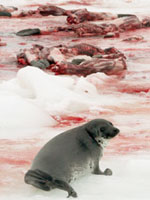
Canadian Hunt of 300,000 Seal Pups Continues
Despite being the target of protests since the 1960s, recent worldwide protests prior to the hunt, and the presence at the hunt itself of numerous protestors from organizations such as the Humane Society of the United States (HSUS) and Sea Shepherd, this year's Canadian seal hunt, which started March 29th, continues unabated with 20-30,000 pups being killed per day. Many countries, including the United States, ban imports of seal products. The hunt, though, still earned about $16.5 million last year, mostly from pelt sales to Norway, Denmark and China. Clubs, rifles and spears are used to kill the animals en masse for their fur. Regulations require that hunters ensure their prey is dead before moving on but animal activists say they have witnessed otherwise and that the pups are are often skinned alive. Up to 300,000 seal pups may be legally slaughtered per year, as the Canadian government has recently increased the totals allowed. Confrontations between hunters and observers have become heated at times. Hunters have physically attacked some observers. Gunfire has also been used seemingly to scare off those who are lawfully observing the hunts. There are laws which govern how close to a hunt observers may come (10 meters) and several animal activists have been beaten and arrested by authorities for breaching this distance although the activists deny they were in violation of the perimeter of an active hunt. This year, HSUS has called for a boycott of Canadian seafood by American distributors, restaurants, and consumers to exert economic pressure on the Canadian government to stop future seal hunts.
Wed Mar 30 2005
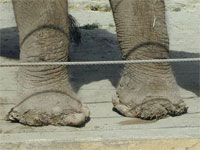
Tinkerbelle, from SF Zoo, Dies at PAWS Sanctuary
Early in 2004, Calle, an Asian elephant, and Maybelle, an African elephant, both died at the SF Zoo due to captivity-related health problems. Their deaths set into motion a maelstrom that involved animal rights activists, sanctuaries, politicians, and zoo accreditators. After nearly 9 months of hard work by activists (letter writing, attending City meetings, leafleting the zoo every weekend, gathering signatures, monitoring the elephants, etc), the SF Zoo decided to transfer an Asian elephant named Tinkerbelle to the Performing Animal Welfare Society (PAWS) sanctuary where she would have the space that elephants need to stay healthy. The American Zoo and Aquarium Association threatened to remove the SF Zoo's accreditation if Tinkerbelle was not transferred to another zoo instead. Despite the threat, after spending 37 years in a small enclosure at the zoo, Tinkerbelle was moved to the sanctuary on November 28, 2004. At the time, Tinkerbelle was already in very "fragile" condition due to the severe arthritis and foot and joint problems she had developed at the zoo. Activists had hoped the move was not too late. In December of 2004, the SF Board of Supervisors approved a law that contains so many restrictions for keeping elephants that it amounts to a de facto ban on them for the SF Zoo. Lulu, an African elephant, the last elephant at the SF Zoo, was moved to PAWS on March 10, 2005. Unfortunately, on March 24, after only 4 months at the sanctuary, Tinkerbelle collapsed and was subsequently euthanized. Many reacted with sadness to the news as elephants in the wild survive nearly twice as long as those in captivity. Some turned to anger, publicly questioning the care Tinkerbelle received at the sanctuary. Most, though, found solace in the fact that the larger battle to remove elephants permanently from the zoo has been won and there will be no more Tinkerbelles at the SF Zoo.
Recent Accounts of Tinkerbelle at PAWS:
Report | Video
Recent History of Tinkerbelle: 1 | 2 | 3
Contention Over Tinkerbelle's Care at PAWS: 1 | 2 | 3 | 4
Captive Elephants Elsewhere: Anchorage 1 | 2, Connecticut, Chicago (#3), Detroit, & Central Valley, CA
IDA's Campaign to Help Stamp Out Captive Elephant Foot Disease
Recent History of Tinkerbelle: 1 | 2 | 3
Contention Over Tinkerbelle's Care at PAWS: 1 | 2 | 3 | 4
Captive Elephants Elsewhere: Anchorage 1 | 2, Connecticut, Chicago (#3), Detroit, & Central Valley, CA
IDA's Campaign to Help Stamp Out Captive Elephant Foot Disease

Sun Mar 27 2005
Easter Weekend Honey-Baked Ham Demo
As Easter Sunday approached, a day that also marks the beginning of spring and the rebirth of life in nature, a number of activists used the occasion to remind the public that the holiday is meant to be a celebration of life by demonstrating and distributing infomation against the Easter-related exploitation of animals, from pigs and ducks to rabbits and baby chicks.
On Saturday March 26, members of Bakersfield Alliance for Animals protested Honey-Baked Ham sales in the Central Valley.
The Bakersfield Alliance for Animals demonstrated outside of the Honey-Baked Ham store on Ming Ave. to discourage people from buying hams for Easter Day. There were eight of them there, holding signs saying such things as "Does your food have a face?" and "Why call some animals pets and others food?" A couple even had gruesome pictures of how pigs are treated in the factory farms that they were raised in.
Photos
More Info on Easter and Animals: In Defense of Animals | Viva!USA
More Info on Easter and Animals: In Defense of Animals | Viva!USA
Tue Mar 22 2005
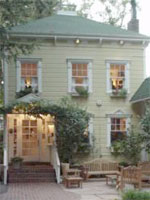
Activists Call for Boycott of Lark Creek Inn in Marin
The Lark Creek Inn Restaurant in Larkspur has not returned activists calls for a meeting to discuss the end of the sale of foie gras at their restaurant with local activists. Activists have hand delivered letters, packages of facts and video tape footage of the cruel process of producing foie gras to the restaurant. The Marin Peace and Justice Animal Rights Committee is now officially calling for a boycott of The Lark Creek Inn restaurant until they stop buying and selling foie gras. Foie Gras is a product of ducks being force fed nearly four pounds of corn mush a day through metal pipes shoved down the birds’ throats until their livers explode and they die. The three daily force-feedings frequently choke, injure or kill the birds by gouging open their throats with the metal pipe. By the end of the force-feeding process, ducks are physically debilitated with livers five to ten times normal size and many are unable to stand or walk. Read more
Sun Mar 20 2005
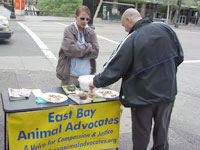
Great American Meatout March 20th 2005
In 1985, the first Great American Meatout was called for in reaction to the U.S. Senate's attempt at the time to endorse a National Meat Week. Starting from a single event that year, it has grown into an international action observed in all 50 states and 21 countries. It is now the world's largest and oldest annual grassroots diet education campaign. Activities include street theater, lectures, public dinners, food samplings, leafleting, and information tables called "steakouts." It is a day when vegetarians ask family, friends, and the general public to consider going meatless for a day, a week, or even a lifetime. People are encouraged to "kick the meat habit on March 20 (first day of spring) and explore a wholesome, nonviolent diet of fruits, vegetables and whole grains." Locally, for the 20th annual Great American Meatout, East Bay Animal Advocates sponsored a vegetarian feed-in in front of the Burger King at 13th and Broadway in Oakland. Information on the negative effects of modern industrial animal farming and the healthy and environmentally-sound option of vegetarianism was offered to the public, as well as samples of vegetarian turkey "deli slices".
Reports & Photos: Oakland · Meatout.org

Fri Mar 18 2005
Worldwide Protests Against Canadian Seal Hunt
On Tuesday, March 15, In Defense of Animals (IDA) joined dozens of animal and environmental protection groups in a massive worldwide protest of the annual Canadian seal slaughter scheduled to begin just days from now. Every year, the Canadian Government sanctions the killing of 350,000 seals off the country's eastern shores, most of whom are just days or weeks old, and are shot, beaten, stabbed and often skinned alive. Many eyewitnesses have even seen hunters sadistically torturing seals with apparent pleasure and absolutely no regard for the animals' pain. Demonstrations were held in 50 cities in twenty-eight countries, including four Canadian provinces.
Read More with Photos

Mon Mar 14 2005
Erik Marcus Speaks at Red Vic in SF
For this year's "Great American Meatout", Bay Area Vegetarians have organized 4 events. The first happened March 6th, at the Red Vic Peace Center B&B in San Francisco. They sponsored a presentation by Erik Marcus, the author of Vegan: the New Ethics of Eating, publisher of vegan.com, a website dedicated to the vegan lifestyle, and host of the podcast show "Erik's Diner" that covers various aspects of veganism and animal agriculture.
Erik Marcus spoke to a full house on his newest book, Meat Market: Animals, Ethics, and Money.
He talked about the issues and problems with factory farming, and then discussed and critiqued the current vegetarian, animal welfare, and animal rights movements. He proposed a fourth movement called "dismantlement", a systematic approach to tackling the huge animal agriculture behemoth.
He also emphasized the importance of outreach to youth and college students. When a young person transitions to a vegetarian or vegan diet, thousands of animals will be spared.
After the presentation, Erik signed books and was available for discussion.
Read More with Photos