Publish to Newswire
 Add an Event
Feature Archives
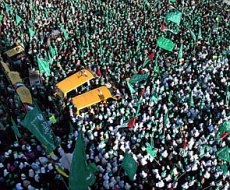
According to Ali Abunimah, from writing on Electronic Intifada:
The election result is not entirely surprising, however, and has been foreshadowed by recent events. Take for example the city of Qalqilya in the north of the West Bank. Hemmed in by Israeli settlements and now completely surrounded by a concrete wall, the city's fifty thousand residents are prisoners in a Israeli-controlled giant ghetto. For years Qalqilya's city council was controlled by Fatah but after the completion of the wall, voters in last years' municipal elections awarded every single city council seat to Hamas. The Qalqilya effect has now spread across the occcupied territories, with Hamas reportedly winning virtually all of the seats elected on a geographic basis. Thus Hamas' success is as much an expression of the determination of Palestinians to resist Israel's efforts to force their surrender as it is a rejection of Fatah. It reduces the conflict to its most fundamental elements: there is occupation, and there is resistance.
For Palestinians under occupation, it is not yet clear what Hamas' win will mean. It is now common to speak of a Palestinian "government" being formed out of the election results, as though Palestine were already a sovereign and independent state. But if the first duty of a government is to protect its people's lives, liberty and property, then the Palestinian Authority has never deserved to be called a government. Since its inception, it has not been able to protect Palestinians from lethal daily attacks by the Israeli army in the heart of their towns and refugee camps, or to prevent a single dunum of land being seized for settlements, nor to save a single sapling of the more than one million trees uprooted by Israel in the past ten years. Rather, in Israel's conception the Palestinian Authority was supposed to crush Palestinian resistance to make the occupied territories safe for continued Israeli colonization.
Democracy Now Coverage | Hamas to Form Cabinet, Loser Fatah Not Joining | Hamas victory redraws political map of Middle East | Who's who in Hamas | Hamas claims victory | How Israel and the United States Helped to Bolster Hamas | Abbas Urges Respect of Result, West Alarmed | Palestinian PM and cabinet resign | Israeli Arab MKs: Hamas win will help peace process | Palestinian Elections: Forcing the West to awake to the voices of the people | Hamas Election Victory: A Vote for Clarity | Listening to the Voices of Palestine | Bush Calls Hamas Kettle Black
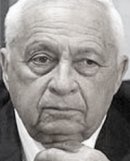
Sharon was one of the main planners of the 1982 Israeli invasion of Lebanon and was widely blamed as being responsible for the massacre of thousands of civilians in the Sabra and Shatila refugee camps. On September 28, 2000 Sharon provoked a riot at the al-Aqsa mosque when he visted the Temple Mount with 1,000 Israeli troops and proclaimed the area eternal Israeli territory. The rioting soon spread and became the second Intifada. Less than a year later, Sharon was elected Prime Minister of Israel. In August 2005, Sharon pulled Israeli settlers out of Gaza in a move which split his Likud party. On November 21, 2005, Sharon resigned as head of Likud, and dissolved parliament to form a new centrist party called Kadima. With Sharon's incapacitation, Deputy Prime Minister Ehud Olmert is Acting Prime Minister of Israel.
An Expanded Brief History of Palestine | Wikipedia: Ariel Sharon | Uri Avnery & Rabbi Michael Lerner Discuss the Future of Israel | Israel: Sharon’s stroke plunges Israel into political turmoil | Pat Robertson: PM's stroke result of God's 'enmity' for Gaza pullout | Michael Lerner: The Loss of Ariel Sharon | Poll shows Kadima will sweep elections even without Sharon | Al-Ahram: Exalting Sharon
Hamas has backed hundreds of candidates in the ongoing municipal elections in the West Bank and Gaza Strip, and has taken nearly a third of the seats. They will likely increase their number of seats in the upcoming elections. "[T]he participation or otherwise of Hamas in Palestinian legislative elections presents Abbas and the PA with a real dilemma. On the one hand, the exclusion of Hamas would eviscerate the elections of credibility and democratic substance. Palestinians would view the poll as a big joke. On the other hand, Hamas's participation could result in victory for Islamic candidates and drastically change the Palestinian political panorama." Sharon has warned that Israel will prevent the organisation of the January elections if the PA failed to disarm Hamas and get it to "abandon its anti-Zionist ideology". "We will make every effort not to help the Palestinians. I don't think they can have elections without our help," Sharon was quoted as telling reporters.
New Israeli incitement campaign against Hamas | Under Israeli Fire, Palestinians Vote in Local Polls | US softens opposition to Hamas role | Hamas parliamentary candidates arrested
For the first time since the start of the intifada, more Palestinians have been killed in internal violence since the start of the year than those who have died in clashes with Israel, according to an official report published Thursday. The Israel Defense Forces has advised the government to release additional Palestinian prisoners, in an effort to strengthen Palestinian Authority Chairman Mahmoud Abbas.
With Israel constantly narrowing the horizons with roadblocks, mass arrests and separation walls, Palestinians this week were closer than ever to a point of implosion. In Gaza, a fortnight of accumulating tension between the PA and Hamas culminated in street clashes between the two sides, resulting in the deaths of three people. Both Hamas and the PA gave contradictory accounts of the Sunday night incident. Hamas accused PA police of having beaten Muhammed Rantisi, son of the late Hamas leader Abdul-Aziz Rantisi who was murdered by Israel over two years ago. The PA had an entirely different version. Interior Ministry spokesman Tawfik Abu Khusa said a routine patrol tried to resolve a scuffle between two citizens at an ATM machine. One of the two was Rantisi, who, the PA statement said, called upon Hamas supporters and fighters to come to his aid.
- Al-Ahram Weekly October 6th 2005
Armed groups join to denounce internal fighting | US, Israel provoking tensions | New group claims Hamas kidnapping | Israel mulls letting PA buy arms | PA police death in clash with Hamas | Fatah gunmen shoot senior Palestinian official
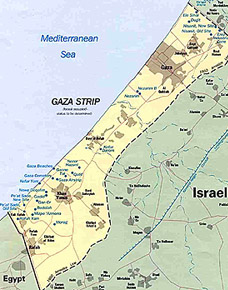
8/23/2005: Israeli troops have completed the evacuation of all settlers from the Gaza Strip and some settlers in the Northern West Bank. Read More
8/22/2005:"With virtually all Jewish settlers evacuated Monday from the Gaza Strip, Israeli forces began moving early today on two West Bank settlements where commanders fear there will be violent confrontations with anti-withdrawal activists."
Left behind in Gaza: A tattered economy | Evacuation of settlers hinders Palestinians' access to medical aid | Israel delays inking Philadelphi deployment deal with Egypt | Settlers vandalize at least eight West Bank villages
8/15/2005: Clashes broke out in the Gaza Strip as Israeli troops prepared to evict Jewish settlers.
Read More | Gaza: Disengagement diary | Israeli Settlers Resist Gaza Pullout
8/14/2005: Israeli and Palestinian forces have deployed to ensure calm in the final countdown to Israel's evacuation of Jewish settlements in the occupied Gaza Strip. Thousands of Israeli police blocked approaches to Gaza to keep back Jewish protesters sworn to stopping the first removal of settlements this week from land Israel captured in the 1967 Middle East war. Read More
8/11/2005: Palestinian security forces are gearing up to deploy 5,000 troops around settlements in the Gaza Strip as Israel intensified preparations just days before the historic pullout is to begin. Read More | Gaza boats mass to mark pullout
8/1/2005: On August 15th, Israel will start removing settlers from the Gaza Strip. "After 38 years of ugly occupation, they are leaving and they will never come back," Qureia said to the some 10,000 Palestinians gathered at a mass rally in the Parliament building in Gaza City in celebration Israel's upcoming withdrawal from the Gaza Strip. While this is often presented as a complete Israeli withdraw, the Palestinians in Gaza will likely still be under indirect Israeli rule with no control over their own borders. Some Palestinians see the "withdraw" as merely a smokescreen that is being used to prevent the world from questioning the expansion of settlements in the West Bank and the wall Israel is building within the 1948 borders, dividing Palestinian communities and likely resulting in expulsions.
Israel government officials predict that half the Jewish settlers in the Gaza Strip will likely refuse to relocate to Israel on time and will be removed by force. Some settlers have said they will try to give up Israeli citizenship and become Palestinian citizens so they can stay; Palestinian leaders said they would accept the change in citizenship but would still demand that the land the settlements are on be returned to the Palestinian people.
The Gaza Strip's borders were originally defined by the armistice lines between Egypt and Israel after the 1948 Arab-Israeli War, which followed the dissolution of the British mandate of Palestine. First controlled by Egyptian military, the Gaza Strip was later captured by Israel in the 1967 Six-Day War. Currently, around 1.37 million Palestinians and about 8,000 Israelis live in the Gaza Strip. The majority of these Palestinians are direct descendants of refugees who fled or were expelled from Israel in 1948 and most Jewish settlers in the Gaza Strip are Israeli citizens who moved into 21 guarded Israeli settlements after the 1967 Six-Day War.
Israel Prime Minister Ariel Sharon first announced a pullout of settlers from Gaza in 2004. On May 2nd of that year, Sharon's Likud party held a referendum and 65% of the voters voted against the idea. On June 6, 2004, Sharon's government approved an amended disengagement plan resulting in several resignations from his government. This left the Likud Party with a minority in the Israeli Parliament and forced a coalition government between Likud and Labour in January 2005. On February 16, 2005, the Knesset finalized and approved the plan with 59 in favor, 40 opposed, and 5 abstaining. A proposed amendment to submit the plan to a referendum was rejected (29-72). On March 17, 2005, the IDF Southern Command issued a military order prohibiting Israeli citizens who do not reside in the Gaza Strip settlements from relocating to that area. On May 9, 2005, the beginning of the evacuation of settlements was officially pushed back from July 20 to August 15 Read More.
Gaza: Between freedom and fear | Gaza: When Will it End? | Behind the smoke screen of the Gaza pullout | Abbas says Palestinians want peaceful Israeli pullout | It can't be Gaza Last
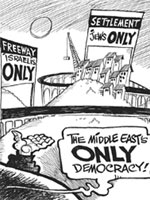
The Great Wall of Palestine marches on. It is generating direct non-violent resistance and civil disobedience on a scale unprecedented in the struggle against the Ihtilal (literally the ‘Suffocation’, the Palestinian term for the ‘Occupation’). For many months, the International Solidarity Movement and the new Israeli group Anarchists Against the Wall among others have been protesting in solidarity with local Palestinian villagers, attempting by non-violent direct action to block further construction of the Wall and the uprooting of Palestinian olive trees. For numerous families, that land and those trees are their sole means of support and central to their identity.
As a May 3, 2005 report on www.ainfos.ca stated:
"No. It is not the Makhnovitsa, nor is it the Spanish revolution... It is just the only region in the world anarchists are in nearly daily direct action confrontation with the state - in a non-violent action against Israeli settler colonialism and especially against the apartheid wall/fence used for the creeping transfer of the Palestinians. This morning the main Israeli radio already reported twice about the anarchists against the wall solidarity action at the Palestinian village Bil'in, the apartheid fence is cutting its fields and orchards. The radio reports on the ongoing activity in which the anarchists chained themselves to olive trees - to hinder the uprooting of an olive orchard situated on the route of the apartheid wall/fence."
Read More | Mahmoud Abbas And Bush
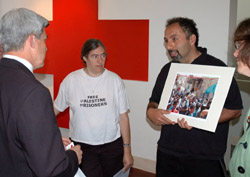
The ICRC is charged by the United Nations to monitor the conditions of prisoners and ensure that international laws governing those conditions are being followed. They are the only international organization which has regular access to Israeli prisons and the only ones who can arrange visits for families of prisoners or deliver clothes and other supplies. Prison activists and lawyers in the Occupied Palestinian Territories charge that the Red Cross is not carrying out frequent visits to central Israeli prisons, and has failed to deliver urgently needed supplies. They also are not aggressively demanding that Israel stop its illegal abuses of prisoners' human rights. In particular, this year's demonstrations highlighted the case of Manal Ghannam and her son, 18-month-old Nour, who are imprisoned in Telmond. Nour has been subjected to tear gas in the prison; he and Manal both have medical conditions which are not being treated by the prison officials, and Nour's relatives have not been allowed to bring any toys for him to play with.
Two dozen activists protested outside the Bay Area Red Cross offices in San Francisco on Monday, April 18, to spotlight the International Committee of the Red Cross's neglect of Palestinian political prisoners. They held up pictures of Palestinian prisoners and their families, and gave out several hundred fliers calling on passersby to contact the ICRC and demand they do their job. Photos | Sumoud
 36
36