







 Publish to Newswire
 Add an Event
Feature Archives
Thu May 25 2006
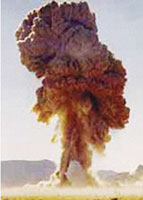
Stop The "Divine Strake" at the Nevada Test Site
Update: Government Withdraws Environmental Finding, Divine Strake Test Delayed Indefinitely
Divine Strake is the government’s latest venture into the realm of broken treaties, state-sponsored terror and the desecration of Mother Earth - a “bunker-busting” bomb which was scheduled to be detonated this June in the Nevada desert. The Shundahai Network, founded by Shoshone Elder Corbin Harney, says “this test could be a precursor” to a nuclear strike against Iran, “with massive civilian casualties.”
The Divine Strake Test, a test sponsored by the Defense Threat Reduction Agency (DTRA), is a detonation of a 700 ton buried heavy ammonium nitrate/fuel oil charge above a tunnel structure. The DTRA reports that the main purpose of the test is to study ground shock effects on deeply buried tunnel structures. Environmental activists and analysists predict, however, that the test is a preparation for the development of new nuclear weapons.
This affects all of us, but especially the Shoshone People downwind of the Nevada Test Site. Oral arguments were heard on May 25th and 26th, at the Nevada District Court in Reno, Nevada. May 28th was declared an International Day of Action and dozens of indigenous, environmental justice and peace and disarmament organizations converged at the Peace Camp outside the Nevada Test Site near Mercury, Nevada to protest the Divine Strake test scheduled for June 2nd, but now apparently postponed indefinitely.
 Video: Explanation of Divine Strake and Bechtel's Management of the Test Site ||
  Audio: Information and Call to Action
[ Divine Strake || Stop "Divine Strake" Bombing in Newe Sogobia (NTS) || Western Shoshone and Downwinders Again Ask Federal Court to Stop Mushroom Cloud Blast || Stop the Divine Strake || Disarmament Activist || Come Rebuild Our World || Earth Cycles Radio Project || Nevada Desert Experience || Citizen Alert || Utah Organizations || Send an Online Letter to a Local Publication ]
In San Francisco: Anti-Nuke Activists Disrupt UC Regents Meeting
In DC: Don't Attack Iran petition delivered to White House
Divine Strake is the government’s latest venture into the realm of broken treaties, state-sponsored terror and the desecration of Mother Earth - a “bunker-busting” bomb which was scheduled to be detonated this June in the Nevada desert. The Shundahai Network, founded by Shoshone Elder Corbin Harney, says “this test could be a precursor” to a nuclear strike against Iran, “with massive civilian casualties.”
The Divine Strake Test, a test sponsored by the Defense Threat Reduction Agency (DTRA), is a detonation of a 700 ton buried heavy ammonium nitrate/fuel oil charge above a tunnel structure. The DTRA reports that the main purpose of the test is to study ground shock effects on deeply buried tunnel structures. Environmental activists and analysists predict, however, that the test is a preparation for the development of new nuclear weapons.
This affects all of us, but especially the Shoshone People downwind of the Nevada Test Site. Oral arguments were heard on May 25th and 26th, at the Nevada District Court in Reno, Nevada. May 28th was declared an International Day of Action and dozens of indigenous, environmental justice and peace and disarmament organizations converged at the Peace Camp outside the Nevada Test Site near Mercury, Nevada to protest the Divine Strake test scheduled for June 2nd, but now apparently postponed indefinitely.
Video: Explanation of Divine Strake and Bechtel's Management of the Test Site || Audio: Information and Call to Action
[ Divine Strake || Stop "Divine Strake" Bombing in Newe Sogobia (NTS) || Western Shoshone and Downwinders Again Ask Federal Court to Stop Mushroom Cloud Blast || Stop the Divine Strake || Disarmament Activist || Come Rebuild Our World || Earth Cycles Radio Project || Nevada Desert Experience || Citizen Alert || Utah Organizations || Send an Online Letter to a Local Publication ]
In San Francisco: Anti-Nuke Activists Disrupt UC Regents Meeting
In DC: Don't Attack Iran petition delivered to White House



Fri Apr 21 2006
Youth And Power Was A Success
The 6th annual Youth And Power 2006, put together by the Watsonville Brown Berets, was a great success. It attracted youth from Watsonville, San Jose, Salinas, Santa Cruz, Aptos, the Bay Area, as well as L.A. and other locations. "Brown And Black Power" was the theme of this years event. Youth were educated about issues that affect us as a community and the social justice movement as well as entertained with great performers and special guests. The vets hall was full to its capacity, it was peaceful throughout the night and seeds were planted in young minds, the future soldiers of the movement. Read more and view photos
see also: An Open Letter to the Hip Hop Community on Immigration
 Photos: Heads Spin at Youth and Power 2006
Videos: Immortal Technique at Youth and Power 2006
download the videos: The "Invasion Tour" || Point of No Return || Fourth Branch || Peruvian Cocaine || History of Our People || Bin Laden || DJ GI Joe || Harlem Streets || Here Forever
see also: An Open Letter to the Hip Hop Community on Immigration
Photos: Heads Spin at Youth and Power 2006 Videos: Immortal Technique at Youth and Power 2006 download the videos: The "Invasion Tour" || Point of No Return || Fourth Branch || Peruvian Cocaine || History of Our People || Bin Laden || DJ GI Joe || Harlem Streets || Here Forever

Thu Apr 20 2006
Anti-Racists Prevent Neo-Nazi Rally Against Immigrants
The National Socialist Movement (a nazi white supremacist group) planned on holding an anti-immigration rally on the west steps of the state capitol in Sacramento on Saturday, April 22nd. An anti-Nazi rally was initially broken up by State Capitol CHP after they declared the gathering to be illegal, and then detained 3 protesters, claiming they needed a permit to be on capitol grounds. A group of 6 Nazis were congregating at the south end of the capitol, and the anti-racist march made its way over. After a short standoff, the CHP were heard telling the Nazis to leave after which they left without holding their rally.
Read More Anti-Racist Announcement
Read More Anti-Racist Announcement

On March 16th 2006,
the University of California's Board of Regents voted to divest from companies tied to the government of Sudan.
On April 30th, the San Francisco Bay Area Darfur Coalition sponsored a silent vigil for Sudan on the Golden Gate Bridge, followed by a rally in Presidio Park.
Photos: 1 | 2
|
3
|
4
|
Stanford STAND
|
Bay Area Darfur Coalition
|
Campus Divestment Campaign Targets Sudan
|
A strategy for divestment from Sudan
Five members of Congress, including Rep. Tom Lantos (D-San Mateo) were arrested on April 28th for engaging in civil disobedience in front of the Embassy of Sudan in Washington, DC. On March 16th, tens of thousands gathered for a demonstration in D.C. against the ongoing genocide in Sudan. At the last minute, organizers had to scramble to find someone who was either Sudanese or Muslim to speak at the rally when Sudanese immigrants realized that the announced speakers included no Muslims and no one from Darfur The Council on American Islamic Relations (CAIR) and other American Muslim groups, including the Islamic Society of North America, the Islamic Circle of North America, the Muslim Public Affairs Council, and the Muslim American Society Freedom Foundation, are members of the coalition. But no representative from these, or any Muslim coalition member, was allowed to speak. There were also very few African Americans who attended the rallies. While everyone aknowledges that attrocities are being comitted, some fear the US is pressing for a war with Sudan for purely economic reasons. Others fear that the right-wing interest in Sudan may be driven by a desire to demonize Arabs and Muslims, even though both the victims and perpetrators of attrocities in Sudan are frequently of the same religion and ethnic background.
Join Our H.O.P.E. for Darfur Campaign | Million Voices for Darfur Campaign | Africa Speaks
History Of The Conflict:
The conflict in Darfur began in February 2003 when JEM and SLM/SLA rebels attacked government forces and installations, accusing Sudan of oppressing non-Arabs in favor of Arabs. The government's response was aerial bombardment supporting ground attacks by a local tribal militia, the Janjaweed. Most observers believe that the Janjaweed are armed by the government of Sudan, but the government denies this. A long-running political battle between Sudanese President Omar Hassan Bashir and radical Islamic cleric (and former protector of Osama bin Laden) Hassan al-Turabi may have been one of the root causes of the conflict." Al-Turabi and Bashir are political rivals. Al-Turabi, though sequestered in his villa, has actively stimulated anti-government uprisings and is thought to have been one of the major backers of the JEM.
In 2004, Chad brokered negotiations, leading to the April 8 Humanitarian Ceasefire Agreement between the Sudanese government and the JEM and SLM. On November 9, 2004, the Sudanese government and the rebels signed two new accords; the first accord established a no-fly zone over rebel-controlled areas and the second granted international humanitarian aid agencies unrestricted access to the Darfur region. Despite the November 9 accords, violence in Sudan continued. In 2005, peace again looked close when on July 10th, SPLA founder John Garang was sworn in as Sudan's vice-president, but less than a month later Garang died in a helicopter crash. (The SPLA was the major rebel group in Sudan demanding democracy and an end to oppression but was not one of the groups fighting the Janjaweed)
On April 30th, 2006, the Sudanese government officially notified the African Union of accepting its proposed Darfur peace deal; part of the deal includes the disarming of the Janjaweed but it's not clear if this new agreement will have any more impact than previous ones and it has already been rejected by the rebels.
Wikipedia History | Pressure grows for Darfur peace | US Steps up Pressure on Khartoum Over Darfur | Main Darfur rebels accept deal | Darfur Peace in Jeopardy Over Rebels Split | Interpreter dies in Darfur camp protest | One-sided reporting that is delaying an end to the killing | Darfur: Inside the Crisis
Genocide And Humanitarian Crisis:
While the conflict has a political basis, and almost everyone on both sides have dark skin and are Muslims, it has also acquired ethnic and economic dimensions. Civilians are deliberately targeted on the basis of their ethnicity and much of the violence is also related to the competition between pastoralists (generally Arabic speaking) and farmers (non-Arabic speaking) for land and water. Both sides have been accused of committing serious human rights violations, including mass killing, looting, and rapes of the civilian population. However, the better-armed Janjaweed clearly have the upper hand. The conflict has been described as "ethnic cleansing" and "genocide." More than 1.8 million people had been displaced from their homes., and a recent British Parliamentary Report ( pdf ) estimates that over 300,000
people have died as a result of the conflict.
pdf ) estimates that over 300,000
people have died as a result of the conflict.
On April 28th 2006, it was announced that the UN is cutting in half its daily rations in Sudan's Darfur region due to a severe funding shortfall. More than 6.1 million people across Sudan require food aid - more than any other country in the world.
Experts Discuss the Sudan Crisis | There is hope in Darfur | Clooney urges action as Sudanese aircraft attack villages in Darfur | UN Sounds Alarm Over Malnutrition in Darfur | U.N.: Darfur Needs Strong Protection Force | BBC: Darfur crisis is 'as bad as ever' | Stunning photographs show the horror of genocide in Darfur | Rwandan nightmare is relived in Sudan | Democracy Now: Darfur Refugee and Top UN Envoy Discuss Crisis in Sudan | Sudan Government Pays Close to $1 Million for New York Times Supplement | Bankrupt peacekeeping mission leaves Darfur civilians exposed | Blood, Ink, and Oil: the Case of Darfur | DAFUR: the open sore of a continent
Regional Implications:
Since 2004, Janjaweed militants involved in the Darfur conflict have been attacking villages and towns in eastern Chad. Several rebel groups have emerged in the Chad-Sudan border region; the groups claim to be fighting against the corrupt and totalitarian government of Chad, but Chad claims they are linked to the government of Sudan. On December 18th, 2005, rebels attacked Chadian troops in the town of Adré, near the Sudanese border. Chad responded by declaring a 'state of belligerency' with Sudan. On January 6, 2006, Janjaweed militants crossed the border from Sudan into Chad and attacked the cities of Borota, Ade, and Moudaina.
On April 13th, 2006, rebels fought there way into N'Djamena, the capital of Chad. Accusing Sudan of backing a failed rebel assault on his capital, Chad's President Idriss Déby broke diplomatic ties with Khartoum, and warned the international community that 200,000 Darfur refugees would soon have to leave the country. UN Special Representative to Sudan, Jan Pronk issued a warning stating that Chad should "abide by its international obligations to secure the full protection and well-being of all refugees on its territories... Forcing refugees, who are the victims of previous conflicts, to flee again in the course of the current conflict, which is not of their making, would result in great additional suffering for them". Chad appears to have backed down from its initial threat, but the situation in Chad is still unstable.
Wikipedia: Chadian-Sudanese conflict | Chaos and killing spread to Sudan's neighbours | Chad threatens to halt oil export | Darfur: New Attacks in Chad Documented | Wikipedia: Battle of N'Djamena | Egypt massacres Sudanese demonstrators in Cairo
SaveDarfur.org | Wikipedia: Darfur conflict | Operation Sudan | The Crisis in Darfur | Darfur Information Center | CBC: Crisis Zone: Darfur, Sudan
Photos: 1 | 2
|
3
|
4
|
Stanford STAND
|
Bay Area Darfur Coalition
|
Campus Divestment Campaign Targets Sudan
|
A strategy for divestment from Sudan
Five members of Congress, including Rep. Tom Lantos (D-San Mateo) were arrested on April 28th for engaging in civil disobedience in front of the Embassy of Sudan in Washington, DC. On March 16th, tens of thousands gathered for a demonstration in D.C. against the ongoing genocide in Sudan. At the last minute, organizers had to scramble to find someone who was either Sudanese or Muslim to speak at the rally when Sudanese immigrants realized that the announced speakers included no Muslims and no one from Darfur The Council on American Islamic Relations (CAIR) and other American Muslim groups, including the Islamic Society of North America, the Islamic Circle of North America, the Muslim Public Affairs Council, and the Muslim American Society Freedom Foundation, are members of the coalition. But no representative from these, or any Muslim coalition member, was allowed to speak. There were also very few African Americans who attended the rallies. While everyone aknowledges that attrocities are being comitted, some fear the US is pressing for a war with Sudan for purely economic reasons. Others fear that the right-wing interest in Sudan may be driven by a desire to demonize Arabs and Muslims, even though both the victims and perpetrators of attrocities in Sudan are frequently of the same religion and ethnic background.
Join Our H.O.P.E. for Darfur Campaign | Million Voices for Darfur Campaign | Africa Speaks
History Of The Conflict:
The conflict in Darfur began in February 2003 when JEM and SLM/SLA rebels attacked government forces and installations, accusing Sudan of oppressing non-Arabs in favor of Arabs. The government's response was aerial bombardment supporting ground attacks by a local tribal militia, the Janjaweed. Most observers believe that the Janjaweed are armed by the government of Sudan, but the government denies this. A long-running political battle between Sudanese President Omar Hassan Bashir and radical Islamic cleric (and former protector of Osama bin Laden) Hassan al-Turabi may have been one of the root causes of the conflict." Al-Turabi and Bashir are political rivals. Al-Turabi, though sequestered in his villa, has actively stimulated anti-government uprisings and is thought to have been one of the major backers of the JEM.
In 2004, Chad brokered negotiations, leading to the April 8 Humanitarian Ceasefire Agreement between the Sudanese government and the JEM and SLM. On November 9, 2004, the Sudanese government and the rebels signed two new accords; the first accord established a no-fly zone over rebel-controlled areas and the second granted international humanitarian aid agencies unrestricted access to the Darfur region. Despite the November 9 accords, violence in Sudan continued. In 2005, peace again looked close when on July 10th, SPLA founder John Garang was sworn in as Sudan's vice-president, but less than a month later Garang died in a helicopter crash. (The SPLA was the major rebel group in Sudan demanding democracy and an end to oppression but was not one of the groups fighting the Janjaweed)
On April 30th, 2006, the Sudanese government officially notified the African Union of accepting its proposed Darfur peace deal; part of the deal includes the disarming of the Janjaweed but it's not clear if this new agreement will have any more impact than previous ones and it has already been rejected by the rebels.
Wikipedia History | Pressure grows for Darfur peace | US Steps up Pressure on Khartoum Over Darfur | Main Darfur rebels accept deal | Darfur Peace in Jeopardy Over Rebels Split | Interpreter dies in Darfur camp protest | One-sided reporting that is delaying an end to the killing | Darfur: Inside the Crisis
Genocide And Humanitarian Crisis:
While the conflict has a political basis, and almost everyone on both sides have dark skin and are Muslims, it has also acquired ethnic and economic dimensions. Civilians are deliberately targeted on the basis of their ethnicity and much of the violence is also related to the competition between pastoralists (generally Arabic speaking) and farmers (non-Arabic speaking) for land and water. Both sides have been accused of committing serious human rights violations, including mass killing, looting, and rapes of the civilian population. However, the better-armed Janjaweed clearly have the upper hand. The conflict has been described as "ethnic cleansing" and "genocide." More than 1.8 million people had been displaced from their homes., and a recent British Parliamentary Report (
pdf ) estimates that over 300,000
people have died as a result of the conflict.
On April 28th 2006, it was announced that the UN is cutting in half its daily rations in Sudan's Darfur region due to a severe funding shortfall. More than 6.1 million people across Sudan require food aid - more than any other country in the world.
Experts Discuss the Sudan Crisis | There is hope in Darfur | Clooney urges action as Sudanese aircraft attack villages in Darfur | UN Sounds Alarm Over Malnutrition in Darfur | U.N.: Darfur Needs Strong Protection Force | BBC: Darfur crisis is 'as bad as ever' | Stunning photographs show the horror of genocide in Darfur | Rwandan nightmare is relived in Sudan | Democracy Now: Darfur Refugee and Top UN Envoy Discuss Crisis in Sudan | Sudan Government Pays Close to $1 Million for New York Times Supplement | Bankrupt peacekeeping mission leaves Darfur civilians exposed | Blood, Ink, and Oil: the Case of Darfur | DAFUR: the open sore of a continent
Regional Implications:
Since 2004, Janjaweed militants involved in the Darfur conflict have been attacking villages and towns in eastern Chad. Several rebel groups have emerged in the Chad-Sudan border region; the groups claim to be fighting against the corrupt and totalitarian government of Chad, but Chad claims they are linked to the government of Sudan. On December 18th, 2005, rebels attacked Chadian troops in the town of Adré, near the Sudanese border. Chad responded by declaring a 'state of belligerency' with Sudan. On January 6, 2006, Janjaweed militants crossed the border from Sudan into Chad and attacked the cities of Borota, Ade, and Moudaina.
On April 13th, 2006, rebels fought there way into N'Djamena, the capital of Chad. Accusing Sudan of backing a failed rebel assault on his capital, Chad's President Idriss Déby broke diplomatic ties with Khartoum, and warned the international community that 200,000 Darfur refugees would soon have to leave the country. UN Special Representative to Sudan, Jan Pronk issued a warning stating that Chad should "abide by its international obligations to secure the full protection and well-being of all refugees on its territories... Forcing refugees, who are the victims of previous conflicts, to flee again in the course of the current conflict, which is not of their making, would result in great additional suffering for them". Chad appears to have backed down from its initial threat, but the situation in Chad is still unstable.
Wikipedia: Chadian-Sudanese conflict | Chaos and killing spread to Sudan's neighbours | Chad threatens to halt oil export | Darfur: New Attacks in Chad Documented | Wikipedia: Battle of N'Djamena | Egypt massacres Sudanese demonstrators in Cairo
SaveDarfur.org | Wikipedia: Darfur conflict | Operation Sudan | The Crisis in Darfur | Darfur Information Center | CBC: Crisis Zone: Darfur, Sudan

Thu Mar 9 2006
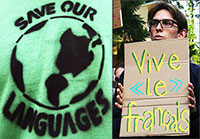
Students Rally to Prioritize Languages at UCSC
On March 8, more than 100 students held a rally outside the UC Santa Cruz Academic Senate's quarterly meeting to demand the prioritization of the language program at the university. They expressed frustration over lucrative salaries and perks for top-administrators, and excessive amounts of money going towards war in Iraq, while students and workers are told there is a 'budget crisis' that requires cuts to needed programs.
Wednesday's 'Save Our Languages' rally marks a second consecutive year of student protests to secure funding for UCSC's language program. While students noted that the current level of funding has been secured for next year, they continue to struggle to ensure that languages are prioritized permanently and that students are not turned away from classes. They insist the UC is in the midst of a 'priorities crisis,' rather than a 'budget crisis.' Read more and view photos
Wednesday's 'Save Our Languages' rally marks a second consecutive year of student protests to secure funding for UCSC's language program. While students noted that the current level of funding has been secured for next year, they continue to struggle to ensure that languages are prioritized permanently and that students are not turned away from classes. They insist the UC is in the midst of a 'priorities crisis,' rather than a 'budget crisis.' Read more and view photos
Fri Feb 10 2006
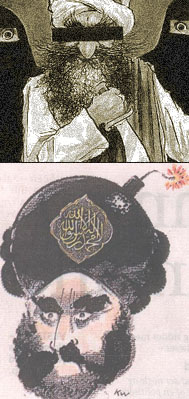
Racist Cartoons In Europe Spark Protests Worldwide
On September 30th, 2005,
Denmark's most widely read newspaper, Jyallands Posten,
published a set of cartoons depicting
Muhammad. The editor of Jyallands Posten claimed to have commissioned the cartoons after a children's book illustrator refused
to use his real name out of concern that any depiction of Muhammad might offend some Muslims. While the children's book was
meant to teach Dutch children respect for other religions (and received no complaints from Muslim readers), the cartoons
Jyallands Posten published were full of racist stereotypes associating all Muslims with violence and misogyny.
Muslim leaders in Denmark sent letters to Jyallands Posten complaining about the racist cartoons. Not only did the newspaper refuse to apologize, but many of those who sent letters received threats and more racist cartoons via email. Anti-immigrant, and specifically anti-Muslim, sentiments in Denmark have been on the rise for years with right-leaning political parties using immigration as the main issue in the election of February 2005 (with the current government relying on the rabidly anti-immigrant Danish People's Party as a key coalition partner). As Muslims in Denmark complained about racism in the media they were mainly met with anti-immigrant rhetoric in the press arguing that the Muslim population in Denmark was restricting the freedom for a newspaper to print racist cartoons without complaint.
Eleven Arab ambassadors asked for a meeting with Danish prime minister Anders Fogh Rasmussen on October 12th to register their protest, but the government declined. On October 27th, a number of Muslim organizations submitted complaints to the Danish police claiming that Jyllands-Posten had committed an offence under section 140 and 266b of the Danish Criminal Code. Section 140 of the Criminal Code prohibits any person from publicly ridiculing or insulting the dogmas of worship of any lawfully existing religious community in Denmark. Section 266b criminalizes the dissemination of statements or other information by which a group of people are threatened, insulted or degraded on account of their religion. On January 6th 2006, the Regional Public Prosecutor in Viborg discontinued the investigation as he found no basis for concluding that the cartoons constituted a criminal offence.
As the Danish Muslim community felt increasingly isolated and under attack, a group of religious leaders toured the Middle East with a dossier containing the racist cartoons to make the broader Muslim community aware of the plight of Danish Muslims. On January 10th 2006, a small Norwegian Christian magazine, Magazinet, printed the drawings after getting authorization from Jyllands-Posten. While a protest of several thousand people had taken place in Denmark in September, until the end of January 2006, all other protests were formal complaints by religious and government officials. On January 29th, the Danish flag was burned at a protest in the West Bank and Danish NGO workers were threatened in Gaza. On January 31st a German newspaper republished several of the cartoons and as did many papers across Europe on February 1st and 2nd. Most of the newspapers displayed the images with a message that it was the right of newspapers to display such racist images rather than because they related to a breaking news story (a strange assertion when Indymedias have been legally threatened and even shut down in Europe over cartoons). On February 2nd protests continued in Gaza and also took place in Morocco. On February 3rd, protests took place in Jakarta and London. On February 4th, the Danish embassy was set on fire in Damascus and on February 5th the Danish consulate was set on fire in Beirut. On February 5th two protesters were shot to death protesting in Kabul and on February 6th two more demonstrators were shot to death in front of the main US base at Bagram with the death toll reaching 10 worldwide. World Socialist Website writes "It is noteworthy that those who have rallied to the defense of the right-wing anti-immigrant newspaper in Denmark that first published the racist cartoons have had little to say about the violence of repressive governments across the Middle East against their own people registering outrage over the widely disseminated insult to their religion."
Much of the mainstream media (and even networks like Air America) have commented on the riots with statements asking why Muslims would riot over something like this while "we have have learned to discuss religion civilly in the West". Juan Cole has responded by listing some recent religious riots in Europe and Ali Abunimah from Electronic Intifada has pointed out that it has only been a decade since a European genocide against Muslims in Bosnia. In the past five years there have been riots in India where 2000 muslims were killed by Hindu fundamentalists, arson attacks on mosques in Holland, thousands killed by the Russian military in Chechnya, and in the last month riots against Muslims in Australia. Yet, while extreme fundamentalists are constantly pointed to in order to justify European and American racism against Muslims, extremist neo-Nazi, fundamentralist Hindu, Jewish fundamentalist and Christian fundamentalist groups which attack Muslims don't result in a similar level of collective guilt even when the attacks occur during elections where anti-immigration rhetoric takes an overtly racist form.
Islam bashing part of racist war for empire | Danes Finally Apologize to Muslims | Freedom of Speech or Incitement to Violence? A Debate Over the Publication of Cartoons | Death toll mounts in worldwide protests against anti-Muslim cartoons | Questions of Rights vs. Responsibilities | Danish Newspaper At Heart of Controversy Rejected Drawings Lampooning Jesus Christ | Robert Fisk: Now Lebanon is Burning | More outrage over Prophet cartoons | Anti-Islamic Racism In The American Media | Do You Support Religious Intolerance As Long As It's Against Muslims? | Muslims 'R' us, not them | Islamophobia Rears Its Ugly Head | Danish Imams Fume at Cartoon Punishment | Cartoons and Bombs: Was Rice Right for Once? | New York Times columnist David Brooks proposes the ‘good crusade’

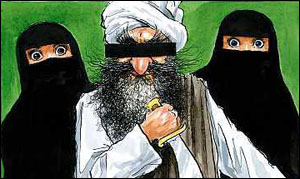
Muslim leaders in Denmark sent letters to Jyallands Posten complaining about the racist cartoons. Not only did the newspaper refuse to apologize, but many of those who sent letters received threats and more racist cartoons via email. Anti-immigrant, and specifically anti-Muslim, sentiments in Denmark have been on the rise for years with right-leaning political parties using immigration as the main issue in the election of February 2005 (with the current government relying on the rabidly anti-immigrant Danish People's Party as a key coalition partner). As Muslims in Denmark complained about racism in the media they were mainly met with anti-immigrant rhetoric in the press arguing that the Muslim population in Denmark was restricting the freedom for a newspaper to print racist cartoons without complaint.
Eleven Arab ambassadors asked for a meeting with Danish prime minister Anders Fogh Rasmussen on October 12th to register their protest, but the government declined. On October 27th, a number of Muslim organizations submitted complaints to the Danish police claiming that Jyllands-Posten had committed an offence under section 140 and 266b of the Danish Criminal Code. Section 140 of the Criminal Code prohibits any person from publicly ridiculing or insulting the dogmas of worship of any lawfully existing religious community in Denmark. Section 266b criminalizes the dissemination of statements or other information by which a group of people are threatened, insulted or degraded on account of their religion. On January 6th 2006, the Regional Public Prosecutor in Viborg discontinued the investigation as he found no basis for concluding that the cartoons constituted a criminal offence.
As the Danish Muslim community felt increasingly isolated and under attack, a group of religious leaders toured the Middle East with a dossier containing the racist cartoons to make the broader Muslim community aware of the plight of Danish Muslims. On January 10th 2006, a small Norwegian Christian magazine, Magazinet, printed the drawings after getting authorization from Jyllands-Posten. While a protest of several thousand people had taken place in Denmark in September, until the end of January 2006, all other protests were formal complaints by religious and government officials. On January 29th, the Danish flag was burned at a protest in the West Bank and Danish NGO workers were threatened in Gaza. On January 31st a German newspaper republished several of the cartoons and as did many papers across Europe on February 1st and 2nd. Most of the newspapers displayed the images with a message that it was the right of newspapers to display such racist images rather than because they related to a breaking news story (a strange assertion when Indymedias have been legally threatened and even shut down in Europe over cartoons). On February 2nd protests continued in Gaza and also took place in Morocco. On February 3rd, protests took place in Jakarta and London. On February 4th, the Danish embassy was set on fire in Damascus and on February 5th the Danish consulate was set on fire in Beirut. On February 5th two protesters were shot to death protesting in Kabul and on February 6th two more demonstrators were shot to death in front of the main US base at Bagram with the death toll reaching 10 worldwide. World Socialist Website writes "It is noteworthy that those who have rallied to the defense of the right-wing anti-immigrant newspaper in Denmark that first published the racist cartoons have had little to say about the violence of repressive governments across the Middle East against their own people registering outrage over the widely disseminated insult to their religion."
Much of the mainstream media (and even networks like Air America) have commented on the riots with statements asking why Muslims would riot over something like this while "we have have learned to discuss religion civilly in the West". Juan Cole has responded by listing some recent religious riots in Europe and Ali Abunimah from Electronic Intifada has pointed out that it has only been a decade since a European genocide against Muslims in Bosnia. In the past five years there have been riots in India where 2000 muslims were killed by Hindu fundamentalists, arson attacks on mosques in Holland, thousands killed by the Russian military in Chechnya, and in the last month riots against Muslims in Australia. Yet, while extreme fundamentalists are constantly pointed to in order to justify European and American racism against Muslims, extremist neo-Nazi, fundamentralist Hindu, Jewish fundamentalist and Christian fundamentalist groups which attack Muslims don't result in a similar level of collective guilt even when the attacks occur during elections where anti-immigration rhetoric takes an overtly racist form.
Islam bashing part of racist war for empire | Danes Finally Apologize to Muslims | Freedom of Speech or Incitement to Violence? A Debate Over the Publication of Cartoons | Death toll mounts in worldwide protests against anti-Muslim cartoons | Questions of Rights vs. Responsibilities | Danish Newspaper At Heart of Controversy Rejected Drawings Lampooning Jesus Christ | Robert Fisk: Now Lebanon is Burning | More outrage over Prophet cartoons | Anti-Islamic Racism In The American Media | Do You Support Religious Intolerance As Long As It's Against Muslims? | Muslims 'R' us, not them | Islamophobia Rears Its Ugly Head | Danish Imams Fume at Cartoon Punishment | Cartoons and Bombs: Was Rice Right for Once? | New York Times columnist David Brooks proposes the ‘good crusade’
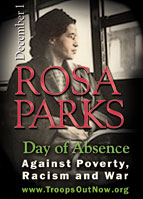
People in cities across the country have been honoring the December 1st, 2005, the 50th anniversary of Rosa Parks's arrest with a Nationwide Day of Absence and Protest Against Poverty, Racism & War. This day is widely viewed as the anniversary of the opening of the mass Civil Rights movement and the struggle that brought Rev. Martin Luther King, Jr.to prominence.
The Troops Out Now Coalition says, "The war in Iraq that has now destroyed the lives of more than 2100 U.S. soldiers and 100,000 Iraqi people; the racism and negelct at all levels of government in the wake of Hurricane Katrina; growing poverty and inequality; the drive to make the Supreme Court even more anti-woman and anti-civil rights; and Rosa Parks' death just days ago, have made this 50th anniversary of her arrest an even more serious and somber occasion to reflect on the need to restart the movement against poverty, racism and war." Downloadable placards and flyers
Organizers plan to use this anniversary to move the movement forward. There were protest marches, rallies, and teach-ins all over the US (Locations). In New York City, there were a march and rally on Wall Street because "a relatively handful of people who either own, control or profit from the economy, must know that we consider the right to live free of war and the right to a job, to be as much of a civil right as the right to sit in the front of the bus." In Rochester, New York, there were a community service project, a teach-in, a funeral march, and a community meal and concert. In Boston, 500 people marched and rallied. The Boston City Council had encouraged schools and businesses to close on December 1st. Photos Demands of these events included: "Bring the troops home now; Justice for Katrina evacuees; Jobs at a living wage; Military recruiters out of our schools; Cut the war budget– not healthcare, education & housing."
On Thursday, December 1st the Healdsburg Peace Project sponsored "WAR: Eyewitnesses Tell the Untold," featuring journalist Dahr Jamail, anti-war organizer Jeff Paterson, and Leuren Moet, who is an expert on depleted uranium. The event took place in the Healdsburg High School Cafeteria.
In Willits, people gathered from 5-6pm on the major highway that runs through town - holding signs, candles and banners proclaiming their desire for bringing the troops home and observing the 50th anniversary of Rosa Parks' arrest.
On Saturday, December 3rd, Troops Out Now Coalition (TONC)-Northern California will sponsor a speak out at 14th and Broadway in Oakland at 12pm. Flyer
The Troops Out Now Coalition says, "The war in Iraq that has now destroyed the lives of more than 2100 U.S. soldiers and 100,000 Iraqi people; the racism and negelct at all levels of government in the wake of Hurricane Katrina; growing poverty and inequality; the drive to make the Supreme Court even more anti-woman and anti-civil rights; and Rosa Parks' death just days ago, have made this 50th anniversary of her arrest an even more serious and somber occasion to reflect on the need to restart the movement against poverty, racism and war." Downloadable placards and flyers
Organizers plan to use this anniversary to move the movement forward. There were protest marches, rallies, and teach-ins all over the US (Locations). In New York City, there were a march and rally on Wall Street because "a relatively handful of people who either own, control or profit from the economy, must know that we consider the right to live free of war and the right to a job, to be as much of a civil right as the right to sit in the front of the bus." In Rochester, New York, there were a community service project, a teach-in, a funeral march, and a community meal and concert. In Boston, 500 people marched and rallied. The Boston City Council had encouraged schools and businesses to close on December 1st. Photos Demands of these events included: "Bring the troops home now; Justice for Katrina evacuees; Jobs at a living wage; Military recruiters out of our schools; Cut the war budget– not healthcare, education & housing."
On Thursday, December 1st the Healdsburg Peace Project sponsored "WAR: Eyewitnesses Tell the Untold," featuring journalist Dahr Jamail, anti-war organizer Jeff Paterson, and Leuren Moet, who is an expert on depleted uranium. The event took place in the Healdsburg High School Cafeteria.
In Willits, people gathered from 5-6pm on the major highway that runs through town - holding signs, candles and banners proclaiming their desire for bringing the troops home and observing the 50th anniversary of Rosa Parks' arrest.
On Saturday, December 3rd, Troops Out Now Coalition (TONC)-Northern California will sponsor a speak out at 14th and Broadway in Oakland at 12pm. Flyer
Racial Justice:
 86
86

86