







 Publish to Newswire
 Add an Event
Feature Archives


Thu May 25 2006
Stop The "Divine Strake" at the Nevada Test Site
Update: Government Withdraws Environmental Finding, Divine Strake Test Delayed Indefinitely
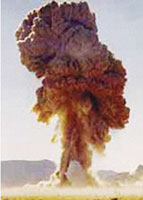
Divine Strake is the government’s latest venture into the realm of broken treaties, state-sponsored terror and the desecration of Mother Earth - a “bunker-busting” bomb which was scheduled to be detonated this June in the Nevada desert. The Shundahai Network, founded by Shoshone Elder Corbin Harney, says “this test could be a precursor” to a nuclear strike against Iran, “with massive civilian casualties.”
The Divine Strake Test, a test sponsored by the Defense Threat Reduction Agency (DTRA), is a detonation of a 700 ton buried heavy ammonium nitrate/fuel oil charge above a tunnel structure. The DTRA reports that the main purpose of the test is to study ground shock effects on deeply buried tunnel structures. Environmental activists and analysists predict, however, that the test is a preparation for the development of new nuclear weapons.
This affects all of us, but especially the Shoshone People downwind of the Nevada Test Site. Oral arguments were heard on May 25th and 26th, at the Nevada District Court in Reno, Nevada. May 28th was declared an International Day of Action and dozens of indigenous, environmental justice and peace and disarmament organizations converged at the Peace Camp outside the Nevada Test Site near Mercury, Nevada to protest the Divine Strake test scheduled for June 2nd, but now apparently postponed indefinitely.
 Video: Explanation of Divine Strake and Bechtel's Management of the Test Site ||
  Audio: Information and Call to Action
[ Divine Strake || Stop "Divine Strake" Bombing in Newe Sogobia (NTS) || Western Shoshone and Downwinders Again Ask Federal Court to Stop Mushroom Cloud Blast || Stop the Divine Strake || Disarmament Activist || Come Rebuild Our World || Earth Cycles Radio Project || Nevada Desert Experience || Citizen Alert || Utah Organizations || Send an Online Letter to a Local Publication ]
In San Francisco: Anti-Nuke Activists Disrupt UC Regents Meeting
In DC: Don't Attack Iran petition delivered to White House
Divine Strake is the government’s latest venture into the realm of broken treaties, state-sponsored terror and the desecration of Mother Earth - a “bunker-busting” bomb which was scheduled to be detonated this June in the Nevada desert. The Shundahai Network, founded by Shoshone Elder Corbin Harney, says “this test could be a precursor” to a nuclear strike against Iran, “with massive civilian casualties.”
The Divine Strake Test, a test sponsored by the Defense Threat Reduction Agency (DTRA), is a detonation of a 700 ton buried heavy ammonium nitrate/fuel oil charge above a tunnel structure. The DTRA reports that the main purpose of the test is to study ground shock effects on deeply buried tunnel structures. Environmental activists and analysists predict, however, that the test is a preparation for the development of new nuclear weapons.
This affects all of us, but especially the Shoshone People downwind of the Nevada Test Site. Oral arguments were heard on May 25th and 26th, at the Nevada District Court in Reno, Nevada. May 28th was declared an International Day of Action and dozens of indigenous, environmental justice and peace and disarmament organizations converged at the Peace Camp outside the Nevada Test Site near Mercury, Nevada to protest the Divine Strake test scheduled for June 2nd, but now apparently postponed indefinitely.
Video: Explanation of Divine Strake and Bechtel's Management of the Test Site || Audio: Information and Call to Action
[ Divine Strake || Stop "Divine Strake" Bombing in Newe Sogobia (NTS) || Western Shoshone and Downwinders Again Ask Federal Court to Stop Mushroom Cloud Blast || Stop the Divine Strake || Disarmament Activist || Come Rebuild Our World || Earth Cycles Radio Project || Nevada Desert Experience || Citizen Alert || Utah Organizations || Send an Online Letter to a Local Publication ]
In San Francisco: Anti-Nuke Activists Disrupt UC Regents Meeting
In DC: Don't Attack Iran petition delivered to White House



Thu May 25 2006
Oxygen Collective Coming to Arcata
The Oxygen Collective has been at the forefront of both public education and popular protest of the so-called “salvage logging” that followed the massive “Biscuit fire” which burned 499,965 in 2002. The Oxygen Collective offers a free multi-media presentation reviewing the Biscuit saga and highlighting how the latest logging proposals will create detrimental national precedents. The high energy show was in Arcata on June 4th at The Milk Barn, 2950 Janes Rd @ 6 pm, and featured music, video, speakers, slides of direct action for the Biscuit, and the films Keep Towing That Line, and Portland IMC's Truth & Lies of the Biscuit Fire.
READ MORE.
SEE INDYBAY'S PAST COVERAGE OF THE STRUGGLE FOR THE BISCUIT: Largest Forest Service Logging Project In Modern History I Old Growth Logging Begins - 11 arrests I Fiddler Timber Sale Blockade I Video of Arrests I Sister’s Of The Siskiyou’s Sound Off Over Lawless Logging I US Forest Service, Loggers Recklessly Endanger Lives of Nonviolent Protesters
READ MORE.
SEE INDYBAY'S PAST COVERAGE OF THE STRUGGLE FOR THE BISCUIT: Largest Forest Service Logging Project In Modern History I Old Growth Logging Begins - 11 arrests I Fiddler Timber Sale Blockade I Video of Arrests I Sister’s Of The Siskiyou’s Sound Off Over Lawless Logging I US Forest Service, Loggers Recklessly Endanger Lives of Nonviolent Protesters

Wed May 24 2006
Decoto Neighbors Revive Garden, Sense of Community Spirit
For the past fifteen years, the Teen Bike Shop’s Community Garden, located in Union City's Decoto District, was in hibernation and filled with weeds. However, Maricela Reynoso, a Decoto native, and other community members took the initiative to start a collaborative effort to revitalize the community garden. In the past few months, community involvement has soared with youth and people of all ages stopping by to pick weeds, plow the land, remove debris, plant plants, and bring donations.
The garden has provided a space that unites the community, and where youth can create something from the ground up. Working with elders who often rely on natural herbs and plants as everyday remedies has taught many of the local youth the medicinal properties of plants and the importance of their existence and care. The garden has also served as a way to show youth that working with nature- and not against it- helps to enhance their community and its resources. Photos and report
Union City's Teen Bike Workshop
The garden has provided a space that unites the community, and where youth can create something from the ground up. Working with elders who often rely on natural herbs and plants as everyday remedies has taught many of the local youth the medicinal properties of plants and the importance of their existence and care. The garden has also served as a way to show youth that working with nature- and not against it- helps to enhance their community and its resources.
Photos and report
Union City's Teen Bike Workshop


Wed May 24 2006 (Updated 06/15/06)
South Central Farm Evicted in Early Morning Raid by Police
The 14-acre South Central Farm was raided early in the morning of June 13th. The police arrested some 40 supporters of the garden, and bulldozed fences and trees.
The South Central Community Farm in Los Angeles had been under consistent attack from the City of LA since the beginning of March. The week before the eviction, the farmers had reported that they had raised enough money to purchase the property.
Photos | Audio 1 | 2
The South Central Community Farm in Los Angeles had been under consistent attack from the City of LA since the beginning of March. The week before the eviction, the farmers had reported that they had raised enough money to purchase the property.
Photos |
Audio 1 | 2
Wed May 24 2006
17-Acre Agricultural Lot in South Bay Faces "Development"
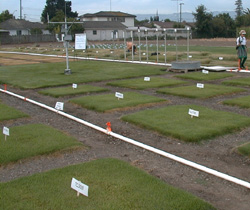
The former UC Davis Ag Center (aka Bay Area Research and Extension Center, or BAREC) is 17 acres of "prime farmland" that is agriculturally zoned. It is located at 90 N. Winchester Blvd. in Santa Clara. The state of California, which still owns this property, is in the process of selling it to SummerHill Homes and the City of Santa Clara for housing developments.
VIVA (Valley Initiative for Values in Agriculture) and SaveBAREC want to turn this property into a small urban farm, which would counterbalance what they say is overdevelopment in the area. They are asking for supporters to contact local polititians to ask them to not change the agricultural zoning, and to preserve the property as farmland. The struggle over BAREC has highlighted other local issues, such as the openness of City Council Meetings (they often have closed meetings). Read more
From 1928 to 2003, the property was a University of California Agricultural/Horticulture Research Center. Composting research was conducted there. Its centralized location made it possible for many people to have access to the results of the research. Urbancompost.org The site has also hosted research into production of specific crops, pests, and weather patterns. The University of California decommissioned the research station when it felt that advances in agricultural technology had improved to the point where it was conducting less research. However, closing the site also helped the UC system to satisfy some of its budgetary requirements.
Save BAREC | City of Santa Clara Meetings | Santa Clara County Division of Agriculture | Santa Clara County History | UC Cooperative Extention Santa Clara County | Santa Clara County Open Space Authority | Fairview Gardens in Goleta (near Santa Barbara)
VIVA (Valley Initiative for Values in Agriculture) and SaveBAREC want to turn this property into a small urban farm, which would counterbalance what they say is overdevelopment in the area. They are asking for supporters to contact local polititians to ask them to not change the agricultural zoning, and to preserve the property as farmland. The struggle over BAREC has highlighted other local issues, such as the openness of City Council Meetings (they often have closed meetings). Read more
From 1928 to 2003, the property was a University of California Agricultural/Horticulture Research Center. Composting research was conducted there. Its centralized location made it possible for many people to have access to the results of the research. Urbancompost.org The site has also hosted research into production of specific crops, pests, and weather patterns. The University of California decommissioned the research station when it felt that advances in agricultural technology had improved to the point where it was conducting less research. However, closing the site also helped the UC system to satisfy some of its budgetary requirements.
Save BAREC | City of Santa Clara Meetings | Santa Clara County Division of Agriculture | Santa Clara County History | UC Cooperative Extention Santa Clara County | Santa Clara County Open Space Authority | Fairview Gardens in Goleta (near Santa Barbara)
Sun May 21 2006
Logging to Resume in Freshwater Creek, Elk River
Following a nearly year-long reprieve in the Freshwater Creek and Elk River areas of Humboldt County, Maxxam/Pacific Lumber will soon resume logging operations in the two fragile areas just east of Eureka. The logging will mark the first time the controversial logging outfit has been allowed to cut trees in these neighboring watersheds since June 16, 2005. Logging stopped when Maxxam/PL stalled the process for creating special waste discharge permits which would address the high levels of dirt and mud deposited in these watercourses from excessive recent and historical logging.
Forest activists are concerned that Maxxam/PL will “cherry-pick” the old-growth trees based on the new restrictions that disallow any additional sediment to be delivered into Freshwater Creek and Elk River by the logging operations.
READ MORE.
Forest activists are concerned that Maxxam/PL will “cherry-pick” the old-growth trees based on the new restrictions that disallow any additional sediment to be delivered into Freshwater Creek and Elk River by the logging operations.
READ MORE.

Developer Joe Shekou recently filed a frivolous lawsuit, aka SLAPP suit, against Gallinas Creek activists. The activists have been effective and vocal in stalling attempts by the developer to build a 3 acre indoor soccer complex on endangered wildlife habitat in Marin County.
Environmentalists and nearby residents are expressing concern over the implications that such a massive complex will mean for the community and wildlife. The wetlands of Gallinas Creek are home to the endangered clapper rail and marsh mouse. The proposed 2.5 acre sports complex sits in the middle of this habitat and is in the pathway of a variety of local and migratory birds, river otters and a wide range of nature enthusiasts. Read more
Environmentalists and nearby residents are expressing concern over the implications that such a massive complex will mean for the community and wildlife. The wetlands of Gallinas Creek are home to the endangered clapper rail and marsh mouse. The proposed 2.5 acre sports complex sits in the middle of this habitat and is in the pathway of a variety of local and migratory birds, river otters and a wide range of nature enthusiasts. Read more