







 Publish to Newswire
 Add an Event
Feature Archives



Thu May 12 2011 (Updated 05/22/11)
Protesters Call for Drastic Change to Japan's Nuclear Energy Policy
Japan's Chubu Electric Power Company started shutting down its nuclear power plant in Hamaoka, approximately 100 miles southwest of Tokyo, this week. On May 6th, Japanese Prime Minister Naoto Kan made public his directive for the company to suspend its operation. His announcement came just hours before an anti-nuclear power demonstration of 10,000 people in Tokyo. On the same day, activists rallied in solidarity with their Japanese counterparts in front of the Japanese consulate in San Francisco.



Thu Apr 28 2011 (Updated 05/15/11)
Anti-Nuclear Events in Bay Area Mark Chernobyl Disaster
Activists in the Bay Area are marking the 25th Anniversary of the Chernobyl nuclear disaster with rallies, speakers, street theater, and educational events. Calling the catastrophe in Ukraine "the most significant nuclear reactor failure in the history of nuclear power", anti-nuke enthusiasts say they want the world to remember that April 26, 1986 was the day when one of the reactors at the Chernobyl nuclear power station exploded, killing plant employees instantly and leading to a projected increase in cancer deaths in the hundreds of thousands.

Mon Apr 25 2011 (Updated 04/26/11)
Civil Disobedience & Arrests at Livermore Labs
To protest the continued development of nuclear weapons in the Bay Area and the United States, a demonstration was held at Livermore Nuclear Lab in Livermore on April 22nd. At dawn, an interfaith prayer service was followed by Stations of the Cross. The demonstration ended at the front gate with the mass arrest of approximately two dozen protesters who refused to stop blocking the entrance when ordered to by police.
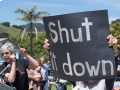
On April 16th, over 300 people gathered for a protest at Avila Beach in San Luis Obispo County. They called for the closure of nearby Diablo Canyon nuclear power plant and insisted that the Nuclear Regulatory Commission must halt PG&E's relicensing application process for the structure.

Mon Apr 18 2011 (Updated 04/19/11)
Brought to You by Oil and Cancer: Modesto Earth Day Festival
Modesto Anarcho writes: The Modesto Earth Day celebration held every year is an exercise in how the world is not changed.... Looking at these sponsors, the event itself becomes even more laughable. The sponsors of this year's Earth Day Festival include... major polluters such as a petroleum company and a waste incinerator. The Modesto Earth Day Festival is a marriage of corporate, state, and media interests, united together in brandishing themselves as protectors of the environment and friends of the earth.
Sat Apr 16 2011 (Updated 04/17/11)
Stop Smart Meters! Disrupts FCC Talk in Mountain View
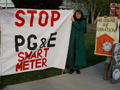
Stop Smart Meters! and allies held a protest in Mountain View on April 14th as Julius Genachowski, Chair of the Federal Communications Commission, spoke about the need to increase wireless capacity, ignoring those who suffer ill health from "electrosmog" throughout the U.S. Several passers-by stopped and joined the demonstration. Activists smuggled a Stop Smart Meters! banner inside the talk and just when they thought everyone in the audience was about to go to sleep, they stirred things up with a classic banner drop disruption.
Tue Apr 12 2011 (Updated 04/25/11)
Sogorea Te (Glen Cove) Under Threat of Imminent Development
4/24 updates: Committee to Protect Sogorea Te Responds to Vallejo Times Herald Op-Ed | Day 10: Hundreds attend community gathering at Glen Cove
Despite efforts by Sacred Sites Protection and Rights of Indigenous Tribes (SSP&RIT) to negotiate a preservation agreement, the Greater Vallejo Recreation District has so far refused to abandon efforts to develop Glen Cove, a sacred Native American burial site also known as Sogorea Te in the Ohlone language. With bulldozing slated to get under way as soon as Friday, April 15th, SSP&RIT has called for an assembly to gather on April 14th at Glen Cove, in preparation for a ceremony to honor the ancestors buried at the site the following morning.
Despite efforts by Sacred Sites Protection and Rights of Indigenous Tribes (SSP&RIT) to negotiate a preservation agreement, the Greater Vallejo Recreation District has so far refused to abandon efforts to develop Glen Cove, a sacred Native American burial site also known as Sogorea Te in the Ohlone language. With bulldozing slated to get under way as soon as Friday, April 15th, SSP&RIT has called for an assembly to gather on April 14th at Glen Cove, in preparation for a ceremony to honor the ancestors buried at the site the following morning.