







 Publish to Newswire
 Add an Event
Feature Archives
Thu Mar 13 2008 (Updated 03/19/08)
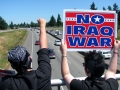
Protests Planned for 5th Anniversary of US Bombing and Invasion of Iraq
Wednesday, March 19th, 2008 marks the five-year anniversary of the beginning of the US war and occupation of Iraq. Events will be held all over the United States to observe and protest the ongoing war and its environmental, societal, and financial tolls. The Iraq war is the second longest in U.S. history. It has killed more than one million Iraqis and 4,000 U.S. troops. The cost of the war is now running at more than $400 million per day, nearly $5,000 per second. In San Francisco, there will be direct actions throughout the day on the 19th, as well as an ANSWER march.

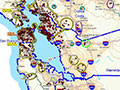
On January 24th, United States Department of Agriculture (USDA) Secretary Chuck Conner announced the availability of $74.5 million in emergency funding to combat the light brown apple moth (LBAM) "infestation" in California. President Bush's recent budget proposal sent to Congress sets aside $330 Million to eradicate plant pests, like the LBAM. It is unprecedented to design a long term plan to spray chemicals on people, which are untested for safety.

Saturday, March 8th is International Women's Day. The first IWD in the United States was observed in 1909, after a declaration by the Socialist Party of America. The day is observed in countries all over the world, with celebrations taking political, social, and cultural forms. In many cities around the world, women participate in a Global Women's Strike. Some organizers focus on the situation of women in countries such as Iran.
The California Supreme
Court will hear oral arguments on March 4th in
the marriage cases challenging the exclusion of same-sex couples from
marriage. Fifteen same-sex couples, Equality California, and Our Family
Coalition will be represented at oral arguments. The California Supreme Court typically issues its decisions within 90
days following oral arguments.

Thu Feb 28 2008 (Updated 03/08/08)
RNC Welcoming Committee Comes to Northern California
On September 1-4 of 2008, the Republican Party is holding their convention in Minnesota. The RNC Welcoming Committee wants to make sure that "this time the fear-mongers will be met with their own biggest fear: people mobilized, organized, and taking the future back into their own hands." From March 2-8, the RNC Welcoming Committee's Infotour will make six stops in Northern California to share their plans and get input to take back to Minneapolis on their preparations to crash the convention in the Twin Cities in September.
Wed Feb 20 2008 (Updated 02/24/08)
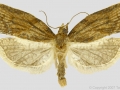
State Plans to Spray LBAM Pesticide from Northern Bay Area to Santa Cruz and Monterey
Aerial spraying of pesticides in Monterey and Santa Cruz is set to continue and soon will come to the Bay Area. Pesticide opponents say, "This supposed 'emergency' is the presence of the light brown apple moth in Bay Area counties, but like all toxic dumping by the agriculture industry, it is likely more about industry profits." While pro-environment organizations are calling on officials to use sticky traps instead of sprays, aerial treatments are scheduled to begin June 1st in the infested areas of Monterey and Santa Cruz counties, with subsequent aerial treatments expected to begin August 1st in San Francisco, Daly City, Colma, Oakland, Piedmont, Emeryville, Albany, El Cerrito, El Sobrante, Tiburon and Belvedere.

Wed Feb 20 2008
The West Coast Tree-sit Raids
Jeff Muskrat writes, "With the fall of the Bear Mountain tree-sit in Victoria, BC, it seems like this is a very crucial time for activists in the trees up and down the west coast. There are two campus trees-sits, one under attack right now at UC Berkeley and one at UC Santa Cruz. These actions are opposing the unnecessary development of greenspace."
California:
 79
79

79