







 Publish to Newswire
 Add an Event
Feature Archives


Fri Nov 12 2004
One year anniversary for tree-sitter in Jerry
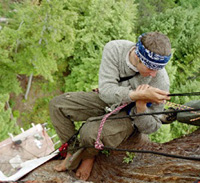
Veteran's Day marked the one-year anniversary for 20 year-old marathon treesitter, Willow, who is defending the ancient redwood known as "Jerry" in the Freshwater Valley of Humboldt County, CA. Willow took up residence in the giant tree following the controversial string of treesit extractions that happened in the area in the spring of 2003. Three previous treesitters were forcibly extracted from Jerry, including marathon treesitter Remedy, who was forcibly removed four days before her one-year mark. The tree was subsequently limbed by the self-proclaimed savior of treesitting activists, Eric "I'm here to rescue you" Schatz. Jerry and the Grateful Grove make up an extensive treesit village East of Eureka. The trees have been occupied since March 2002.

Sun Nov 7 2004
Maxxam/Pacific Lumber Facing New EPIC Lawsuits
Maxxam/Pacific Lumber found itself facing two new lawsuits this week, one
in Federal court and one in California Superior Court. The Environmental Protection Information
Center (EPIC) filed the suits against PL and government agencies
entrusted to uphold environmental laws, but who all too often fail to keep
Pacific Lumber in compliance with these regulations. The Federal suit,
which names U.S. Fish & Wildlife Service and NOAA Fisheries as well as
Pacific Lumber was filed by award winning EPIC attorney Sharon Duggan, who
fought and
won a four year long case challenging PL's "fatally flawed" Sustained
Yield Plan.

Fri Oct 29 2004
Vigil for Ancient Trees Held in Front of Humboldt Courthouse
Activists and supporters of a ban on the cutting of old growth trees in California gathered in front of the Eureka Courthouse with mock tombstones on Oct. 28 to commemorate the ancient trees lost to Maxxam/Pacific Lumber's clear-cutting.
Liquidation logging practices continue unabated in the Freshwater, Grizzly Creek, and Mattole watersheds, with the state's approval, despite court rulings, a pending fraud suit by the county, continuous protests, and public outcry. Maxxam/PL's Sustained Yield Plan has been ruled "non-existent" by Judge Golden, but no halt has been called to the company's overcutting. A suit by District Attorney Paul Gallegos has charged Maxxam/PL with business fraud, but no restraining orders have been issued.
The ancient trees would have been protected by the Heritage Tree Act, a bill to protect all trees older than the state of California, which failed in the state legislature last month. North Coast Earth First!ers say that protests will continue in the absence of a legal or legislative solution. Read more | North Coast Earth First!
Liquidation logging practices continue unabated in the Freshwater, Grizzly Creek, and Mattole watersheds, with the state's approval, despite court rulings, a pending fraud suit by the county, continuous protests, and public outcry. Maxxam/PL's Sustained Yield Plan has been ruled "non-existent" by Judge Golden, but no halt has been called to the company's overcutting. A suit by District Attorney Paul Gallegos has charged Maxxam/PL with business fraud, but no restraining orders have been issued.
The ancient trees would have been protected by the Heritage Tree Act, a bill to protect all trees older than the state of California, which failed in the state legislature last month. North Coast Earth First!ers say that protests will continue in the absence of a legal or legislative solution. Read more | North Coast Earth First!
Mon Oct 18 2004
Solar Conference—Co-sponsored by PG&E—Comes to San Francisco
Solar Power 2004 has set up shop at San Francisco's Hyatt Regency from 10/18 thru 10/21. Admission is priced for industry insiders, but exposition halls in the Hyatt and at One Market Street are free to the public. Oddly, the conference is co-sponsored by PG&E, which has opposed renewable energy for 30 years and public power for nearly 100 years, and SF's public power agency, the Public Utilities Commission, as well as a number of oil companies. Conference-goers will have to cross Local 2's picket lines at the Hyatt, where workers have been locked out of their jobs for weeks in a protracted battle over the terms of a new contract.
The Solar Power conference focuses on business development, policy, and technology, leaving out such broader hot topics as global warming or fossil fuel depletion. US energy corporations, from oil companies to utilities like PG&E, have worked for decades to cast doubt on climate change and discourage development of energy efficiency or renewable energy technology. PG&E is currently fighting hard at the California Public Utilities Commission to maintain its monopoly over energy efficiency funds and kill proposals for independent programs that would save more energy and cut into PG&E's profits.
PG&E aside, solar power in San Francisco has made big gains recently—on paper. The Energy Independence Ordinance, passed unanimously by the Board of Supervisors this year, is designed to work with the state "Community Choice" law to provide 40% of SF's power from renewable energy & efficiency. Solar Bonds (Prop H), passed in 2001, gave SF Supervisors unlimited bonding authority for solar, wind and other renewables and energy efficiency.
Lennar Corporation, a Florida company notorious for building housing on toxic dumps -- including cases of whole neighborhoods sinking into toxic dumps -- and favored by Mayors Willie Brown and Gavin Newsom to build 1,600 homes on the Hunters Point Shipyard superfund site, made it into the Solar 2004 program as part of a session on solar power in residential construction. Lennar has angered residents of the BVHP district after it went out of its way last month to cancel KPOO's broadcast of a public meeting on the Hunters Point redevelopment plan. Read more
In related news, FedEx Corp. and the City of Oakland announced on 10/18 that FedEx will construct California's largest corporate solar electric system atop its hub at Oakland International Airport.
The Solar Power conference focuses on business development, policy, and technology, leaving out such broader hot topics as global warming or fossil fuel depletion. US energy corporations, from oil companies to utilities like PG&E, have worked for decades to cast doubt on climate change and discourage development of energy efficiency or renewable energy technology. PG&E is currently fighting hard at the California Public Utilities Commission to maintain its monopoly over energy efficiency funds and kill proposals for independent programs that would save more energy and cut into PG&E's profits.
PG&E aside, solar power in San Francisco has made big gains recently—on paper. The Energy Independence Ordinance, passed unanimously by the Board of Supervisors this year, is designed to work with the state "Community Choice" law to provide 40% of SF's power from renewable energy & efficiency. Solar Bonds (Prop H), passed in 2001, gave SF Supervisors unlimited bonding authority for solar, wind and other renewables and energy efficiency.
Lennar Corporation, a Florida company notorious for building housing on toxic dumps -- including cases of whole neighborhoods sinking into toxic dumps -- and favored by Mayors Willie Brown and Gavin Newsom to build 1,600 homes on the Hunters Point Shipyard superfund site, made it into the Solar 2004 program as part of a session on solar power in residential construction. Lennar has angered residents of the BVHP district after it went out of its way last month to cancel KPOO's broadcast of a public meeting on the Hunters Point redevelopment plan. Read more
In related news, FedEx Corp. and the City of Oakland announced on 10/18 that FedEx will construct California's largest corporate solar electric system atop its hub at Oakland International Airport.
Sat Sep 25 2004
Gypsy Mountain Treesits Raided
Update 9/26: Old-growth redwood Aradia was felled after being cordoned off by Pacific Lumber security. One forest activist reported being tackled by PL security dressed in camouflage and hiding in the bushes. Full Report | Video
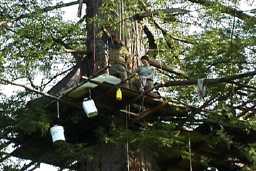
9/25/04: According to activists, four treesit extractors are raiding Gypsy Mountain as of this morning. Four extractors have ascended four adjacent treesits, including the old-growth redwood, Aradia, which has been occupied since January 2002. Aradia stands above Grizzly Creek, near the death site of David "Gypsy" Chain, who was killed six years ago when a Pacific Lumber logger fell a tree in his direction. The treesitters are reportedly suspended on traverse lines between the trees high above the ground. Read more


9/25/04: According to activists, four treesit extractors are raiding Gypsy Mountain as of this morning. Four extractors have ascended four adjacent treesits, including the old-growth redwood, Aradia, which has been occupied since January 2002. Aradia stands above Grizzly Creek, near the death site of David "Gypsy" Chain, who was killed six years ago when a Pacific Lumber logger fell a tree in his direction. The treesitters are reportedly suspended on traverse lines between the trees high above the ground. Read more
Mon Aug 23 2004
Pepper Spray Brutality Trial: MISTRIAL!
Jury Deadlocks 6-2 in Favor of Plaintiffs.
SAN FRANCISCO (22 Sept) -- The eight jurors in the Pepper Spray by Q-tip trial informed the judge at 3:15 Wednesday afternoon that they were "hopelessly deadlocked" and could not find resolution through further deliberation. After encouraging them to rethink their opinions and meeting privately with the jury foreman, Judge Susan Illston declared a mistrial. It was then that plaintiffs and defendants learned there were six jurors in favor of plaintiffs and only two against. Read More...
9/21: Closing Arguments Conclude, Jury Deliberates. The defense (police) yesterday presented its entire argument, calling just four witnesses. Some highlights include testimony elicited from Sheriff Gary Philp and retired Sheriff Dennis Lewis under eviscerating cross-examination by plaintiffs' attorney, Bob Bloom:
 Sept 8: Being heard before Federal Judge Susan Illston, the case revolves around the question of whether direct application of liquid pepper spray into the eyes of passive protesters is an appropriate police tactic. Jury selection began on Sept. 8th. The start date changed from Sept. 7th to the 8th A lunchtime solidarity rally was held on Wednesday, September 8th at noon on the Polk St. side of the Federal Building. Jurors who might be passing by on the street were repeatedly asked to not listen to the speakers and performers. Photos Video Report Oral arguments began on the 9th at 8:30am. An info night was held Sunday, September 5th at the Long Haul in Berkeley. It included a screening of the film Fire in the Eyes.
Headwaters Forest Defense v. County of Humboldt et al. charges use of excessive force by law enforcement in that county. After the first trial in 1998 ended without a verdict, appeals court decisions and finally the U.S. Supreme Court have sent the case back to federal court in San Francisco. An evidentiary hearing was held on August 24th, the next hearing will be jury selection at the beginning of the trial, on September 8th in the federal courthouse in San Francisco at 450 Golden Gate Ave., with Judge Susan Illston presiding (likely in in courtroom 10, on the 19th floor). More details
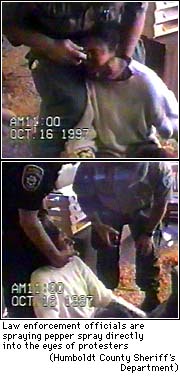
The lawsuit stems from three Headwaters Forest protests in 1997, at the height of the campaign to save ancient redwoods. Activists had locked themselves to each other in a circle at sit-in protests in rural northern California. As Sheriffs' deputies tried to remove them, they used the unprecedented tactic of application of pepper spray by Q-tip. When police footage aired on national tv, the horrified public saw officers force activists' heads back, pry open their eyes and precisely smear the burning chemical into their eyes. Most of the activists were young-some were first time protesters. The activists subsequently filed suit against the Humboldt County Sheriffs Department and Eureka Police. This time, the case will be argued by the legal team that won the historic 2002 victory in the Judi Bari v. FBI civil rights case.
 S.F. Federal District Judge Vaughn Walker threw the case out in 1998 after a jury deadlock, issuing a "directed verdict", claiming "no
reasonable juror" would decide the activists' rights had been violated by the tactic Amnesty International called "tantamount to
torture". However, the 1998 jury forewoman said at the time, "If you can't sit down in a nonviolent way and protest on behalf of your
beliefs without being subjected to the police swabbing your eyes with pepper spray or some other chemical agents, I think that's sort of
going back to the days of the cattle prod and the fire hose."
S.F. Federal District Judge Vaughn Walker threw the case out in 1998 after a jury deadlock, issuing a "directed verdict", claiming "no
reasonable juror" would decide the activists' rights had been violated by the tactic Amnesty International called "tantamount to
torture". However, the 1998 jury forewoman said at the time, "If you can't sit down in a nonviolent way and protest on behalf of your
beliefs without being subjected to the police swabbing your eyes with pepper spray or some other chemical agents, I think that's sort of
going back to the days of the cattle prod and the fire hose."
The 9th Circuit Court of Appeals scuttled Walker's finding, ruling in May 2000 that the plaintiffs had a right to trial by jury. Amicus brief from the ACLU about pepper spray. That court also removed Walker from the case for bias following his attempt to move the case to the polarized community of Eureka. In the seven years since the first trial, appeals court decisions have all favored the plaintiffs, who attempted to settle the case with Humboldt County, if law enforcement would alter their policy of using chemical agents on non-violent protesters. Generally, pepper spray is recognized as a tool of last resort when suspects in custody are violent or out of control.
Nopepperspray.org | Bay Area Coalition for Headwaters (BACH) | Fire in the Eyes, documentary by Earth Films
SAN FRANCISCO (22 Sept) -- The eight jurors in the Pepper Spray by Q-tip trial informed the judge at 3:15 Wednesday afternoon that they were "hopelessly deadlocked" and could not find resolution through further deliberation. After encouraging them to rethink their opinions and meeting privately with the jury foreman, Judge Susan Illston declared a mistrial. It was then that plaintiffs and defendants learned there were six jurors in favor of plaintiffs and only two against. Read More...
9/21: Closing Arguments Conclude, Jury Deliberates. The defense (police) yesterday presented its entire argument, calling just four witnesses. Some highlights include testimony elicited from Sheriff Gary Philp and retired Sheriff Dennis Lewis under eviscerating cross-examination by plaintiffs' attorney, Bob Bloom:
- The defense objected to mention of Saddam Hussein's use of pepperspray as a torture tool in Iraq.
- Sheriff Lewis admitted that the grinder had been used hundreds of times by his deputies to quickly extricate locked-down protesters with no injuries to protesters or deputies, aside from a deputy cutting his finger on a jagged pipe edge.
- Sheriff Philp and Lewis said they had no concern that applying pepperspray with q-tips and blasting directly in the face of non-violent, non-hostile peaceful activists might be uncivilized or unconstitutional.
- Sheriff Lewis described Carl Anderson, the Pac. Lumber security chief previously on the stand, as a close friend. Lewis also claimed Judi Bari as a friend, to which Plaintiff's attorney Bob Bloom "objected" apparently on principle alone, not for any legal reason (overruled).
- Sheriff Lewis stated that family and friends who were Pac. Lumber employees urged him to get tough with and even "hang" the protesters.
- Sheriff Lewis admitted he had been teased by these folks as being "too soft" (Judge Illston sustained an objection to the word "wimp").
- Sheriff Lewis admitted that botched arrests at a large demonstration of thousands of anti-clearcutting protesters, which resulted in the dismissal of all charges, had been a major embarrassment for the department, as had an incident where Charles Hurwitz was pied outside a private shmooze event.
- Sheriff Lewis reiterated something previously stated in his deposition, that in authorizing his new methods of applying pepperspray, unprecedented and unstudied anywhere in the U.S., he "used pain as a means of coercion" to gain compliance. Bloom asked, "did you know that is the dictionary definition of torture?"; Sheriff Lewis responded "No!"
Sept 8: Being heard before Federal Judge Susan Illston, the case revolves around the question of whether direct application of liquid pepper spray into the eyes of passive protesters is an appropriate police tactic. Jury selection began on Sept. 8th. The start date changed from Sept. 7th to the 8th A lunchtime solidarity rally was held on Wednesday, September 8th at noon on the Polk St. side of the Federal Building. Jurors who might be passing by on the street were repeatedly asked to not listen to the speakers and performers. Photos Video Report Oral arguments began on the 9th at 8:30am. An info night was held Sunday, September 5th at the Long Haul in Berkeley. It included a screening of the film Fire in the Eyes.
Headwaters Forest Defense v. County of Humboldt et al. charges use of excessive force by law enforcement in that county. After the first trial in 1998 ended without a verdict, appeals court decisions and finally the U.S. Supreme Court have sent the case back to federal court in San Francisco. An evidentiary hearing was held on August 24th, the next hearing will be jury selection at the beginning of the trial, on September 8th in the federal courthouse in San Francisco at 450 Golden Gate Ave., with Judge Susan Illston presiding (likely in in courtroom 10, on the 19th floor). More details
The lawsuit stems from three Headwaters Forest protests in 1997, at the height of the campaign to save ancient redwoods. Activists had locked themselves to each other in a circle at sit-in protests in rural northern California. As Sheriffs' deputies tried to remove them, they used the unprecedented tactic of application of pepper spray by Q-tip. When police footage aired on national tv, the horrified public saw officers force activists' heads back, pry open their eyes and precisely smear the burning chemical into their eyes. Most of the activists were young-some were first time protesters. The activists subsequently filed suit against the Humboldt County Sheriffs Department and Eureka Police. This time, the case will be argued by the legal team that won the historic 2002 victory in the Judi Bari v. FBI civil rights case.
S.F. Federal District Judge Vaughn Walker threw the case out in 1998 after a jury deadlock, issuing a "directed verdict", claiming "no
reasonable juror" would decide the activists' rights had been violated by the tactic Amnesty International called "tantamount to
torture". However, the 1998 jury forewoman said at the time, "If you can't sit down in a nonviolent way and protest on behalf of your
beliefs without being subjected to the police swabbing your eyes with pepper spray or some other chemical agents, I think that's sort of
going back to the days of the cattle prod and the fire hose."
The 9th Circuit Court of Appeals scuttled Walker's finding, ruling in May 2000 that the plaintiffs had a right to trial by jury. Amicus brief from the ACLU about pepper spray. That court also removed Walker from the case for bias following his attempt to move the case to the polarized community of Eureka. In the seven years since the first trial, appeals court decisions have all favored the plaintiffs, who attempted to settle the case with Humboldt County, if law enforcement would alter their policy of using chemical agents on non-violent protesters. Generally, pepper spray is recognized as a tool of last resort when suspects in custody are violent or out of control.
Nopepperspray.org | Bay Area Coalition for Headwaters (BACH) | Fire in the Eyes, documentary by Earth Films
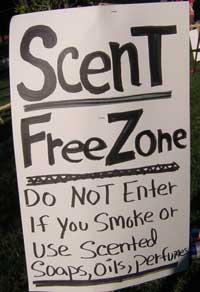
According to the Environmental Working Group, "Most consumers would be surprised to learn that the government does not require health studies or pre-market testing for cosmetics and other personal care products before they are sold. According to the government agency that regulates cosmetics, the FDA's Office of Cosmetics and Colors, '...a cosmetic manufacturer may use almost any raw material as a cosmetic ingredient and market the product without an approval from FDA' (FDA 1999)." The EWG conducted a six-month computer investigation into the health and safety assessments on more than 10,000 personal care product ingredients and found major gaps in the regulatory safety net for these products. The organization developed an online rating system that consumers can use. It ranks products on their potential health risks and the absence of basic safety evaluations. The core of the analysis compares ingredients in 7,500 personal care products against government, industry, and academic lists of known and suspected chemical health hazards. Areas of concern include allergies, sensitization, fragrances, sensitizers, and penetration enhancers -- chemicals that deliver patch drugs such as birth control and nicotine deeper and faster through the skin and into the blood vessels, but that are also used as inert ingredients in other products. Read more at The EWG's Website | Searchable Product Guide | The Campaign for Safe Cosmetics | Environmental Health Network of California