







 Publish to Newswire
 Add an Event
Feature Archives



Berkeley's BioFuel Oasis is one of the few biodiesel refueling locations in the Bay Area. Last year, a family from the East Bay drove to Argentina in a car that ran on used veggie oil.
Yokayo Biofuels | BioDiesel.org | BioDiesel Council | BioDiesel Now | California Biodiesel Calendar | Green-Trust National Events List

The logging of "protected" old-growth reserves began at the Biscuit timber sale, atop Fiddler Mountain. 11 people, including a 72-year old womyn from rural Selma, Oregon was arrested on Monday. Another 11 were arrested on Wednesday, including one man who locked down to the rear axle of a police vehicle with a steel lockbox.The logging takes place in areas set aside for protection of the northern spotted owl by Clinton, and is directly adjacent to a pristine, roadless area. Logging of so-called "killer trees" along roadsides in the Biscuit timber sale began early in 2004 under the farce of public safety concerns. Despite successful summer efforts preventing logging, cutting on unprotected ancient forests began again in the fall. Although stalled by roadblockades (1, 2), the destruction has continued unceasingly over the past months. Ultimately, this logging project is is slated to log 19,500 acres (30.41 sq. miles) of public National Forest land, or roughly 70,000 truck-loads of logs. This logging includes 8,173 acres (12.77 sq. miles) in the Pacific Northwest's largest untouched, unroaded area and 6,303 acres (9.85 miles) of logging on these "protected" old-growth reserves.
A US District court will hear arguments in the case on March 22, 2005 and could likely rule the logging operations are illegal.
Photos: 1, 2 Videos: 1, 2, 3 Logging Photos: 1, 2
related: Rogue imc (Southern Oregon) | Portland imc forest defense page | Oxygen Collective | Siskiyou Project | Cascadia Rising EcoDefense

Unit 11 is an 18 acre logging unit, directly adjacent to the 335 contiguous acre Inventoried Roadless Area timber sale the Forest Service has laid out in the Mikes Gulch watershed/South Kalmiopsis Roadless Area and Briggs Late-Successional Reserve.
About 11 people were arrested Monday morning, in a peaceful blockade of the Babyfoot Lake/Fiddler timber sale road. A heavy law enforcement presence drew a big line around the road blockade, called it a crime scene and threatened to arrest anyone, including media, within the line. Read more.
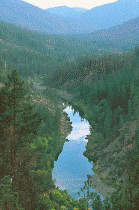
The Kalmiopsis Wilderness Area is ground zero for the Bush Administration’s aggressive attempts to gut hard fought legal protections for Old Growth reserves, inventoried roadless areas and salmon-bearing streams. This is a crucial moment in a historic campaign that will set precedent for forest policy for decades to come.
The Green Bridge is a rallying point for those who wish to show their opposition to the so-called Biscuit Fire Recovery Project, an extreme logging scheme that would remove tens of thousands of log trucks from remote regions of unmanaged native forest. A small group of local organizers are camping beneath the bridge on the bank of the picturesque Illinois River. The camp is becoming the public face of a growing campaign that is increasingly supported by old timers and locals who bring food, warm clothes and camp fire songs to share with those gathered. Read more here, here, and here.

Lack of complete landslide data did not discourage the Regional Water Quality Board from giving the controversial logging corporation the go-ahead to log more timber. The Board began asking for the data last summer as part of a year-long process to prepare permits for waste discharge for PL logging operations scheduled to begin January 2005. A US District Court found in October 2003 that sediment erosion running off cut-over hillsides that clogs creeks and rivers constitutes a "point-source" of pollution. PL’s refusal to turn over the data left them without the necessary permits, and threats of bankruptcy ensued after the company claimed a “log shortage."
“This decision reinforces PL’s bad behavior by rewarding them for their pressure tactics,” said Humboldt Watershed Council president Mark Lovelace. Read more.

The furor over the dozen logging plans started last November, when the Water Board declined to grant logging permits after PL refused to turn over landslide data on their timber lands. “Interim” permits were granted for four plans in the impaired watersheds after PL claimed a shortage of logs. PL has since been cited for violations in all four logging plans less than a month after cutting began. 38 mill workers were laid-off in January while PL pointed fingers at the Water Board. Maxxam CEO Charles Hurwitz had a January private meeting with Governor Arnold Schwarzenegger to promote his logging agenda, though local residents did not receive a similar opportunity.
Water Board Executive Officer Catherine Kuhlman said the final decision on the logging plans will be announced soon. Read more.

The U.S. Forest Service lost 44 court cases during the past two years in which the agency was found guilty of violating environmental laws by a federal court, according to an internal memo released by Public Employees for Environmental Responsibility (PEER). The rate of adverse court findings has been steadily growing with each passing year of the Bush Administration.
In Northern California, the Happy Camp Ranger District of the Klamath National Forest is proposing the 358-acre Elk Thin timber sale. The Elk Creek watershed is already fragmented from past logging and roadbuilding activities, and it is designated a "key watershed" for salmon recovery.
Meanwhile, in Southern Oregon, the US Forest Service threatens to jumpstart their controversial logging in Biscuit Fire Old Growth Reserves. The Forest Service is wanting rush in and log thousands of acres of old-growth reserves affected by the Biscuit fire before a court can determine if the logging is illegal. A court ordered injunction that prevented logging in seven timber sales was recently lifted. As a result, sensitive old-growth reserves are now imminently threatened by the Fiddler, Steed, Berry, Wafer, Hobson, Lazy, and Briggs Six logging sales. The Forest Service is trying to saw through these sales before a court case on the legality of the logging can be heard by a judge on March 22, 2005.
See the Forest Service summary of environmental cases it lost in FY 2003 and 2004.
MORE: 1 | 2 | 3 | 4 | KSWILD | Cascadia Rising | The Siskiyou Project | EPIC Alert