







 Publish to Newswire
 Add an Event
Feature Archives



Residents and tribal members reported the lowest Chinook (or King) Salmon runs in recorded history that impact the local way of life. They demanded Pacific Power remove the dams to bring the salmon home to the upper Klamath watershed, which has not seen salmon in almost a century.
Previous Reports: 1 I 2

In court Tuesday, PL attorneys accused the water board of “parroting” local environmental and property rights groups, and threw out accusations of a conspiracy designed to “cripple” Pacific Lumber. Nick Stern, an attorney with the Attorney General’s office deflected the accusation, citing the State Water agency's April 27 report which shows that the timber giant’s precarious financial position “is the result of the risky business model that (Texas parent company) MAXXAM has chosen to follow.”
At dozens of meetings over the last eight years, watershed residents have expressed frustration at slow regulatory reaction to what they describe as on-going harm stemming from PL’s high logging rate, and say the permits are long over-due. Pacific Lumber’s claims in court that they are victims of unfair regulation added to that frustration. “Here is another cynical ploy by Maxxam to obstruct regulatory efforts to reign in the reckless overcutting that has been their standard practice since the hostile takeover of PL in 1985,” said Larry Evans, President of the Environmental Protection Information Center.
North Coast Water Board

7/24/2005:Yesterday was moving day. Joan Norman was moving into an apartment that she had endured two years on a waiting list for, in Brookings. She was killed in a car accident and her nephew, who had been in the car with her, survived with minor injuries. Joan Norman was interviewed by a Portland Indymedia reporter during the women's actions in the Biscuit earlier this year. Ms. Norman had been arrested on March 8th, and one of her statements in the interview was, "There are only 5% of the old growth trees left in the United States." She was arrested twice during the Biscuit campaign. At 72 years of age, she spent several weeks in jail, as she had refused bail on the moral grounds that she was not the law breaker. She was arrested more than 100 times in her more than 30 years of activism.
Activists were attending a Sisters of the Siskiyou benefit in Ashland when this news was relayed to them last night. Joan Norman had been their "number one Sister of the Siskiyous, dear friend, mentor and leader." The group decided to do what would have please Joan-- Biscuiteers will take lawn chairs and sit down in front of the McGuire timber sale. A new blockade in the Siskiyou Free State had just been started this week. The action will occur in a timeframe most respectful toward Joan's family. Details about Joan's memorial will be announced soon.
Articles about Joan Norman:
Tell them to come with fire in their bellies | Grandma Joan out of jail and fired up | Sisters of the Siskiyous Sound off Over Lawless Logging | Direct Action continues in the Biscuit: Women Draw the Line Against Lawless Old-Growth Logging | Biscuit Update - Written from the Josephine County Jail | "Grandma Joan" Spends 14th Day in Jail | Joan Norman Arrested on March 8th: Video Photos
For more information about the Biscuit: Rogue Valley IMC's Environment and Forest Defense Page | Cascadia Rising | Portland Indymedia's Battle of the Biscuit Page | Oxygen Collective Website
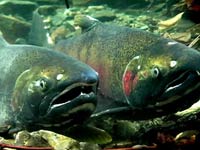
Glasgow, Scotland - Member of Scottish Parliament (MSP) Robin Harper announced today that he will be introducing a resolution to support the Hoopa, Karuk, Klamath, and Yurok Tribes' efforts to have Klamath River Dams removed, and the fishery restored. These are the three largest tribes in California and the largest in Oregon.
The Tribes are campaigning in Scotland to pressure multinational energy giant Scottish Power (NYSE - SPI) to remove dams which block over 350 miles of spawning habitat for salmon and degrade water quality. Since the building of the dams, Klamath salmon numbers have plummeted to less that 8% of their historic levels, devastating tribal cultures and local economies.

Wells Fargo is one of the largest US banks still operating without meaningful social or environmental safeguards to prevent destructive investments. Despite their surprise July 11 announcement of a so-called "10-point environmental commitment," Wells Fargo continues to be a top financier of environmentally and socially destructive corporations like Burlington Resources, a Houston-based company drilling for oil on indigenous homelands in Ecuador, and BlueLinx, a timber-importer linked to illegal logging and human rights abuses in Indonesia.
Unlike competitors such as Citigroup, Bank of America, and JPMorgan Chase, Wells Fargo refuses to take seriously its role as a bankroller of global warming, and consistently avoids making any specific commitments to curtail oil investments, safeguard endangered ecosystems, or to uphold human rights in areas where it invests money. Moreover, Wells Fargo profits from other types of social injustice such as predatory lending and charging exorbitant fees to low-income immigrants seeking to wire money home to their families overseas.
Photos Of the Demonstration | Rainforest Action Network
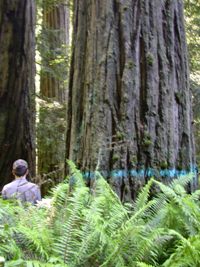
The logging plan, called “Bonanza”, is open to public comment until July 8, 2005. Of the 249 acres covered by the plan, 192 acres are occupied stands for the murrelet. The Environmental Protection Information Center is requesting letters opposing the plan be sent to the California Department of Forestry. A sample letter is available.
Since the take-over of PALCO by MAXXAM CEO Charles Hurwitz in 1986, the forest – and the timber industry it supports – has suffered a swift decline. A recent report commissioned by the California Water Resources Control Board found that logging such irreplaceable areas would not deter bankruptcy. “...even if (MAXXAM) cut every tree they own, it may not be enough to pay back its current debts.” Maxxam continues to pursue logging in landslide-prone areas, in habitat for many sensitive, threatened and endangered species including the northern spotted owl, marbled murrelet, and coho and chinook salmon. “Maxxam is driving Pacific Lumber and marbled murrelets into extinction,” said a long-time critic of the Texas-based corporation. Read more
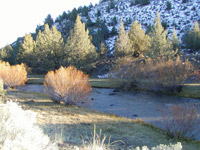
Three of the West Coast’s major river systems – the Columbia, Klamath and Central Valley (Sacramento, San Joaquin) are under threat. In 1992, Congress recognized the shortage to the Bay and Delta and voted in the Central Valley Project Improvement Act (CVPIA) to provide the Federal share of that amount by allocating an additional 800,000 acre-feet of yield from the Central Valley Project for fish and wildlife. Unfortunately, the U.S. Bureau of Reclamation, charged with implementing the CVPIA, subscribes to a culture that worships dams and views water diversions as a holy sacrament. Read More - 1 | 2 | 3
Meanwhile, in the northeastern corner of California, the beautiful, majestic South Fork of the Pit River located in Modoc County, is endangered due to California's grab for land and the water rights that go along with it. Many ranchers have sold out and large corporate ranching operations have purchased the small ranches, including Alturas Ranches, owned by multimillionaire Silicon Valley Land Developer, Barry Swenson, members of his family, various partners of his and the Green Valley Corporation. As a result, they hold an almost sixty percent control of the South Fork Irrigation District (SFID) a public entity, and a controlling share of the water rights of the South Fork of the Pit River. Read More - 1 | 2