







 Publish to Newswire
 Add an Event
Feature Archives


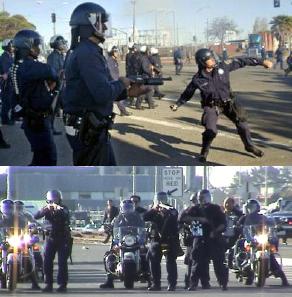
Michael Haddad, a civil rights lawyer who helped implement the guidelines, says the new protections for the right to assemble are important because prior to this, the OPD "had no policy. Their policy was anything goes."
The ACLU, the National Lawyer's Guild, civil rights lawyers, city officials, and Oakland Police Chief Richard Word developed the new crowd control policy, which prohibits the indiscriminate use of wooden bullets, rubber bullets, tasers, bean bags, pepper spray and police motorcycles to control or disperse crowds or demonstrations.
Efforts to implement this policy were inspired by the incident on April 7, 2003, when police fired wooden bullets, sting ball grenades and shot-filled bean bags at hundreds of peaceful anti-war activists during an organized demonstration at the Port of Oakland. The new policy does not resolve claims for monetary damages by those who were injured as a result of the police action. Federal District Court Judge Thelton Henderson has scheduled those claims for trial in January, 2006.
Willow Rosenthal of Oakland was hit in the back of her calf with a wooden bullet. She required several surgeries, including skin grafts due to internal bleeding. At a press conference on Nov. 9, 2004 announcing the new crowd control policy, Rosenthal said that she is still not able to attend protests because she does not trust what the cops may do. "They can never take away what they did to me and what they did to us." Full story | ACLU/NLG news release | PDF

Bush said, "With the Senate's approval, Judge Gonzales will succeed another superb public servant, Attorney General John Ashcroft. Attorney General Ashcroft has served with excellence during a demanding time. In four years, he's reorganized the Department of Justice to meet the new threat of terrorism. He's fairly and forcefully applied the Patriot Act and helped to dismantle terror cells inside the United States. During his watch, violent crime has dropped to a 30-year low, and prosecutions of crimes committed with guns have reached an all-time high. Drug use amongst our students is down. Confidence in the financial markets has been restored because the Attorney General aggressively prosecuted corporate fraud. And thanks to John Ashcroft's leadership, America has stepped up its efforts to prosecute the cruel exploitation of children by Internet pornographers. The nation is safer and more just today because John Ashcroft has served our country so well." Scary, huh?
In response, Gonzales said, "As a former judge, I know well that some government positions require a special level of trust and integrity. The American people expect and deserve a Department of Justice guided by the rule of law, and there should be no question regarding the Department's commitment to justice for every American. On this principle, there can be no compromise." However, Gonzales did not define what the word "justice" means to him...However, some people have done some research and learned about a bit about Judge Al's views. One example of his thoughts on the matter: Alberto Gonzales said in 2002 that the Geneva Conventions on prisoners of war should not apply to al-Qaida or Taliban prisoners. Another: on Gonzales's recommendation, many of the Texas executions that Governor Bush did not stop included circumstances that flouted international law or safeguards. Judge Al forgot to mention these details in his memos to the governor. Gonzales is clearly not opposed to executing people who are mentally-retarded or committed crimes when they were minors. Read more
The National Lawyers Guild urges Senate to reject Alberto Gonzales's nomination.
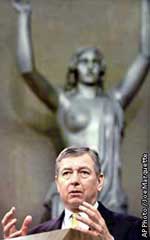
John Ashcroft is an evangelical christian and an amateur musician. He is a former Governor of Missouri and US Senator. He lost his Senate seat in 2000 to a dead man, Mel Carnahan, but in consolation, Bush appointed him to the Attorney General position.
In a statement today, NARAL Pro-Choice America said "John Ashcroft's resignation is the first major test of whether President Bush meant what he said last week about uniting Americans...John Ashcroft changed the Attorney General's job description from law enforcement to ideological warfare. He attempted to invade Americans' personal privacy in innumerable ways. He aggressively defended the federal abortion ban that three federal courts have declared unconstitutional and unenforceable, going so far as to subpoena the private medical records of thousands of women relating to their abortion care. As part of these efforts, he stated that patients no longer have a reasonable expectation of privacy in their medical records. Ashcroft's Justice Department also argued in favor of a state abortion ban that clearly endangers women's health. Even after promising at his confirmation hearing to uphold Roe v. Wade as the law of the land, Ashcroft never stopped trying to roll back the right to choose."
In his resignation letter, Ashcroft said, "I take great personal satisfaction in the record which has been developed. The objective of securing the safety of Americans from crime and terror has been achieved. The rule of law has been strengthened and upheld in the courts. Yet, I believe that the Department of Justice would be well served by new leadership and fresh inspiration."
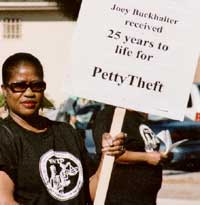
10/31/2004: This fall's statewide Proposition 66 would amend California's Three Strikes law, which was one of the first of its type in the nation. It reforms California’s three strikes sentencing law to require that a third strike, which carries a mandatory 25-to-life sentence, be a violent or serious felony. It also changes the list of crimes counting as “strikes” to exclude some nonviolent or nonserious crimes. Resentencing would be an option for some prisoners who are currently classified as third strikers. According to the Yes on 66 campaign, "California is the only state in the nation whose three-strikes law applies the same sentences to petty criminals that it does to rapists, robbers and murderers." Read more It includes a complicated schedule for increased sentences for each "strike," or felony conviction.
Proposition 66 provides for re-sentencing: Re-sentencing is not automatic. Prisoners would have to apply for a hearing and be granted it by the Judge in their court of origin. Re-sentencing would only apply to non-violent offenders who have "behaved" while they were in prison- a third striker who has attempted escape or been violent while in prison will not qualify for re-sentencing. Governor Schwarzenegger appears frequently in television ads that state that if Prop. 66 passes, violent criminals will be released into our neighborhoods. Yes on 66 Campaign Rebuttal Currently, if an applicant for commutation of sentence has been convicted of two or more felonies in separate proceedings a majority of the California Supreme Court must vote to approve the Governor's grant of clemency.
Text of Prop 66 (Word File) | Supporters of the current Three Strikes Law | FACTS, or Families to Amend California's Three Strikes | Yes on 66 website | Still Striking Out: Ten Years of California's Three Strikes | Three Strikes: Seven Years Later | The November Coalition

Corina Cardenas is a daughter of Rudy Cardenas, a man who was shot in the back and killed in downtown San Jose this year when he was mistaken for a fugitive earlier this year. She said, “I wish I wasn’t here tonight. I wish my dad was here with us... Now my eyes have been opened to the way the system works.” Representatives of the Coalition for Justice and Accountability, which has been helping the Commission deal with police violence, providing information and a compelling point of view on various cases, also spoke.
Sheila Stevens of the Commission said, “I am concerned with how our police deal with refugees, foreigners, and people who are upset or have mental health issues,” referring in part to Cau Tran and Zaim Bojcic, who, it is said, were both suffering from mental illness. Since the killing of Cau Tran, the SJPD has been armed with tasers, which are electric shock devices. These were supposed to lower the number of officer-involved shootings. Activist David Taylor showed a graph to the Commission that indicated shootings had actually gone up since the introduction of the tasers. The Commission agreed for the Justice Committee to continue to meet and gather more information and perspective, and then to give a report to the Commission when a decision for a recommendation to action can be made.
The next Justice Committee meeting will be November 18 at 5:30 in the Basement of 70 W. Hedding St. in San Jose, in the Heritage Room.
Read more

Why in the six months since Cammerin's murder has the community not mobilized a nationwide campaign on the level of Amadou Diallo's killing in New York? Police intimidation, apartheid in the activist community, demoralizing neighborhood rivalries and negative mainstream media sensationalism have all worked to cover-up a racist and horrifying display of deadly force. Supporters, family and friends of Cammerin Boyd will gather on the 6-month anniversary of Cammerin's death at 4:45pm on Friday, Nov. 5th at Larch Way and Laguna St. (between Eddy and Turk) for a vigil and march on City Hall from the site of Cammerin's murder at the hands of the SFPD. Announcement 11/4 Press Release Video Photos
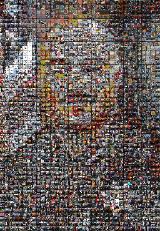 |
| Chief Word as assembled from four-years worth of Indymedia photography in Oakland. |
With Police Chief Richard Word leaving the mean streets of Oakland for the greener pastures of Vacaville, in Solano County, let's review some of the headlines from his tenure as boss of "Jerry's gang" (gathered in part from a 10/22 article in the Berkeley Daily Planet).
Chief Word presided over the riders' scandal, in which four police officers were arrested for allegedly beating citizens, planting evidence, falsifying police reports, lying on the witness stand, and stealing drugs and money from arrestees. The accused police officers say they got the green light to "bend the law" from Mr. Word himself, who wanted the officers to "clean up" West Oakland.
But the Riders were only the most glaring example of a larger story; the city was forced to pay out an $11 million police misconduct lawsuit settlement to 119 plaintiffs because of police actions similar to the ones that got the Riders in trouble. The Oakland Police Department was also placed into a court-ordered program to monitor its efforts at reform.
OPD's chance for a little of what law enforcement calls "anti-terrorism" action came in April 2003 at the Port of Oakland, when the the Oakland police fired tear gas and wooden dowels and tossed concussion grendades at unarmed antiwar protesters, causing serious injuries and receiving reprimands from the United Nations and Amnesty International. One month earlier at another antiwar protest, Oakland police officers reportedly used their motorcycles to run over high-school students on Broadway.
The Oakland Police Dept. spent a million dollars a year in police overtime, over many years, in a poorly planned and poorly executed attempt to shutdown Oakland's sideshow scene, with rather damaging results for police-citizen relations. Read more in Berkeley Daily Planet article by J. Douglas Allen-Taylor
Word's failures as Police Chief leave Oakland residents debating this election season between giving even more money to the police, in the form of 63 new officers, or investing in other areas where the City of Oakland is suffering: schools, afterschool programs, rec centers, libraries, healthcare, jobs, food, and housing.
Here are a few Indymedia headlines from Word's term at the helm of the OPD:
- Pre-trial in Judi Bari vs. FBI; Trial set for October 1
- Community Organizing Against Police Brutality on Both Sides of the Bay
- Oct 22nd Protest in Oakland Against Police Brutality
- Community Protests Murder by Oakland PD
- Global Apartheid in Oakland: Some of Riders Gang on Trial
- Bari v. FBI Trial Underway
- Rally Kicks off Trial
- Corrupt Oakland Police Trial Begins 5/28
- FBI Tries to Stop Jury from Reading Constitution
- Oakland Cops on Trial for Widespread Corruption, Frame-ups, Beatings
- FBI LOSES: Jury Awards $4.4 Million Against FBI
- Activists Win In Judi Bari Trial
- Hundreds Demonstrate Against Police Brutality in Oakland
- Port Of Oakland Shut Down: Police Fire Concussion Grenades and Wooden Bullets at Protesters and Dock Workers
- Community Responds to Oakland Police Violence
- California counter-terrorism agency monitoring peace activists, equates them with terrorists
- Oakland to Pay $2M to settle Bari lawsuit
- "I'm an ass man," says arresting officer in police report
- Former Educator's Charge of Prostitution Reduced to Disturbing the Peace
- Riots On International Blvd Following Raiders Super Bowl Loss
- Oakland Students Detained, Searched and Threatened by Racist Police
- OPD Harass Students "Under Suspicion of Being Black"
- Stop the Nuisance Eviction Ordinance
- Remember the Shots! Return to the Docks!
- Will Oakland Fire Racist Cops?
- DA Drops Charges Against Oakland 25 Protesters
- Oakland Organizes Against Measure Y- No More Police Funding