







 Publish to Newswire
 Add an Event
From the Open-Publishing Calendar
From the Open-Publishing Newswire
Indybay Feature
Rally in Santa Cruz on Eighth Anniversary of the Invasion and Occupation of Iraq
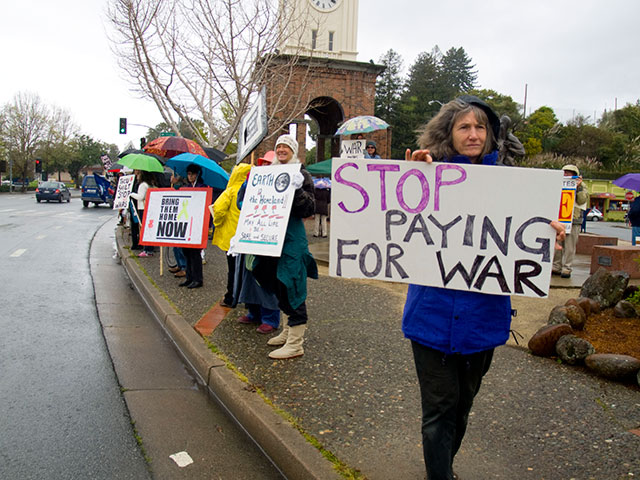
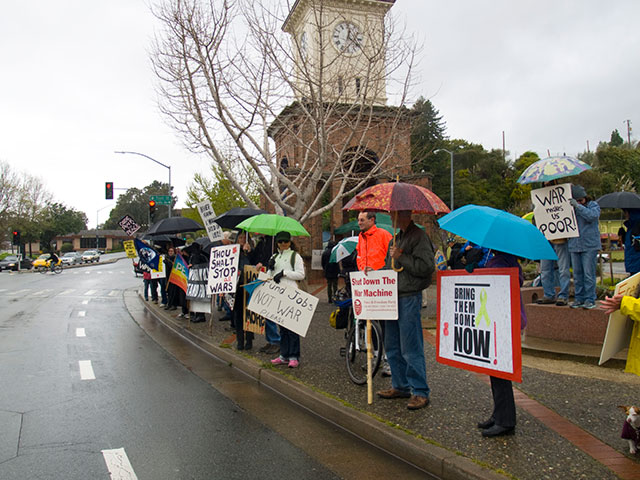
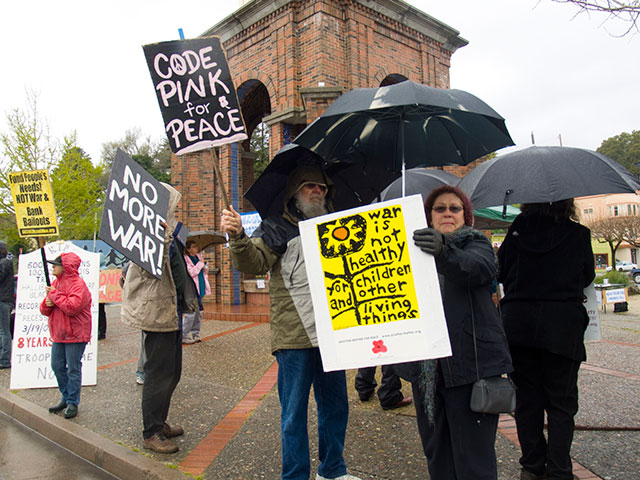
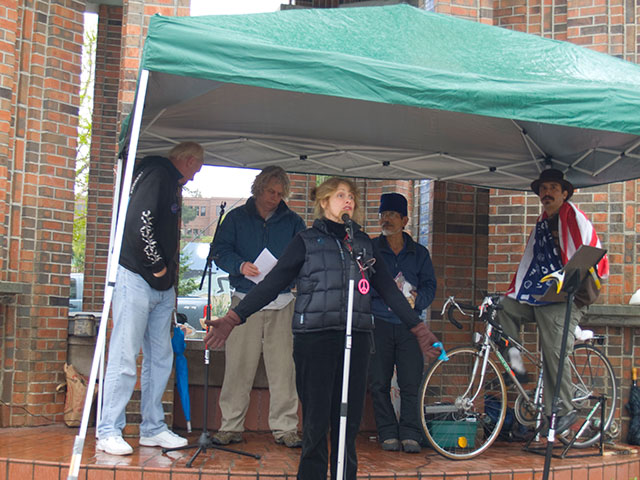
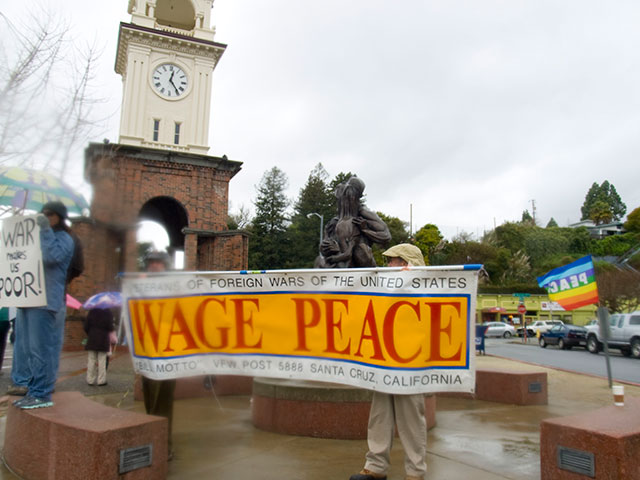
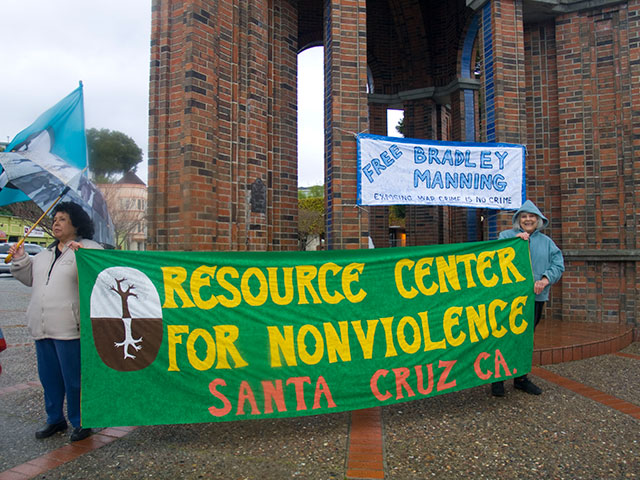
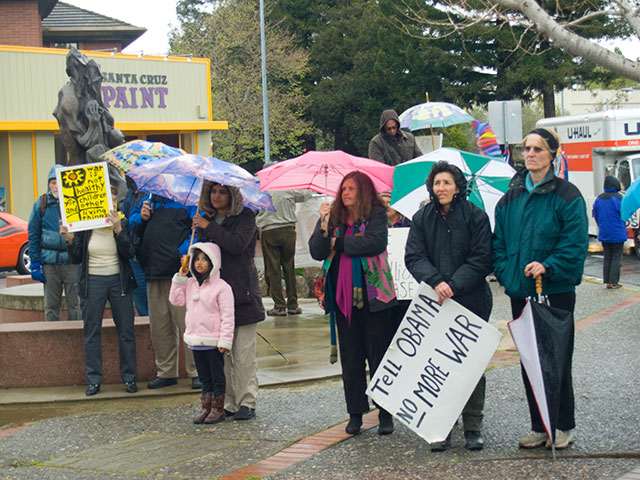
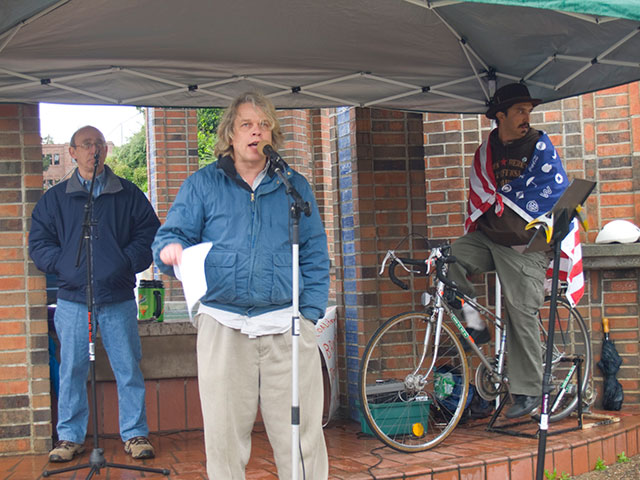
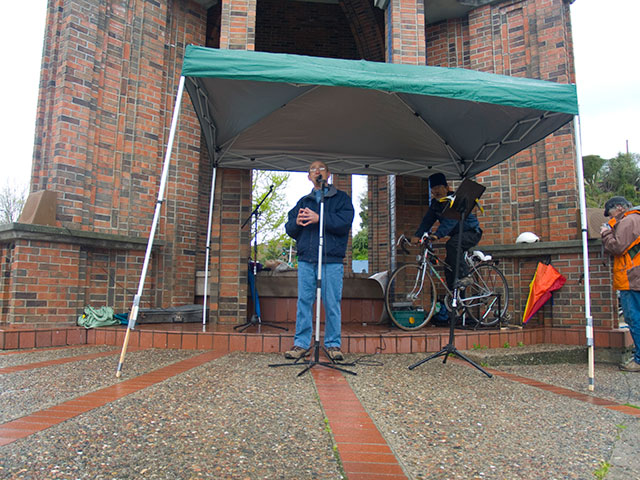
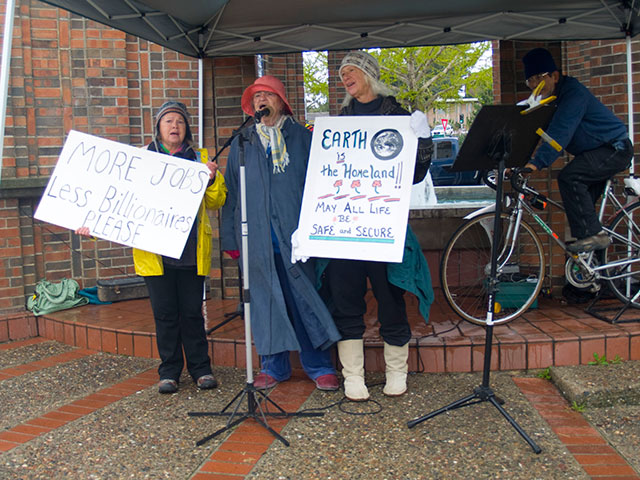
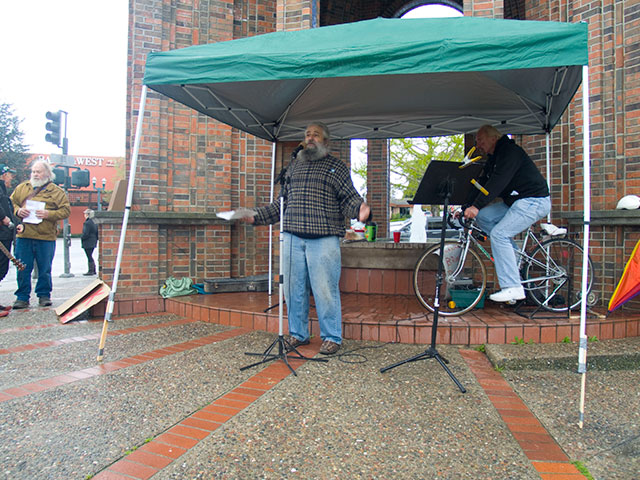
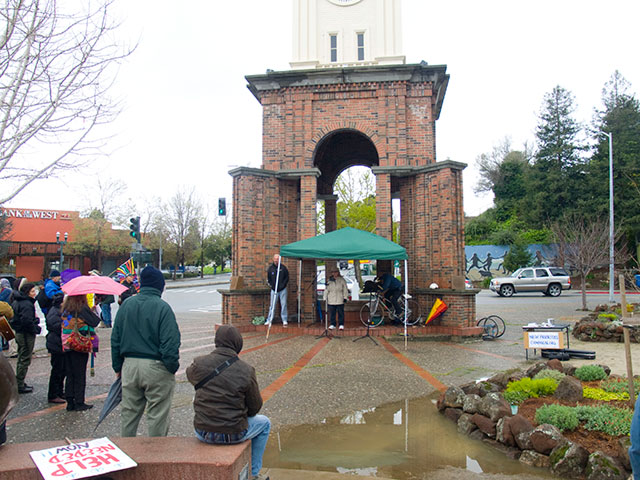
On March 19th, a day which began with a heavy hail storm in Santa Cruz, dozens of people rallied at the Town Clock to protest the eighth anniversary of the U.S. invasion and occupation of Iraq. The rally was also a demonstration against the incarceration of Bradley Manning, the increasing militarism of society, and the war at home against the poor and houseless. Protests were taking place in other cities as well, including San Francisco and Fresno.
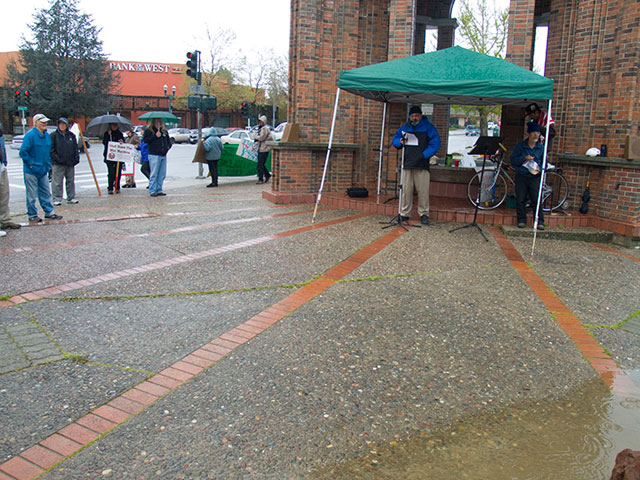
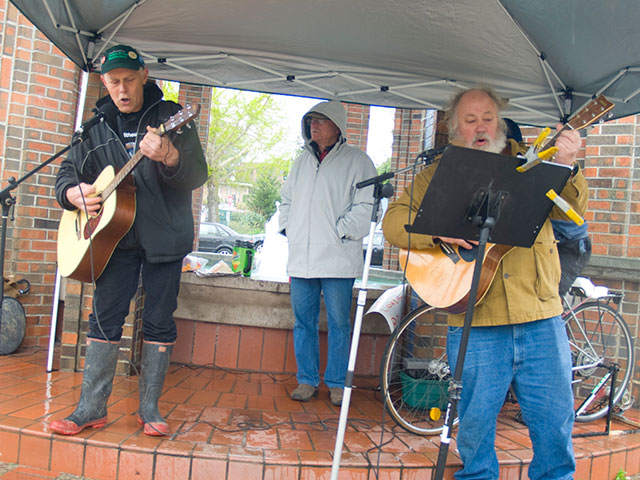
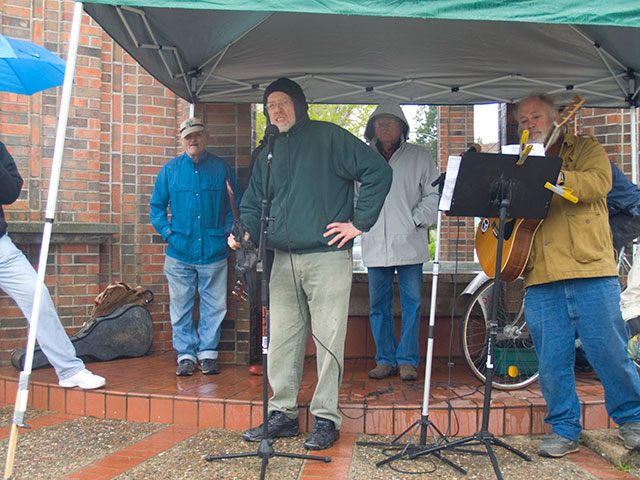
Walt Oicle, an organizer of the rally, gave a moving speech and performed a song on the guitar. Walt's first protest was a candlelight vigil against the Vietnam War in 1970. At the Town Clock, Walt stated, "We must force our government to do things because they are right, and not merely expedient or profitable for some particular constituent. We've got to stop letting corporations write our laws for their benefit. We've got to reverse the idea that bloodless corporations should have the same rights as actual people. Corporations are set up to make money, and to avoid personal responsibility. Corporations can't be jailed, and their officers seldom are. So we've got to amend the Constitution to rectify that mistaken notion that has caused so much trouble."
For more information:
http://bradleystuart.net

Add Your Comments
Comments
(Hide Comments)
Tuesday, March 15, 2011
http://balkin.blogspot.com/2011/03/statement-on-private-mannings-detention.html
Yochai Benkler and I invite members of the academic legal community to join us in signing the following statement, asking the Administration either publicly to justify, or end, the humiliation and mistreatment of Private Bradley Manning, the suspected whistleblower who is said to have leaked classified government documents to Wikileaks.
For background, you can read this editorial in today’s New York Times, The Abuse of Private Manning and get more details from Soldier in Leaks Case Will Be Made to Sleep Naked Nightly.
If you'd like to add your signature, please send your name and institutional affiliation to manningprofletterjoin [at] gmail.com. Signatories added below in periodic updates.
220 signatories as of March 19, 5:30pm.
UPDATE:Our initial draft relied on news reports in the major news outlets. Comments we received since then lead us to think that two facts may be overstated in the original draft:
1. The instance of forced nudity overnight and in morning parade apparently occurred once. The continuing regime apparently commands removal of Pvt. Manning's clothes and his wearing a "smock" at night.
2. The shackling apparently occurs when Private Manning is moved from his cell to the exercise room, but not while walking during the one hour of exercise.
Other responses we have received suggest that there are claims of myriad other abuses that make conditions worse in various ways than we describe. We do not, and cannot, seek to adjudicate these factual claims. The conflicting responses underscore the need for a public, transparent, and credible response to the reported abuse, and cessation of those among them that cannot be justified.
Private Manning’s Humiliation
Bradley Manning is the soldier charged with leaking U.S. government documents to Wikileaks.
He is currently detained under degrading and inhumane conditions that are illegal and immoral.
For nine months, Manning has been confined to his cell for 23 hours a day. During his one remaining hour, he can walk in circles in another room, with no other prisoners present. He is not allowed to doze off or relax during the day, but must answer the question “Are you OK?” verbally and in the affirmative every five minutes. At night, he is awakened to be asked again, “are you OK” every time he turns his back to the cell door or covers his head with a blanket so that the guards cannot see his face. During the past week he was forced to sleep naked and stand naked for inspection in front of his cell, and for the indefinite future must remove his clothes and wear a "smock" under claims of risk to himself that he disputes.
The sum of the treatment that has been widely reported is a violation of the Eighth Amendment’s prohibition of cruel and unusual punishment, and the Fifth Amendment’s guarantee against punishment without trial. If continued, it may well amount to a violation of the criminal statute against torture, defined as, among other things, “the administration or application… of… procedures calculated to disrupt profoundly the senses or the personality.”
Private Manning has been designated as an appropriate subject for both Maximum Security and Prevention of Injury (POI) detention. But he asserts that his administrative reports consistently describe him as a well-behaved prisoner who does not fit the requirements for Maximum Security detention. The Brig psychiatrist began recommending his removal from Prevention of Injury months ago. These claims have not been publicly contested. In an Orwellian twist, the spokesman for the brig commander refused to explain the forced nudity “because to discuss the details would be a violation of Manning’s privacy.”
The Administration has provided no evidence that Manning’s treatment reflects a concern for his own safety or that of other inmates. Unless and until it does so, there is only one reasonable inference: this pattern of degrading treatment aims either to deter future whistleblowers, or to force Manning to implicate Wikileaks founder Julian Assange in a conspiracy, or both.
If Manning is guilty of a crime, let him be tried, convicted, and punished according to law. But his treatment must be consistent with the Constitution and the Bill of Rights. There is no excuse for his degrading and inhumane pre-trial punishment. As the State Department’s PJ Crowly put it recently, they are “counterproductive and stupid.” And yet Crowley has now been forced to resign for speaking the plain truth.
The Wikileaks disclosures have touched every corner of the world. Now the whole world watches America and observes what it does; not what it says.
President Obama was once a professor of constitutional law, and entered the national stage as an eloquent moral leader. The question now, however, is whether his conduct as Commander in Chief meets fundamental standards of decency. He should not merely assert that Manning’s confinement is “appropriate and meet[s] our basic standards,” as he did recently. He should require the Pentagon publicly to document the grounds for its extraordinary actions --and immediately end those which cannot withstand the light of day.
Signed:
Bruce Ackerman, Yale Law School
Yochai Benkler, Harvard Law School
Additional Signatories (institutional affiliation, for identification purposes only):
Jack Balkin, Yale Law School
Richard L. Abel, UCLA Law, Emeritus
David Abrams, Harvard Law School
Kirsten Ainley, London School of Economics
Jeffrey Alexander, Yale University
Philip Alston, NYU School of Law
Anne Alstott, Harvard Law School
Elizabeth Anderson, Philosophy and Women's Studies, University of Michigan
Scott Anderson, Philosophy, University of British Columbia
Claudia Angelos, NYU School of Law
Donald K. Anton. Australian National University College of Law
Kwame Anthony Appiah, Princeton University
Stanley Aronowitz, Sociology, CUNY Graduate Center
Jean Maria Arrigo, PhD, social psychologist, Project on Ethics and Art in Testimony
Reuven Avi-Yonah, University of Michigan Law
H. Robert Baker, Georgia State University
Duncan Bell, Politics and International Studies, University of Cambridge
Steve Berenson, Thomas Jefferson School of Law
Michael Bertrand, UNC Chapel Hill
Rebecca M. Bratspies, CUNY School of Law
Jason Brennan, Philosophy, Brown University
Talbot Brewer, Philosophy, University of Virginia
John Bronsteen, Loyola University Chicago
Peter Brooks, Princeton University
James Robert Brown, University of Toronto
Sande L. Buhai,Loyola Law School, Los Angeles
Ahmed I Bulbulia, Seton Hall Law School.
Susannah Camic, University of Wisconsin Law School
Alexander M. Capron, University of Southern California, Gould School of Law
Michael W. Carroll, Law American University
Marshall Carter-Tripp, Ph.D, Foreign Service Officer, retired
Jonathan Chausovsky, Political Science, SUNY-Fredonia
John Clippinger, Berkman Center for Internet and Society
Andrew Jason Cohen, Georgia State University
Marjorie Cohn, Thomas Jefferson School of Law
Doug Colbert, Maryland School of Law
Nancy Combs, William & Mary Law School
Stephen A. Conrad, Indiana University Mauer School of Law
Thomas P. Crocker, University of South Carolina
Deryl D. Dantzler, Walter F. Gorge School of Law of Mercer University
Benjamin G. Davis, University of Toledo College of Law
Rochelle Davis, School of Foreign Service, Georgetown University
Wolfgang Deckers, Richmond University, London
Michelle M. Dempsey, Villanova University School of Law
Wai Chee Dimock, English, Yale University
Sinan Dogramaci, Philosophy, University of Texas at Austin
Judith Donath, Fellow, Berkman Center for Internet and Society
Michael W. Doyle, International Affairs, Law and Political Science, Columbia
Bruce T. Draine, Astrophysics, Princeton University
Lisa Duggan, Social and Cultural Analysis, NYU
Cynthia Fuchs Epstein, Graduate Center,CUNY
Simon Evnine, Philosophy, University of Miami
Mark Fenster,Levin College of Law, University of Florida
Martha Field, Harvard Law School
Justin Fisher, Philosophy, Southern Methodist University
William Fisher, Harvard Law School
Joseph Fishkin, University of Texas School of Law
Martin S. Flaherty, Fordham Law School
George P. Fletcher, Columbia University, School of Law
John Flood, Law and Sociology, University of Westminster
Bryan Frances, Philosophy, Fordham University
Nancy Fraser, Philosophy and Politics, New School for Social Research
Eric M. Freedman, Hofstra Law School
Monroe H. Freedman, Hofstra University Law School
A. Michael Froomkin, University of Miami School of Law
Gerald Frug, Harvard Law School
Louis Furmanski, University of Central Oklahoma
James K. Galbraith, LBJ School of Public Affairs, University of Texas at Austin
Herbert J Gans, Columbia University
William Gardner, Pediatrics, Psychology, & Psychiatry, The Ohio State University
Urs Gasser, Harvard Law School, Berkman Center for Internet and Society
Julius G. Getman, University of Texas Law School
Todd Gitlin, Columbia University
David Golove, NYU School of Law
James R. Goetsch Jr., Philosophy, Eckerd College
Thomas Gokey, Art and Information Studies, Syracuse University
Robert W. Gordon, Yale Law School
Stephen E. Gottlieb, Albany Law School
Mark A. Graber, University of Maryland School of Law
Roger Green, Pol. Sci. and Pub. Admin., Florida Gulf Coast
Daniel JH Greenwood, Hofstra University School of Law
Christopher L. Griffin, Visiting, Duke Law School
James Gronquist,Charlotte School of Law
Lisa Guenther, Philosophy, Vanderbilt University
Gillian K. Hadfield, Law, Economics, University of Southern California
Susan Hazeldean, Robert M. Cover Fellow, Yale Law School
Kevin Jon Heller, Melbourne Law School
Lynne Henderson, UNLV--Boyd School of Law (emerita)
Stephen Hetherington, Philosophy, University of New South Wales
Kurt Hochenauer, University of Central Oklahoma
Lisa Hajjar, University of California - Santa Barbara
Nathan Robert Howard, St. Andrews ( please check this has little information)
Marc Morjé Howard, Government, Georgetown University
Kyron Huigens, Cardozo School of Law
Alexandra Huneeus, University of Wisconsin Law School
David Ingram, Philosophy, Loyola University Chicago
David Isenberg, Isen.com
Sheila Jasanoff, Harvard Kennedy School
Christopher Jencks, Harvard Kennedy School
Paula Johnson, Alliant International University
Robert N. Johnson, Philosophy, University of Missouri
Albyn C. Jones, Statistics, Reed College
Lynne Joyrich, Modern Culture and Media, Brown University
Eileen Kaufman, Touro Law Center
Kevin B. Kelly, Seton Hall University School of Law
Randall Kennedy, Harvard Law School
Daniel Kevles, Yale University
Heidi Kitrosser, University of Minnesota Law School
Gillian R. Knapp, Princeton University
Seth F. Kreimer University of Pennsylvania Law School
Alex Kreit, Thomas Jefferson School of Law
Stefan H. Krieger, Hofstra University School of Law
Mitchell Lasser, Cornell Law School
Mark LeBar, Philosophy, Ohio University
Brian Leiter, University of Chicago
Mary Clare Lennon, Sociology, The Graduate Center, CUNY
George Levine, Emeritus, Rutgers University
Sanford Levinson, University of Texas Law School
Margaret Levy Political Science, University of Washington
Tracy Lightcap, Political Science, LaGrange College
Stacy Litz, Drexel University
Fiona de Londras, University College Dublin, Ireland
David Luban, Georgetown University Law Center
Peter Ludlow, Philosophy, Northwestern University
Colin Maclay, Harvard University, Berkman Center
Joan Mahoney, Emeritus, Wayne State University Law School
Chibli Mallat, Visiting Professor, Harvard Law School
Phil Malone, Harvard Law School
Jane Mansbridge, Harvard Kennedy School
Dan Markel, Florida State University
Daniel Markovits, Yale Law School
Richard Markovitz, University of Texas Law School
Ruth Mason, University of Connecticut School of Law
Jamie Mayerfeld, Political Science, University of Washington
Diane H. Mazur, University of Florida Levin College of Law
Jason Mazzone, Brooklyn Law School
Jeff McMahan, Philosophy, Rutgers University
Agustín José Menéndez, Universidad de León and University of Oslo
Hope Metcalf, Yale Law School
Frank I. Michelman, Harvard University
John Mikhail, Georgetown University Law Center
Gregg Miller, Political Science, University of Washington
Eben Moglen, Columbia Law School and Software Freedom Law Center
Charles Nesson, Harvard University
Joel Ngugi, Law, African Studies, University of Washington
Ralitza Nikolaeva, ISCTE Business School, Lisbon University Institute
John Palfrey, Harvard Law School
Adrian du Plessis, Wolfson College, Cambridge University
Patrick S. O'Donnell, Philosophy, Santa Barbara City College
Hans Oberdiek, Philosophy, Swarthmore College
Philip Pettit, University Professor of Politics and Human Values, Princeton
Frank A. Pasquale, Seton Hall Law School
Leslie Plachta, MD MPH, Albert Einstein College of Medicine
Matthew Pierce, University of North Carolina
Thomas Pogge, Yale University
Giovanna Pompele, University of Miami
Joel Pust, Philosophy, University of Delaware
Margaret Jane Radin, University of Michigan and emerita, Stanford University
Aziz Rana, Cornell University Law School
Calair Rasmussen, Affiliation: Political Science, University of Delaware
Daniel Ray, Thomas M. Cooley Law School
Jeff A. Redding, Saint Louis University School of Law
C. D. C. Reeve, Philosophy, University of North Carolina at Chapel Hill
Bryan Register, Philosophy, Texas State University
Cassandra Burke Robertson, Case Western Reserve University School of Law
John A. Robertson, University of Texas Law School
Corey Robin, Brooklyn College and the CUNY Graduate Center
Clarissa Rojas, CSU Long Beach
Kermit Roosevelt, University of Pennsylvania Law School
Susan Rose-Ackerman, Law, Political Science, Yale University
Norm Rosenberg, History, Macalester College
Clifford Rosky, University of Utah
Brad R. Roth, Poli. Sci. and Law, Wayne State University
Barbara Katz Rothman, Sociology, City University of New York
Bo Rothstein Political Science, University of Gothenburg
Donald Rutherford,Philosophy, University of California, San Diego
Leonard Rubenstein, JD, Johns Hopkins Bloomberg School of Public Health
DeWitt Sage, Flimmaker
Cindy Skach, Comparative Government and Law, Oxford
William J. Talbott, Philosophy, University of Washington
Natsu Taylor Saito, Georgia State University College of Law
Dean Savage, Queens College, Sociology, CUNY
Kent D. Schenkel, New England Law
Kim Scheppele, Princeton Univeristy
Jeffrey Schnapp, Harvard University
Jeffrey Selbin, Yale Law School
Wendy Seltzer, Fellow, Princeton Center for Information Technology Policy
Jose M. Sentmanat, Philosophy, Moreno Valley College, California
Omnia El Shakry, History, University of California
Scott Shapiro, Yale University
Stephen Sheehi, Languages, Lit. and Cultures, University of South Carolina
James Silk, Yale Law School
Robert D. Sloane, Boston University School of Law
Ronald C. Slye, Law, Seattle University
Matthew Noah Smith, Philosophy, Yale University
John M. Stewart, Emeritus, Psychology, Northland College
Alec Stone Sweet, Yale Law School
Mateo Taussig-Rubbo, SUNY-Buffalo Law School
John Torpey, CUNY Graduate Center
Frank Thompson, University of Michigan
Matthew Titolo, West Virginia University College of Law
Vilna Bashi Treitler, Black & Hispanic Studies, Baruch College, City
Laurence H. Tribe, Harvard University
David M. Trubek, University of Wisconsin (emeritus)
Robert L. Tsai, American University, Washington College of Law
Peter Vallentyne, Philosophy, University of Missouri
Joan Vogel, Vermont Law School
Paul Voice, Philosophy, Bennington College
David Watkins, Political Science, University of Dayton
Jonathan Weinberg, Wayne State University
Henry Weinstein, Law, Literary Journalism, University of California,
Christina E. Wells, University of Missouri School of Law
Lauris Wren, Hofstra Law School
Elizabeth Wurtzel, Attorney and author
Betty Yorburg, Emerita, City University of New York
Benjamin S. Yost, Philosophy, Providence College
Michael J. Zimmer, Professor of Law, Loyola University Chicago
Lee Zimmerman, English, Hofstra University
http://balkin.blogspot.com/2011/03/statement-on-private-mannings-detention.html
Yochai Benkler and I invite members of the academic legal community to join us in signing the following statement, asking the Administration either publicly to justify, or end, the humiliation and mistreatment of Private Bradley Manning, the suspected whistleblower who is said to have leaked classified government documents to Wikileaks.
For background, you can read this editorial in today’s New York Times, The Abuse of Private Manning and get more details from Soldier in Leaks Case Will Be Made to Sleep Naked Nightly.
If you'd like to add your signature, please send your name and institutional affiliation to manningprofletterjoin [at] gmail.com. Signatories added below in periodic updates.
220 signatories as of March 19, 5:30pm.
UPDATE:Our initial draft relied on news reports in the major news outlets. Comments we received since then lead us to think that two facts may be overstated in the original draft:
1. The instance of forced nudity overnight and in morning parade apparently occurred once. The continuing regime apparently commands removal of Pvt. Manning's clothes and his wearing a "smock" at night.
2. The shackling apparently occurs when Private Manning is moved from his cell to the exercise room, but not while walking during the one hour of exercise.
Other responses we have received suggest that there are claims of myriad other abuses that make conditions worse in various ways than we describe. We do not, and cannot, seek to adjudicate these factual claims. The conflicting responses underscore the need for a public, transparent, and credible response to the reported abuse, and cessation of those among them that cannot be justified.
Private Manning’s Humiliation
Bradley Manning is the soldier charged with leaking U.S. government documents to Wikileaks.
He is currently detained under degrading and inhumane conditions that are illegal and immoral.
For nine months, Manning has been confined to his cell for 23 hours a day. During his one remaining hour, he can walk in circles in another room, with no other prisoners present. He is not allowed to doze off or relax during the day, but must answer the question “Are you OK?” verbally and in the affirmative every five minutes. At night, he is awakened to be asked again, “are you OK” every time he turns his back to the cell door or covers his head with a blanket so that the guards cannot see his face. During the past week he was forced to sleep naked and stand naked for inspection in front of his cell, and for the indefinite future must remove his clothes and wear a "smock" under claims of risk to himself that he disputes.
The sum of the treatment that has been widely reported is a violation of the Eighth Amendment’s prohibition of cruel and unusual punishment, and the Fifth Amendment’s guarantee against punishment without trial. If continued, it may well amount to a violation of the criminal statute against torture, defined as, among other things, “the administration or application… of… procedures calculated to disrupt profoundly the senses or the personality.”
Private Manning has been designated as an appropriate subject for both Maximum Security and Prevention of Injury (POI) detention. But he asserts that his administrative reports consistently describe him as a well-behaved prisoner who does not fit the requirements for Maximum Security detention. The Brig psychiatrist began recommending his removal from Prevention of Injury months ago. These claims have not been publicly contested. In an Orwellian twist, the spokesman for the brig commander refused to explain the forced nudity “because to discuss the details would be a violation of Manning’s privacy.”
The Administration has provided no evidence that Manning’s treatment reflects a concern for his own safety or that of other inmates. Unless and until it does so, there is only one reasonable inference: this pattern of degrading treatment aims either to deter future whistleblowers, or to force Manning to implicate Wikileaks founder Julian Assange in a conspiracy, or both.
If Manning is guilty of a crime, let him be tried, convicted, and punished according to law. But his treatment must be consistent with the Constitution and the Bill of Rights. There is no excuse for his degrading and inhumane pre-trial punishment. As the State Department’s PJ Crowly put it recently, they are “counterproductive and stupid.” And yet Crowley has now been forced to resign for speaking the plain truth.
The Wikileaks disclosures have touched every corner of the world. Now the whole world watches America and observes what it does; not what it says.
President Obama was once a professor of constitutional law, and entered the national stage as an eloquent moral leader. The question now, however, is whether his conduct as Commander in Chief meets fundamental standards of decency. He should not merely assert that Manning’s confinement is “appropriate and meet[s] our basic standards,” as he did recently. He should require the Pentagon publicly to document the grounds for its extraordinary actions --and immediately end those which cannot withstand the light of day.
Signed:
Bruce Ackerman, Yale Law School
Yochai Benkler, Harvard Law School
Additional Signatories (institutional affiliation, for identification purposes only):
Jack Balkin, Yale Law School
Richard L. Abel, UCLA Law, Emeritus
David Abrams, Harvard Law School
Kirsten Ainley, London School of Economics
Jeffrey Alexander, Yale University
Philip Alston, NYU School of Law
Anne Alstott, Harvard Law School
Elizabeth Anderson, Philosophy and Women's Studies, University of Michigan
Scott Anderson, Philosophy, University of British Columbia
Claudia Angelos, NYU School of Law
Donald K. Anton. Australian National University College of Law
Kwame Anthony Appiah, Princeton University
Stanley Aronowitz, Sociology, CUNY Graduate Center
Jean Maria Arrigo, PhD, social psychologist, Project on Ethics and Art in Testimony
Reuven Avi-Yonah, University of Michigan Law
H. Robert Baker, Georgia State University
Duncan Bell, Politics and International Studies, University of Cambridge
Steve Berenson, Thomas Jefferson School of Law
Michael Bertrand, UNC Chapel Hill
Rebecca M. Bratspies, CUNY School of Law
Jason Brennan, Philosophy, Brown University
Talbot Brewer, Philosophy, University of Virginia
John Bronsteen, Loyola University Chicago
Peter Brooks, Princeton University
James Robert Brown, University of Toronto
Sande L. Buhai,Loyola Law School, Los Angeles
Ahmed I Bulbulia, Seton Hall Law School.
Susannah Camic, University of Wisconsin Law School
Alexander M. Capron, University of Southern California, Gould School of Law
Michael W. Carroll, Law American University
Marshall Carter-Tripp, Ph.D, Foreign Service Officer, retired
Jonathan Chausovsky, Political Science, SUNY-Fredonia
John Clippinger, Berkman Center for Internet and Society
Andrew Jason Cohen, Georgia State University
Marjorie Cohn, Thomas Jefferson School of Law
Doug Colbert, Maryland School of Law
Nancy Combs, William & Mary Law School
Stephen A. Conrad, Indiana University Mauer School of Law
Thomas P. Crocker, University of South Carolina
Deryl D. Dantzler, Walter F. Gorge School of Law of Mercer University
Benjamin G. Davis, University of Toledo College of Law
Rochelle Davis, School of Foreign Service, Georgetown University
Wolfgang Deckers, Richmond University, London
Michelle M. Dempsey, Villanova University School of Law
Wai Chee Dimock, English, Yale University
Sinan Dogramaci, Philosophy, University of Texas at Austin
Judith Donath, Fellow, Berkman Center for Internet and Society
Michael W. Doyle, International Affairs, Law and Political Science, Columbia
Bruce T. Draine, Astrophysics, Princeton University
Lisa Duggan, Social and Cultural Analysis, NYU
Cynthia Fuchs Epstein, Graduate Center,CUNY
Simon Evnine, Philosophy, University of Miami
Mark Fenster,Levin College of Law, University of Florida
Martha Field, Harvard Law School
Justin Fisher, Philosophy, Southern Methodist University
William Fisher, Harvard Law School
Joseph Fishkin, University of Texas School of Law
Martin S. Flaherty, Fordham Law School
George P. Fletcher, Columbia University, School of Law
John Flood, Law and Sociology, University of Westminster
Bryan Frances, Philosophy, Fordham University
Nancy Fraser, Philosophy and Politics, New School for Social Research
Eric M. Freedman, Hofstra Law School
Monroe H. Freedman, Hofstra University Law School
A. Michael Froomkin, University of Miami School of Law
Gerald Frug, Harvard Law School
Louis Furmanski, University of Central Oklahoma
James K. Galbraith, LBJ School of Public Affairs, University of Texas at Austin
Herbert J Gans, Columbia University
William Gardner, Pediatrics, Psychology, & Psychiatry, The Ohio State University
Urs Gasser, Harvard Law School, Berkman Center for Internet and Society
Julius G. Getman, University of Texas Law School
Todd Gitlin, Columbia University
David Golove, NYU School of Law
James R. Goetsch Jr., Philosophy, Eckerd College
Thomas Gokey, Art and Information Studies, Syracuse University
Robert W. Gordon, Yale Law School
Stephen E. Gottlieb, Albany Law School
Mark A. Graber, University of Maryland School of Law
Roger Green, Pol. Sci. and Pub. Admin., Florida Gulf Coast
Daniel JH Greenwood, Hofstra University School of Law
Christopher L. Griffin, Visiting, Duke Law School
James Gronquist,Charlotte School of Law
Lisa Guenther, Philosophy, Vanderbilt University
Gillian K. Hadfield, Law, Economics, University of Southern California
Susan Hazeldean, Robert M. Cover Fellow, Yale Law School
Kevin Jon Heller, Melbourne Law School
Lynne Henderson, UNLV--Boyd School of Law (emerita)
Stephen Hetherington, Philosophy, University of New South Wales
Kurt Hochenauer, University of Central Oklahoma
Lisa Hajjar, University of California - Santa Barbara
Nathan Robert Howard, St. Andrews ( please check this has little information)
Marc Morjé Howard, Government, Georgetown University
Kyron Huigens, Cardozo School of Law
Alexandra Huneeus, University of Wisconsin Law School
David Ingram, Philosophy, Loyola University Chicago
David Isenberg, Isen.com
Sheila Jasanoff, Harvard Kennedy School
Christopher Jencks, Harvard Kennedy School
Paula Johnson, Alliant International University
Robert N. Johnson, Philosophy, University of Missouri
Albyn C. Jones, Statistics, Reed College
Lynne Joyrich, Modern Culture and Media, Brown University
Eileen Kaufman, Touro Law Center
Kevin B. Kelly, Seton Hall University School of Law
Randall Kennedy, Harvard Law School
Daniel Kevles, Yale University
Heidi Kitrosser, University of Minnesota Law School
Gillian R. Knapp, Princeton University
Seth F. Kreimer University of Pennsylvania Law School
Alex Kreit, Thomas Jefferson School of Law
Stefan H. Krieger, Hofstra University School of Law
Mitchell Lasser, Cornell Law School
Mark LeBar, Philosophy, Ohio University
Brian Leiter, University of Chicago
Mary Clare Lennon, Sociology, The Graduate Center, CUNY
George Levine, Emeritus, Rutgers University
Sanford Levinson, University of Texas Law School
Margaret Levy Political Science, University of Washington
Tracy Lightcap, Political Science, LaGrange College
Stacy Litz, Drexel University
Fiona de Londras, University College Dublin, Ireland
David Luban, Georgetown University Law Center
Peter Ludlow, Philosophy, Northwestern University
Colin Maclay, Harvard University, Berkman Center
Joan Mahoney, Emeritus, Wayne State University Law School
Chibli Mallat, Visiting Professor, Harvard Law School
Phil Malone, Harvard Law School
Jane Mansbridge, Harvard Kennedy School
Dan Markel, Florida State University
Daniel Markovits, Yale Law School
Richard Markovitz, University of Texas Law School
Ruth Mason, University of Connecticut School of Law
Jamie Mayerfeld, Political Science, University of Washington
Diane H. Mazur, University of Florida Levin College of Law
Jason Mazzone, Brooklyn Law School
Jeff McMahan, Philosophy, Rutgers University
Agustín José Menéndez, Universidad de León and University of Oslo
Hope Metcalf, Yale Law School
Frank I. Michelman, Harvard University
John Mikhail, Georgetown University Law Center
Gregg Miller, Political Science, University of Washington
Eben Moglen, Columbia Law School and Software Freedom Law Center
Charles Nesson, Harvard University
Joel Ngugi, Law, African Studies, University of Washington
Ralitza Nikolaeva, ISCTE Business School, Lisbon University Institute
John Palfrey, Harvard Law School
Adrian du Plessis, Wolfson College, Cambridge University
Patrick S. O'Donnell, Philosophy, Santa Barbara City College
Hans Oberdiek, Philosophy, Swarthmore College
Philip Pettit, University Professor of Politics and Human Values, Princeton
Frank A. Pasquale, Seton Hall Law School
Leslie Plachta, MD MPH, Albert Einstein College of Medicine
Matthew Pierce, University of North Carolina
Thomas Pogge, Yale University
Giovanna Pompele, University of Miami
Joel Pust, Philosophy, University of Delaware
Margaret Jane Radin, University of Michigan and emerita, Stanford University
Aziz Rana, Cornell University Law School
Calair Rasmussen, Affiliation: Political Science, University of Delaware
Daniel Ray, Thomas M. Cooley Law School
Jeff A. Redding, Saint Louis University School of Law
C. D. C. Reeve, Philosophy, University of North Carolina at Chapel Hill
Bryan Register, Philosophy, Texas State University
Cassandra Burke Robertson, Case Western Reserve University School of Law
John A. Robertson, University of Texas Law School
Corey Robin, Brooklyn College and the CUNY Graduate Center
Clarissa Rojas, CSU Long Beach
Kermit Roosevelt, University of Pennsylvania Law School
Susan Rose-Ackerman, Law, Political Science, Yale University
Norm Rosenberg, History, Macalester College
Clifford Rosky, University of Utah
Brad R. Roth, Poli. Sci. and Law, Wayne State University
Barbara Katz Rothman, Sociology, City University of New York
Bo Rothstein Political Science, University of Gothenburg
Donald Rutherford,Philosophy, University of California, San Diego
Leonard Rubenstein, JD, Johns Hopkins Bloomberg School of Public Health
DeWitt Sage, Flimmaker
Cindy Skach, Comparative Government and Law, Oxford
William J. Talbott, Philosophy, University of Washington
Natsu Taylor Saito, Georgia State University College of Law
Dean Savage, Queens College, Sociology, CUNY
Kent D. Schenkel, New England Law
Kim Scheppele, Princeton Univeristy
Jeffrey Schnapp, Harvard University
Jeffrey Selbin, Yale Law School
Wendy Seltzer, Fellow, Princeton Center for Information Technology Policy
Jose M. Sentmanat, Philosophy, Moreno Valley College, California
Omnia El Shakry, History, University of California
Scott Shapiro, Yale University
Stephen Sheehi, Languages, Lit. and Cultures, University of South Carolina
James Silk, Yale Law School
Robert D. Sloane, Boston University School of Law
Ronald C. Slye, Law, Seattle University
Matthew Noah Smith, Philosophy, Yale University
John M. Stewart, Emeritus, Psychology, Northland College
Alec Stone Sweet, Yale Law School
Mateo Taussig-Rubbo, SUNY-Buffalo Law School
John Torpey, CUNY Graduate Center
Frank Thompson, University of Michigan
Matthew Titolo, West Virginia University College of Law
Vilna Bashi Treitler, Black & Hispanic Studies, Baruch College, City
Laurence H. Tribe, Harvard University
David M. Trubek, University of Wisconsin (emeritus)
Robert L. Tsai, American University, Washington College of Law
Peter Vallentyne, Philosophy, University of Missouri
Joan Vogel, Vermont Law School
Paul Voice, Philosophy, Bennington College
David Watkins, Political Science, University of Dayton
Jonathan Weinberg, Wayne State University
Henry Weinstein, Law, Literary Journalism, University of California,
Christina E. Wells, University of Missouri School of Law
Lauris Wren, Hofstra Law School
Elizabeth Wurtzel, Attorney and author
Betty Yorburg, Emerita, City University of New York
Benjamin S. Yost, Philosophy, Providence College
Michael J. Zimmer, Professor of Law, Loyola University Chicago
Lee Zimmerman, English, Hofstra University
Thank you for being out there to witness for peace. Unbelievable to me that in 2011, as we are spending billions on endless wars, Congress is considering cutting funding for women's health (H.R.3). I hope the disgusting actions of these politicians galvanizes the Women's Movement to promote real change in the form of peace, equality and reproductive rights. Thanks again. Peace.
We are 100% volunteer and depend on your participation to sustain our efforts!
Donate

$230.00 donated
in the past month
Get Involved
If you'd like to help with maintaining or developing the website, contact us.
Publish
Publish your stories and upcoming events on Indybay.
Topics
More
Search Indybay's Archives
Advanced Search
►
▼
IMC Network