







 Publish to Newswire
 Add an Event
From the Open-Publishing Calendar
From the Open-Publishing Newswire
Indybay Feature
Sun Apr 25 2004
Unrest In Iraq Spreads As Bloodbath Looms In Najaf and Fallujah
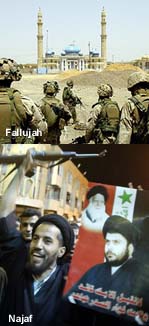
Standoff In Fallujah and Najaf
4/25/2004:
The US is threatening to move
into both Najaf and Fallujah as troops continue to surround both cities, engaging in
daily skirmishes with both Sunni and Shi'ite
resistance fighters.
Bombings across Iraq have resulted in many civilian deaths but it remains unclear who has
been carrying them out.
The US is threatening to move troops into the Shi'ite holy city of Najaf, claiming that Sadr's militia is stockpiling weapons and ammunition. Grand Ayatollah Sistani has declared a "red line" around the city forbidding the US from entering. Sadr has threatened suicide attacks against the US if attacked and Iran has also expressed its concern about the US entrance into a city considered holy to most Iranians. An emergency delegation of U.S. civilians (including two activists from Santa Cruz) has gone to Najaf to place themselves "nonviolently, symbolically and physically" between the U.S. armed forces and the civilian population. As the Najaf standoff continues, clashes are already taking place in Karbala, which is the second holiest city to Shi'ites after Najaf. Anger over US attacks on Sadr and an attack on free speech that makes even private displays of Sadr's picture illegal have lead to widespread Shi'ite unrest that now appears to include the "infiltration" of the US backed Iraqi army by resistance fighters.
Coverage of the Fallujah massacre in the Arab press has raised anti-American sentiments in Iraq (and the rest of the Arab world) to unprecedented levels, but the details of what has been happening in Fallujah are only starting to emerge in the mainstream Western press. As US soldiers brag of the number of Iraqis they have killed in Fallujah, estimates of the number of civilian dead grows. Schools no longer have pupils, homes are being demolished, and "the stench of dead bodies has become overpowering" due to the US targeting of ambulances and hospitals. Despite the large number of deaths in a city of only 300,000, resistance fighters in Fallujah remain resolute with anger over deaths of relatives and destruction of mosques only encouraging them to fight harder.
On April 21st, 68 Iraqis were killed and over 200 injured when bombs went off in downtown Basra. No group took responsibility for the attacks but protesters in Basra blamed British forces. On April 24th, over 40 died in a day of violence that included a rocket attack on a busy market in Sadr City that locals claim to have come from US helicopters. Also on the 24th, three boats exploded, as suicide boats attacked Iraq's main oil terminal. Instability and violence in Iraq have resulted in endless suffering for most Iraqis who can not "change the channel" as Brigadier General Mark Kimmitt asked people to do in response to questions about problems in the country.
The US is threatening to move troops into the Shi'ite holy city of Najaf, claiming that Sadr's militia is stockpiling weapons and ammunition. Grand Ayatollah Sistani has declared a "red line" around the city forbidding the US from entering. Sadr has threatened suicide attacks against the US if attacked and Iran has also expressed its concern about the US entrance into a city considered holy to most Iranians. An emergency delegation of U.S. civilians (including two activists from Santa Cruz) has gone to Najaf to place themselves "nonviolently, symbolically and physically" between the U.S. armed forces and the civilian population. As the Najaf standoff continues, clashes are already taking place in Karbala, which is the second holiest city to Shi'ites after Najaf. Anger over US attacks on Sadr and an attack on free speech that makes even private displays of Sadr's picture illegal have lead to widespread Shi'ite unrest that now appears to include the "infiltration" of the US backed Iraqi army by resistance fighters.
Coverage of the Fallujah massacre in the Arab press has raised anti-American sentiments in Iraq (and the rest of the Arab world) to unprecedented levels, but the details of what has been happening in Fallujah are only starting to emerge in the mainstream Western press. As US soldiers brag of the number of Iraqis they have killed in Fallujah, estimates of the number of civilian dead grows. Schools no longer have pupils, homes are being demolished, and "the stench of dead bodies has become overpowering" due to the US targeting of ambulances and hospitals. Despite the large number of deaths in a city of only 300,000, resistance fighters in Fallujah remain resolute with anger over deaths of relatives and destruction of mosques only encouraging them to fight harder.
On April 21st, 68 Iraqis were killed and over 200 injured when bombs went off in downtown Basra. No group took responsibility for the attacks but protesters in Basra blamed British forces. On April 24th, over 40 died in a day of violence that included a rocket attack on a busy market in Sadr City that locals claim to have come from US helicopters. Also on the 24th, three boats exploded, as suicide boats attacked Iraq's main oil terminal. Instability and violence in Iraq have resulted in endless suffering for most Iraqis who can not "change the channel" as Brigadier General Mark Kimmitt asked people to do in response to questions about problems in the country.
2026-04-19
Peninsula Open Space Trust Purchases 2,284 Acres of Sacred Amah Mutsun Lands
Front Page
| Environment & Forest Defense
| Racial Justice
| South Bay
| California
| Americas
| Santa Cruz Indymedia2026-04-06
"Factory Farm Watch" Website Aims to Hold Factory Farms Accountable
Front Page
| California
| Animal Liberation2026-04-03
Millions March Against Trump's Authoritarianism, Xenophobia, and War
Front Page
| Anti-War
| Global Justice & Anti-Capitalism
| Central Valley
| San Francisco
| Peninsula
| California
| U.S.
| Government & Elections
| Palestine
| Immigrant Rights2026-02-04
Protest in San Francisco Demands TPS Protection for Haitians
Front Page
| San Francisco
| U.S.
| Haiti
| Immigrant Rights2026-01-20
Convict Killer ICE Agent Jonathan Ross
Front Page
| Police State & Prisons
| Labor & Workers
| Global Justice & Anti-Capitalism
| San Francisco
| South Bay
| East Bay
| Peninsula
| North Coast
| U.S.
| Americas2026-01-15
Hundreds of "Free America Walkouts" Were Organized on January 20
Front Page
| Police State & Prisons
| Anti-War
| Womyn
| Central Valley
| San Francisco
| South Bay
| East Bay
| Peninsula
| North Bay / Marin
| North Coast
| California
| U.S.2025-12-24
Advocates Rally at Governor’s Office to Pardon UC Berkeley
Student Zoe Rosenberg
Police State & Prisons
| Education & Student Activism
| Central Valley
| East Bay
| North Bay / Marin
| California
| Government & Elections
| Animal Liberation2025-12-23
Our Faiths Teach Us: Love Thy Neighbor, Disrupt Injustice
Police State & Prisons
| San Francisco
| California
| Americas2025-12-16
There's Nothing More Despicable and Dangerous Than a Mercenary
Anti-War
| California
| U.S.
| Americas2025-11-16
"People Over Billionaires" March Tours San Francisco's Ritziest Neighborhood
Health, Housing & Public Services
| Global Justice & Anti-Capitalism
| San Francisco2025-11-15
First Day of Starbucks Strike Shuts Down Stores in Santa Cruz
Labor & Workers
| Peninsula
| Santa Cruz Indymedia

We are 100% volunteer and depend on your participation to sustain our efforts!
Donate

$115.00 donated
in the past month
Get Involved
If you'd like to help with maintaining or developing the website, contact us.
Publish
Publish your stories and upcoming events on Indybay.
Topics
More
Search Indybay's Archives
Advanced Search
►
▼
IMC Network