







 Publish to Newswire
 Add an Event
Feature Archives
5/16/2005:
Protests over US abuses at Guantanamo have spread to Egypt, Sudan, the West Bank and Pakistan and the governments of Pakistan, Saudi Arabia and several other Muslim countries filed formal protests with Washington.
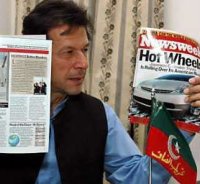
Even though there have been many reports of the use of Islam during interrogations at Guantanamo and several reports of the desecration of the Koran, Newsweek's "report" has taken most of the flak for the recent violence. Strangely Newsweek never had an article or report and what is at issue is a several word mention in a box to the side of a story merely stating that a government offical told them he saw a mention of the desecration incident in an unreleased document investigating conditions at the US prison camp. The reason for the focus on Newsweek was probably because Pakistani cricket legend turned politician Imran Khan displayed a copy of Newsweek when talking about the incident during a press conference last week. A more likely spark for the protests than an English language magazine was an interview on the BBC Urdu service earlier this month where former Guantanamo inmates reported that some Arab prisoners had still not spoken to their interrogators after three years to protest at the desecration of the Koran by guards at the camp.
Responding to pressure from the White House and Pentagon, Newsweek claims it checked with its source - a senior US official - who confirmed that he had come across references to the mistreatment of the Koran in the results of an US investigation into the mistreatment of prisoners at Guantanamo, but he was no longer certain that they had come from the specific report he had originally named. When Newsweek offered its sympathies "to victims of the violence and to the U.S. soldiers caught in its midst", the White House and much of the corporate media took this as an admission that the "story" was false and have forced Newsweek to retract its "story".
The head of Pakistan's conservative six-party Islamic alliance, Qazi Hussain Ahmed, told the BBC that Newsweek's clarification held no weight. "There have been reports by the prisoners who have been released from Guantanamo Bay of desecration of the holy Koran, and different atrocities perpetrated on them. Therefore, the clarification of Newsweek has no meaning."
The Newsweek Backtrack: Did the Right Win a Game of Chicken? | Reporting the truth | Newsweek Got Gitmo Right | Cageprisoners Publishes Quran Desecration Report
Even though there have been many reports of the use of Islam during interrogations at Guantanamo and several reports of the desecration of the Koran, Newsweek's "report" has taken most of the flak for the recent violence. Strangely Newsweek never had an article or report and what is at issue is a several word mention in a box to the side of a story merely stating that a government offical told them he saw a mention of the desecration incident in an unreleased document investigating conditions at the US prison camp. The reason for the focus on Newsweek was probably because Pakistani cricket legend turned politician Imran Khan displayed a copy of Newsweek when talking about the incident during a press conference last week. A more likely spark for the protests than an English language magazine was an interview on the BBC Urdu service earlier this month where former Guantanamo inmates reported that some Arab prisoners had still not spoken to their interrogators after three years to protest at the desecration of the Koran by guards at the camp.
Responding to pressure from the White House and Pentagon, Newsweek claims it checked with its source - a senior US official - who confirmed that he had come across references to the mistreatment of the Koran in the results of an US investigation into the mistreatment of prisoners at Guantanamo, but he was no longer certain that they had come from the specific report he had originally named. When Newsweek offered its sympathies "to victims of the violence and to the U.S. soldiers caught in its midst", the White House and much of the corporate media took this as an admission that the "story" was false and have forced Newsweek to retract its "story".
The head of Pakistan's conservative six-party Islamic alliance, Qazi Hussain Ahmed, told the BBC that Newsweek's clarification held no weight. "There have been reports by the prisoners who have been released from Guantanamo Bay of desecration of the holy Koran, and different atrocities perpetrated on them. Therefore, the clarification of Newsweek has no meaning."
The Newsweek Backtrack: Did the Right Win a Game of Chicken? | Reporting the truth | Newsweek Got Gitmo Right | Cageprisoners Publishes Quran Desecration Report

8/21/2005: Four US soldiers were killed and three wounded by a roadside bomb in southern Afghanistan.
8/18/2005: Two U.S. soldiers were killed when a homemade bomb hit an American convoy supporting crews improving a road from the main southern city of Kandahar to outlying mountains. A U.S. Marine was killed during battles with militants in eastern Afghanistan. Read More
7/26/2005: Nearly 2,000 Afghans protested Tuesday outside the US air base in Bagram, north of the Afghan capital, Kabul. Chanting “Die America!” the crowd threw stones and tried to break down an outer gate to the base, demanding the release of eight detained villagers. Read More
5/13/2005: At least nine more people - five civilians and four policemen - have been killed in a fourth day of anti-US protests in Afghanistan, officials say. The protests and violence appear to be spreading with reports of disturbances coming from across the country. Read More
5/12/2005: Three protesters will killed as police fired on hundreds of anti-U.S. demonstrators in the town of Khogyani to prevent them from departing toward Jalalabad. In Kabul, more than 200 young men marched from a dormitory block near Kabul University chanting "Death to America!" and carrying banners. Read More
On May 10th 2005 anti-American riots broke out across Afghanistan in response to reports of US use of religion in the humiliation of Afghan prisoners. More than 5000 people took to the streets of Jalalabad. Four Afghan protesters were killed when police opened fire on the crowd and the crowd responded by burning down a governor's office and attacking several UN buildings. There were also protests in the south-eastern city of Khost, and in Laghman province.
The immediate cause of the riots was an article in Newsweek magazine that said investigators probing abuses at Guantanamo Bay naval base in Cuba had discovered that interrogators "had placed Korans on toilets, and in at least one case flushed a holy book down the toilet". Over the past few months reports have revealed a pattern of sexual humiliation and torture of Afghan prisoners. In his new book "Inside the Wire", Army Sergeant Erik Saar (NPR interview) reveals details of what he saw while he was working at the Guantanamo camp. "One of the most disturbing interrogations Sgt Saar says he saw in his six months at the prison concerned a female interrogator ... He tells how she began peeling off her clothes, taunting the man sexually in an attempt to shame him and stop him relying on his faith for support ... When the interrogator wiped what he thought was menstrual blood on his face, the prisoner raged, almost breaking free from his handcuffs. [the interrogator] taunted him further ... asking whether Allah would be pleased with him and telling him to have fun trying to pray. Finally the detainee was returned to his cell without water, leaving him unable to cleanse himself."
Anger at the US and government of Hamid Karzai has been on the rise for several months. On March 26th four US soldiers were killed in a mine blast southwest of Kabul. On March 29th, a powerful blast ripped through a car near the provincial governor's office in the eastern Afghan city of Jalalabad. On April 2nd, suspected Taliban fighters ambushed a convoy of civilian trucks carrying vehicles to the US military in southern Afghanistan, killing eight of the drivers. On April 6th, a US helicopter crashed in south-eastern Afghanistan killing 16 people, at least four of them American crew. On April 8th Taleban fighters killed five policemen on a main road in the Nawarak area of Zabul province. On April 26th, suspected Taliban fighters ambushed a police convoy in southern Afghanistan, killing four officers and abducting two others. On May 4th nine Afghan soldiers were killed in an ambush by militants in the southern province of Kandahar, as 50 died in 3 days of fighting. On May 7th two people were killed and five wounded when a hand grenade exploded in an internet cafe in central Kabul. On May 9th, two US marines were killed in a battle in eastern Afghanistan in which up to 23 militants are also thought to have died.
Anger at the US over treatment of prisoners and conflicts over Afghanistans huge opium trade, have been compounded by the recently announced push for permanent US bases in the country.
Democracy Now: Afghanistan 3 1/2 Years After the U.S. Invasion | UN Human Rights Investigator in Afghanistan Ousted Under U.S. Pressure | Afghanistan: When Cops Become Robbers
8/18/2005: Two U.S. soldiers were killed when a homemade bomb hit an American convoy supporting crews improving a road from the main southern city of Kandahar to outlying mountains. A U.S. Marine was killed during battles with militants in eastern Afghanistan. Read More
7/26/2005: Nearly 2,000 Afghans protested Tuesday outside the US air base in Bagram, north of the Afghan capital, Kabul. Chanting “Die America!” the crowd threw stones and tried to break down an outer gate to the base, demanding the release of eight detained villagers. Read More
5/13/2005: At least nine more people - five civilians and four policemen - have been killed in a fourth day of anti-US protests in Afghanistan, officials say. The protests and violence appear to be spreading with reports of disturbances coming from across the country. Read More
5/12/2005: Three protesters will killed as police fired on hundreds of anti-U.S. demonstrators in the town of Khogyani to prevent them from departing toward Jalalabad. In Kabul, more than 200 young men marched from a dormitory block near Kabul University chanting "Death to America!" and carrying banners. Read More
On May 10th 2005 anti-American riots broke out across Afghanistan in response to reports of US use of religion in the humiliation of Afghan prisoners. More than 5000 people took to the streets of Jalalabad. Four Afghan protesters were killed when police opened fire on the crowd and the crowd responded by burning down a governor's office and attacking several UN buildings. There were also protests in the south-eastern city of Khost, and in Laghman province.
The immediate cause of the riots was an article in Newsweek magazine that said investigators probing abuses at Guantanamo Bay naval base in Cuba had discovered that interrogators "had placed Korans on toilets, and in at least one case flushed a holy book down the toilet". Over the past few months reports have revealed a pattern of sexual humiliation and torture of Afghan prisoners. In his new book "Inside the Wire", Army Sergeant Erik Saar (NPR interview) reveals details of what he saw while he was working at the Guantanamo camp. "One of the most disturbing interrogations Sgt Saar says he saw in his six months at the prison concerned a female interrogator ... He tells how she began peeling off her clothes, taunting the man sexually in an attempt to shame him and stop him relying on his faith for support ... When the interrogator wiped what he thought was menstrual blood on his face, the prisoner raged, almost breaking free from his handcuffs. [the interrogator] taunted him further ... asking whether Allah would be pleased with him and telling him to have fun trying to pray. Finally the detainee was returned to his cell without water, leaving him unable to cleanse himself."
Anger at the US and government of Hamid Karzai has been on the rise for several months. On March 26th four US soldiers were killed in a mine blast southwest of Kabul. On March 29th, a powerful blast ripped through a car near the provincial governor's office in the eastern Afghan city of Jalalabad. On April 2nd, suspected Taliban fighters ambushed a convoy of civilian trucks carrying vehicles to the US military in southern Afghanistan, killing eight of the drivers. On April 6th, a US helicopter crashed in south-eastern Afghanistan killing 16 people, at least four of them American crew. On April 8th Taleban fighters killed five policemen on a main road in the Nawarak area of Zabul province. On April 26th, suspected Taliban fighters ambushed a police convoy in southern Afghanistan, killing four officers and abducting two others. On May 4th nine Afghan soldiers were killed in an ambush by militants in the southern province of Kandahar, as 50 died in 3 days of fighting. On May 7th two people were killed and five wounded when a hand grenade exploded in an internet cafe in central Kabul. On May 9th, two US marines were killed in a battle in eastern Afghanistan in which up to 23 militants are also thought to have died.
Anger at the US over treatment of prisoners and conflicts over Afghanistans huge opium trade, have been compounded by the recently announced push for permanent US bases in the country.
Democracy Now: Afghanistan 3 1/2 Years After the U.S. Invasion | UN Human Rights Investigator in Afghanistan Ousted Under U.S. Pressure | Afghanistan: When Cops Become Robbers

Tue Mar 1 2005
Torture And Abuse By US Soldiers Continues In Afghanistan
3/19/2005
"What has been glimpsed in Afghanistan is a radical plan to replace Guantánamo Bay. When that detention centre was set up in January 2002, it was essentially an offshore gulag - beyond the reach of the US constitution and even the Geneva conventions. That all changed in July 2004. The US supreme court ruled that the federal court in Washington had jurisdiction to hear a case that would decide if the Cuban detentions were in violation of the US constitution, its laws or treaties. The military commissions, which had been intended to dispense justice to the prisoners, were in disarray, too. No prosecution cases had been prepared and no defence cases would be readily offered as the US National Association of Criminal Defence Lawyers had described the commissions as unethical, a decision backed by a federal judge who ruled in January that they were "illegal". Guantánamo was suddenly bogged down in domestic lawsuits. It had lost its practicality. So a global prison network built up over the previous three years, beyond the reach of American and European judicial process, immediately began to pick up the slack. The process became explicit last week when the Pentagon announced that half of the 540 or so inmates at Guantánamo are to be transferred to prisons in Afghanistan and Saudi Arabia."
Read More | Taliban Country: Afghanistan 3 1/2 Years After the U.S. Invasion
2/17/2005 Evidence has emerged that "US forces in Afghanistan engaged in widespread Abu Ghraib-style abuse, taking 'trophy photographs' of detainees and carrying out rape and sexual humiliation" The UK's Guardian newspaper has obtained documents that "contain evidence that such abuses took place in the main detention centre at Bagram, near the capital Kabul, as well as at a smaller US installation near the southern city of Kandahar." Photographs taken in southern Afghanistan "show US soldiers from the 22nd Infantry Battalion posing in mock executions of blindfolded and bound detainees." In addition, several American soldiers are under investigation in the shooting deaths of two Afghan villagers outside a U.S. base in western Afghanistan. Witnesses and local officials said the on the afternoon of February 11th, two villagers were shot while they fled across a field. Two witnesses said in an interview that two American soldiers then approached one of the Afghans, who was wounded, and shot him dead at close range.
The US is also accused of spraying toxic chemicals on Afghan fields causing serious health problems for the population. Afghanistan has become the world's largest opium producer (producing 90% of the heroin sold in Britain) and its likely the spayings were part of a US attempt to destroy opium fields. WHile the US has denied carrying out such sprayings, “They are the ones with the planes,” said Abdul Ahmad who lost, together with his brother Abdullah, 200 animals from symptoms that suggested poisoning. Abdullah told an American daily that one night in early February he was watching over his animals when suddenly a plane flew overhead three time. In the morning, the animals “went mad, their eyes went blue and they could not eat,” said his brother Abdul Ahmad. “Water was coming from their mouths, they were trying to eat their droppings and they were shivering,” he added. The February 3 incident also left villagers, particularly children, complaining of fevers, skin rashes and bloody diarrhea.
UK attempt to eradicate Afghan opium fails | US Troops Slaughter Afghan villagers | Abu Ghraib-style abuse by the US in Afghanistan
Read More | Taliban Country: Afghanistan 3 1/2 Years After the U.S. Invasion
2/17/2005 Evidence has emerged that "US forces in Afghanistan engaged in widespread Abu Ghraib-style abuse, taking 'trophy photographs' of detainees and carrying out rape and sexual humiliation" The UK's Guardian newspaper has obtained documents that "contain evidence that such abuses took place in the main detention centre at Bagram, near the capital Kabul, as well as at a smaller US installation near the southern city of Kandahar." Photographs taken in southern Afghanistan "show US soldiers from the 22nd Infantry Battalion posing in mock executions of blindfolded and bound detainees." In addition, several American soldiers are under investigation in the shooting deaths of two Afghan villagers outside a U.S. base in western Afghanistan. Witnesses and local officials said the on the afternoon of February 11th, two villagers were shot while they fled across a field. Two witnesses said in an interview that two American soldiers then approached one of the Afghans, who was wounded, and shot him dead at close range.
The US is also accused of spraying toxic chemicals on Afghan fields causing serious health problems for the population. Afghanistan has become the world's largest opium producer (producing 90% of the heroin sold in Britain) and its likely the spayings were part of a US attempt to destroy opium fields. WHile the US has denied carrying out such sprayings, “They are the ones with the planes,” said Abdul Ahmad who lost, together with his brother Abdullah, 200 animals from symptoms that suggested poisoning. Abdullah told an American daily that one night in early February he was watching over his animals when suddenly a plane flew overhead three time. In the morning, the animals “went mad, their eyes went blue and they could not eat,” said his brother Abdul Ahmad. “Water was coming from their mouths, they were trying to eat their droppings and they were shivering,” he added. The February 3 incident also left villagers, particularly children, complaining of fevers, skin rashes and bloody diarrhea.
UK attempt to eradicate Afghan opium fails | US Troops Slaughter Afghan villagers | Abu Ghraib-style abuse by the US in Afghanistan
Sat Oct 9 2004
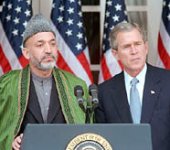
Karzai Becomes President Despite Election Irregularities
On December 7th 2004, Hamid Karzai was sworn into office as President of Afghanistan despite clear evidence of stuffed ballot boxes and irregularities at many polling places. While Afghanistan has dropped out of the news and is virtually ignored by the Western press, things are not very different from how they were a few years ago when it was the top story in every US newspaper. Bin Laden is still reported to be hiding in the North, Mulla Omar and Hekmatyar continues to make threats, the Taliban continues to engage in attacks on both Afghan and US forces, warlords continue to control most of the country (with Karzai ruling mainly over Kabul) and opium sales continue to rise keeping Afghanistan the word's largest producer of heroin.
Afghan Recovery Report: Daughters Sold to Settle Debts | Detritus of War Keeps Claiming New Victims
On Saturday October 9th, Afghanistan held its first "election" under US occupation. The election ended in controversy after most presidential candidates called for a boycott half-way through voting due to fears of fraud resulting from problems in the method used to prevent people from voting more than once. Without basic infrastructure, the election faced credibility problems from the start and the competition between warlords is likely to make ethnic tensions worse. The Bush administration's role in the October timing of the Afghan election seems primarily designed for the benefit of Bush's own re-election, but the booming opium trade and recent surge in violence make it hard to use Afghanistan as an example of success.
Women and Elections in Afghanistan | Common Dreams | Democracy Now | Credibility at stake after Karzai’s rivals boycott polls
Afghan Recovery Report: Daughters Sold to Settle Debts | Detritus of War Keeps Claiming New Victims
On Saturday October 9th, Afghanistan held its first "election" under US occupation. The election ended in controversy after most presidential candidates called for a boycott half-way through voting due to fears of fraud resulting from problems in the method used to prevent people from voting more than once. Without basic infrastructure, the election faced credibility problems from the start and the competition between warlords is likely to make ethnic tensions worse. The Bush administration's role in the October timing of the Afghan election seems primarily designed for the benefit of Bush's own re-election, but the booming opium trade and recent surge in violence make it hard to use Afghanistan as an example of success.
Women and Elections in Afghanistan | Common Dreams | Democracy Now | Credibility at stake after Karzai’s rivals boycott polls
Fri Oct 1 2004
Occupied Afghanistan Turns To Opium To Survive
10/1/2004
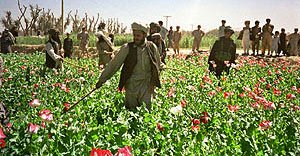
According to the Los Angeles Times Afganistan's "opium poppy crop this year is set to break all records, surging past the peak levels reported under the Taliban". Officials in the US State Department warn that there are record levels of poppy cultivation in areas not previously used for this purpose.
With increased warlordism and a collapsed economy, many Afghans find growing opium one of the few ways to support themselves. "The yields farmers can make on opium compared with wheat or rice are stratospheric. There is little incentive to grow anything else as law enforcement is poor and hundreds of senior officials are allegedly involved in the multi-billion-dollar drug business themselves.... farmers stand to make only 5,000 Afghanis (35 dollars) from planting half an acre with wheat or rice, but 10 times that amount for harvesting opium."
The role of US forces in Afghan's drug trade is unclear. Many of the warlords the US is working with to fight the Taliban are among the country's largest opium producers. Vladimir Putin has accused the US and NATO of looking the other way as occupied Afghanistan floods Europe with over 70% of the world's opium.
Opium production spreading in Afghanistan | Disinfopedia | The Politics Of Afghan Opium
With increased warlordism and a collapsed economy, many Afghans find growing opium one of the few ways to support themselves. "The yields farmers can make on opium compared with wheat or rice are stratospheric. There is little incentive to grow anything else as law enforcement is poor and hundreds of senior officials are allegedly involved in the multi-billion-dollar drug business themselves.... farmers stand to make only 5,000 Afghanis (35 dollars) from planting half an acre with wheat or rice, but 10 times that amount for harvesting opium."
The role of US forces in Afghan's drug trade is unclear. Many of the warlords the US is working with to fight the Taliban are among the country's largest opium producers. Vladimir Putin has accused the US and NATO of looking the other way as occupied Afghanistan floods Europe with over 70% of the world's opium.
Opium production spreading in Afghanistan | Disinfopedia | The Politics Of Afghan Opium
Sat Apr 24 2004
Latest Afghanistan Updates: Warlordism, Drugs and Oppression
4/24/2004
Afghan President Hamid Karzai has
little power outside of Kabul.
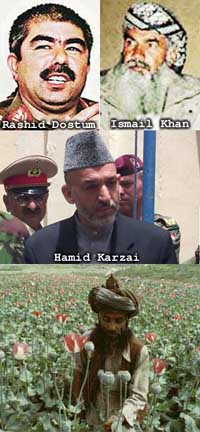
In March fighting broke out between the Afghan army and forces loyal to warlord Ismail Khan.
In early April, between 2,000 and 3,000 soldiers loyal to Rashid Dostum invaded and took control of several Afghan cities . General Abdul Rashid Dostum is officially an adviser to Karzai, but in reality Dostum has more real military power and Karzai's role is effectively that of a US ambassador to the various warlords.
The Afghanistan government's problems are not restricted to former warlords from the Northern Alliance. While the US government says the "spring offensive by Taliban and al Qaeda guerrillas in Afghanistan's restive south is the weakest in two years", a look the attacks in just the past few days reveals the extent of Afghanistan's problems. On Thursday April 22th, fighting between US forces and Taliban fighters resulted in the death of former football star Pat Tillman. Also on Thursday, a bomb targeting the provincial governor exploded in Kandahar province. On Friday April 23rd, "Suspected Taliban rebels fired rockets and machine-guns at a checkpoint in a remote southwestern region, killing eight Afghan soldiers in a nighttime attack." Also on the 23rd, a US Patrol was ambushed in Khost province sparking a one-hour firefight and "a group of 50 armed men attacked aid workers" in Kandahar, "setting fire to eight vehicles." Taliban leader Mulla Dadullah claims that his fighters are now in control of 26 rural districts in southern and south-western Afghanistan and even Mullah Omar is now talking to the media, giving one of his first interviews since he was forced out of power in 2001.
A recent Human Rights Watch report has detailed how US backed warlords in Afghanistan are threatening women's rights and freedom of expression. Last November, thousands of Afghan women were expelled from school simply for being married, there are reports that a growing number of women in Herat Province have been killing themselves through self-immolation, and on April 17th, Nangahar province declared female entertainers un-Islamic and "banned them from performing on television and radio.
In 2002 Afghanistan became the world's largest opium producer. In 2003, Afghanistan was thought to be producing 76 percent of the world's opium, and this year's harvest could be "twice as large as last year's near-record crop".
In January, retired Army Colonel Hy Rothstein concluded in a Pentagon commissioned report that the US has failed to adapt to new conditions created by the Taliban's collapse and created conditions that have given "warlordism, banditry and opium production a new lease on life."
The New Yorker: The Other War | A Look At the Role of Women in Post-9/11 Afghanistan
The Afghanistan government's problems are not restricted to former warlords from the Northern Alliance. While the US government says the "spring offensive by Taliban and al Qaeda guerrillas in Afghanistan's restive south is the weakest in two years", a look the attacks in just the past few days reveals the extent of Afghanistan's problems. On Thursday April 22th, fighting between US forces and Taliban fighters resulted in the death of former football star Pat Tillman. Also on Thursday, a bomb targeting the provincial governor exploded in Kandahar province. On Friday April 23rd, "Suspected Taliban rebels fired rockets and machine-guns at a checkpoint in a remote southwestern region, killing eight Afghan soldiers in a nighttime attack." Also on the 23rd, a US Patrol was ambushed in Khost province sparking a one-hour firefight and "a group of 50 armed men attacked aid workers" in Kandahar, "setting fire to eight vehicles." Taliban leader Mulla Dadullah claims that his fighters are now in control of 26 rural districts in southern and south-western Afghanistan and even Mullah Omar is now talking to the media, giving one of his first interviews since he was forced out of power in 2001.
A recent Human Rights Watch report has detailed how US backed warlords in Afghanistan are threatening women's rights and freedom of expression. Last November, thousands of Afghan women were expelled from school simply for being married, there are reports that a growing number of women in Herat Province have been killing themselves through self-immolation, and on April 17th, Nangahar province declared female entertainers un-Islamic and "banned them from performing on television and radio.
In 2002 Afghanistan became the world's largest opium producer. In 2003, Afghanistan was thought to be producing 76 percent of the world's opium, and this year's harvest could be "twice as large as last year's near-record crop".
In January, retired Army Colonel Hy Rothstein concluded in a Pentagon commissioned report that the US has failed to adapt to new conditions created by the Taliban's collapse and created conditions that have given "warlordism, banditry and opium production a new lease on life."
The New Yorker: The Other War | A Look At the Role of Women in Post-9/11 Afghanistan
Fri Sep 7 2001
September 11th and The Buildup To The Afghan War
On September 11th 2001 two planes flew into the
World Trade Center in New York and one plane flew into the Pentagon in Washington DC. Within days the US government and media were blaming Osama Bin Laden and his Al Qaeda network.
Bin Laden was thought to have moved to Afghanistan in May 1996 after being expelled from Sudan.
When two US embassies in Africa were blown
up on August 7th 1998.
Clinton had responded on August 20th by launching missles
at Sudan and supposed terrorist training camps in Afghanistan.
Immediately after 9/11, ">international aid agencies in Afghanistan feared feared a massive US attack and left the country.
On September 17th, a Pakistani delegation
arrived in Afghanistan to try to persuade the Taliban to hand over Osama Bin Laden, but the Taliban denied that
Bin Laden took part in the WTC attacks.
Afghanistan's neighbors all feared for the
worst
as the US "dismissed as inadequate a ruling by Afghanistan's senior clerics that Bin Laden would be asked to leave the country".
On September 24th
the Taliban claimed to have mobilized 300,000 troops in preparation for U.S. strikes on the country and in response the
Pakistan foreign ministry pulled out all of its diplomatic staff from Kabul.
On September 25th
Saudi Arabia cut off diplomatic ties with the Taliban.
As the world waited for the US attacks to begin, US Special forces had already deployed in Afghanistan.
The official US line on September 29th
was that the US would offer aid to opponents of the Taliban, but wouldn't try to choose the countries next rulers.
On October 5th US Troops deployed to Uzbekistan.
On October 6th, the Taliban claimed that its forces shot anti-aircraft fire at an American plane and on October 7th the US air war had begun.
US Governments Official Timeline | Center for Cooperative Research Timeline | AP Post-Sept. 11 Chronology
US Governments Official Timeline | Center for Cooperative Research Timeline | AP Post-Sept. 11 Chronology
Afghanistan:
 3
3

3